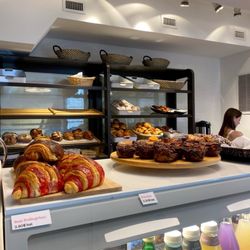
Brodflour has built a considerable reputation in Toronto around its distinctive approach to…read morebreadmaking, particularly its commitment to sourcing Canadian grains and milling them fresh on-site to preserve their flavour and character. It's an admirable philosophy, one that places ingredient quality and craftsmanship at the forefront and naturally raises expectations for the finished product.
I ordered a butter croissant and an espresso, totalling $10.23.
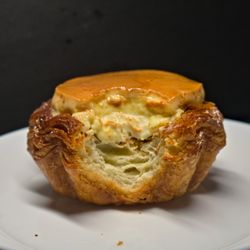
At first glance, the croissant was promising. Beautifully browned, with pronounced ridges, visible lamination, and an attractive shape, it certainly looked the part. Cutting into it, however, revealed an entirely different story.
A well-made croissant should have a light, airy interior with a distinctive honeycomb structure, characterized by irregular, elongated air pockets separated by delicate layers of dough. This isn't merely an aesthetic ideal. It's the result of successful lamination, fermentation, and expansion during baking, producing the wonderfully delicate interior that contrasts with a crisp, flaky exterior.
Brodflour's croissant bore little resemblance to this. Beneath its attractive crust was an enormous hollow cavity, while much of the remaining crumb appeared dense and unevenly developed. The interior lacked the layer definition and aeration I had expected. Of course, a croissant doesn't need a perfectly uniform or dramatically open honeycomb to be excellent. There's a considerable difference, however, between a naturally irregular crumb and a pastry that's largely hollow in one section and dense in another.
More disappointing was the flavour. A good butter croissant should offer a richness that goes beyond simply tasting fatty, with the aroma of butter, subtle fermentation notes, and the toasted complexity of its browned exterior. Here, I struggled to detect much butter character at all. The pastry was remarkably bland, and without the richness or textural delicacy I associate with a good croissant, there was little to redeem its disappointing interior.
The espresso fared no better. It was aggressively acidic, with a sharp sourness that seemed to overwhelm whatever sweetness or depth the coffee might have possessed. Acidity isn't inherently undesirable in espresso. In fact, a well-extracted lighter roast can exhibit wonderful brightness, fruitiness, and complexity. But acidity needs something to balance it, and this particular cup offered little beyond its sourness.
At $10.23 for a croissant and espresso, I don't find the price unreasonable in principle. Quality ingredients and skilled craftsmanship deserve to command a premium. What I find difficult to justify is paying that premium for two products that offered so little enjoyment.
I can't speak to Brodflour's celebrated sourdough, and perhaps that's where its commitment to fresh milling is best appreciated. But judging by the croissant and espresso, I left considerably less impressed than I had hoped. The croissant was beautifully presented yet structurally disappointing and remarkably bland, while the espresso offered little beyond an aggressive acidity.
I admire Brodflour's philosophy. There's something genuinely appealing about a bakery that takes such care in sourcing its grains and milling its own flour. But the quality of an ingredient is only as meaningful as what you ultimately do with it. For all the thought that goes into Brodflour's process, I found surprisingly little of that care reflected in what I actually tasted.
1/5