Honolulu Skyline Photos


You might also consider


More like Honolulu Skyline
Recommended Reviews - Honolulu Skyline
Start your review...


Reviews With Photos


Thanks to Nadine C. for riding the rail with me today. It was better than I expected. It was pretty smooth except for a few bumps along the way. Once they build it to Ala Moana it'll be a lot faster to get to Kapolei. You no longer will have to sit in all that traffic. I know that some people feel that there's no parking at some of the rail stops. I believe that we can still make it work. I've travelled quite extensively in my life before Covid. I've taken the rail in many countries and can honestly say that none of them had parking. In Hong Kong and New York the metro was underground. In Chicago, Taiwan, Japan, London and Paris it was above ground. I didn't see parking at any of their stops. I am happy that they put a glass closure that opens and closes when the train arrives. So many rail systems just leave the platforms open. People are pushed or accidentally fall over and die. Don't hate on me if you don't like the rail. I'm a believer in rail. It made getting around so much easier for me in different cities. I didn't even have to rent a car. I just connected to the rail by bus or taxi depending on where I was. You'll need a HOLO pass to get on. It's $3 to get on every time, unless you get a daily pass. I'm not sure if they do a monthly or annual pass. We got on at the Halawa stop. They had machines where you could scan your card and deposit money. There weren't any instructions though and they didn't have a chart listing the fares. I was told that I needed to scan my card to exit the station, which I found odd. Usually, at most rails the entrances and exits are at different places. You don't need to scan to get out. Here the entrance and exit are at the same place. I guess you have to scan to get out, so people can't come in without paying.
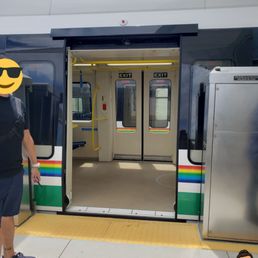

Came for a ride on Ohana day. We were all excited to be one of the first public riders! Its been a long time coming... this project began around the time I had my youngest child and she is now pretty much a teen! I did say it probably wouldn't be until 2025 and beyond that it would finally be finished and technically its not quite reached its final anticipated destination. For now the rail will be able to board from the KROC center (Kualaka'i aka East Kapolei Station) to the Aloha Stadium (Hālawa station) with a total of 9 stops going through Waipahu and Pearl City. Each way took approximately 20m. About 2-5m between each stop. We boarded at the Aloha Stadium with lots of parking stalls available for commuters. There are 2 elevators, escalators and stairs to get up to the platform. Bathrooms were available with assistance from workers to open the doors. Wheelchair accessible, space for luggage, bikes and skateboards welcome. Unsure how the HOLO card will be used for this transit system yet. I believe July 1st will be the first day the HOLO card is required and will still be free from 6/30/23-7/4/23. Theres still lots of room for improvement as its still in its early stage of opening and operations. Unfortunately this line is not realistic for my family and I to utilize. Hopefully it will help some. For now I feel this is more of a novelty for locals. Still looking forward to seeing more phases of this project opening in the future.


The Honolulu Skyline is a light metro system that consists of 18.9 miles of automated fixed-guideway line that was planned, designed & constructed by the HI Authority for Rapid Transportation, a semi-autonomous government agency. It is the largest public works project in HI. The plans for this mass transit line to connect Honolulu's urban center with its outlying areas began in the 1960's, but funding was not approved until 2005, & construction started on 2/22/11. Estimated cost is $12.4 billion & climbing higher. There are 21 stations from east Kapolei to the Civic Center in Honolulu. There are 3 main phases: * Phase 1: opened on 6/30/23, links east Kapolei to Aloha Stadium via 9 stations. * Phase 2: to open in mid-2025, links Pearl Harbor & Dan Inouye Intl Airport until just before Middle St, via 4 stations. * Phase 3: to open in 2031, links Middle St. to the Civic Center via 6 stations. This review is for Phase 1, which includes the following 9 stations: * Halawa ("curve") Station (Aloha Stadium). This station, built on a former stadium overflow parking lot, was planned to accommodate the many sports & entertainment venues held at the stadium; however, delays in building or renovating the stadium exist. New housing, retail businesses, restaurants & a hotel were being planned for this redevelopment project. There are 590 parking stalls in the park-&-ride lot. * Kalauao ("multitude of clouds") Station (Pearlridge). This rail segment is the closest station to Oahu's 2nd-largest shopping mall; however, the station exit is a 5 to 10-minute walk along Kam Hwy & Kaonohi St, & a planned pedestrian bridge was subsequently eliminated. * Waiawa ("milkfish water") Station (Pearl Highlands). Initially designed to connect riders from Central Oahu & the North Shore, plans have drastically been reduced for easy accessibility. There is no parking, so drop-offs only. * Halaulani ("heavenly halau, chief's house, name of a star") Station (Leeward Community College). The most isolated, light use is expected due to the low enrollment at the college & not much of a surrounding population. There is no parking or bus connections. * Pouhala ("Pandanus post or pillar") Station (Waipahu Transit Center). A bus transfer hub, the popular Highway Inn Restaurant is just steps away & Elena's is close by. There is no parking. * Ho'ae'ae ("to make soft or fine") Station (West Loch). This station serves Ewa Beach residents via TheBus & drop-and-ride connections. There are only 21 parking stalls. * Honouliuli ("dark boy") Station (Ho'opili). Located between UH West Oahu & western end of Waipahu, this station is surrounded by farmland, with Aloun Farms nearby. There is a temporary 344-stall park-&-ride lot. * Keone'ae ("fine, soft, powdery sand") Station (UH West Oahu). Known as "the train to nowhere," future planned development plans are still in discussion. There is a temporary 304-stall park-&-ride lot. * Kualaka'I ("to show the way, stand & lead") Station (East Kapolei). The station is isolated & not near many homes or businesses. Bus connections are necessary, & there is no parking. Introductory free rides were provided to the public from 6/30 to 7/4/23, & hubby and I were fortunate to try it out. As we live in HI Kai & far from the rail line, we parked at Aloha Stadium & caught the rail there. We got off at the Waipahu Station to have lunch at Highway Inn & continued our round-trip rail ride. In order to do this, I had to do a bit of research to determine what stop we would exit & how to get to the restaurant. My observations are as follows: * It is disappointing to see how initial plans were significantly scaled back, resulting in many stations that are isolated, have no parking & have no pedestrian bridges or accessibility to nearby business & retail centers. Major redevelopment plans to build new housing & businesses near to the train stations are still being discussed & will not be in fruition until many years from now. Only 3 of the 9 stations had park-&-ride lots: Halawa, Keone'ae & Honouliuli. * Riders need to be educated to make quick decisions to exit the train & allow others to exit before the automatic doors close. They need to learn the train stops & how far they need to walk or use the bus to get to their destination. * Riders sitting in elderly & disabled priority seating should offer their seats to the elderly & disabled if they are standing. * Get to know the Hawaiian names of the stations, as they are used frequently. * Recorded announcements of train stations are muffled & are difficult to understand. * Shaky & uneven rides at times. Have ridden on trains in Japan, the Skyline is not as technologically sophisticated; however, it's a beginning step for Honolulu to stay abreast in the world-wide developments in public transportation. I hope that local residents and tourists will support the Skyline to make it a success so that future developments may proceed and to keep maintenance costs at a minimum.
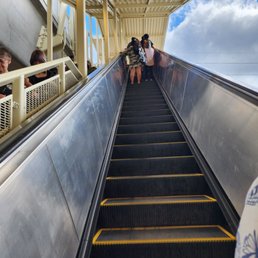

7-04-2023: I took the opportunity to ride the rail for free. I would like to congratulate the city for getting this first segment of Skyline up and running. It was a long and expensive journey. The city had promoted the views from the rail as a reason to ride the rail. Yes, the views were picturous. My wife dropped the three of us at the station. She entered from Salt Lake Boulevard, and I didn't see any kiss and ride drop off. My wife told me later that Sha saw kiss and ride signs as she exited. I guess we went in thru the wrong entrance . We got off in the parking lot and had to cross two bus lanes to get to the station. With a tap of the holo card, we were on our way. Up the escalators and a short wait, we boarded the train. Hold on if you're standing. Acceleration and deceleration weren't as smooth as other rail systems that I've been on. The ride was bumpy for the majority of the ride. There were a few short segments in which the ride was smooth. Well, that's my opinion.


Halawa Station has alot of parking. We parked in the handicap stall. The Entrance was all the way on the other side from where the handicap stalls were. Not too smart in the planning process. Alot of people are disabled and have a hard time walking. The gate was closed to enter the building from the handicap parking side. It doesn't make sense that we had to walk all the way to the other side to enter. The view from the Rail was cool though. There is only one elevator for the platform and if busy you gotta wait for the next elevator. The elevator is too small to accommodate both strollers and wheelchairs at the same time along with people. The overall experience was ok. I was hoping it went all the way to Ka Makana Ali'i mall or water park or target in Kapolei at least.


The Skyline opened for business on June 30, 2023 with free rides until July 4. We rode on Sunday afternoon and parked at the Halawa station. We boarded the rail and went for a ride from Halawa to Kapolei. It was twenty minutes one way with stops every ten minutes. The views along the way are beautiful. It's a different perspective when looking from above and of course not driving in a car. There are some bumps along the way but overall the ride is fairly smooth and quick. This is only one part of the rail project as there will be more to come once completed. It will be interesting to see how many people will be using this transportation mode. But for today it was a fun experience.


Finally got to ride "The Rail" This weekend! We drove to Halawa station where it currently end/start all the way to the Kualaka'i start/end, depending on your frame of reference. There are only nine stations for now and some are conveniently located, some I'm not sure about. Currently the drive and park stations are free and seem convenient. What was confusing - after you park at the Halawa parking lot and walk towards the rail station there aren't signs telling you where the entrance is. But it's easy enough to figure out. Holo card kiosks were along the wall if you need to add funds. I think you can also purchase regular standard cards for $2. Seniors and other non-standard must be purchased else where with proof of age, or disability, etc. Card tap entrances into the station worked very well and smoothly. Hubby and daughter and I all used a different entrance and all went well for us. Ride was relatively smooth as long as you are sitting. View is nice. Rain is A/C'd so it's comfortable. Stations that seemed convenient (we didn't get off at any - we were just along for the ride): Halawa if you live in the area once the rail goes into town. Pearlridge station if you want to go to the West, or a Mauka side of the shopping center. (We contemplated getting off here to grab a bite to eat, since you can get back on for free if you do it within the time limit. But decided not to.) The Leeward Community College station looked convenient, as did the Waipahu stations if you want to shop in the stores near the stops. Some seem to need a transfer to a bus. If you are a bus rider, that's probably ok. If you are not, then probably not convenient. Would have loved to have a station closer to Ka Makana'ali'i shopping center. The Kualaka'i station doesn't seem convenient except for those wanting to ride into town or perhaps UH once there are stations there. Stations are clearly marked, recorded voice announcing the stops was easy to understand. Signs in the train make it easy to see what stop us next. There was also a nice map of the rail route in the train. Oops - didn't see the sign saying no photos of the station. (You have to go rather close to read the signs if you don't have good eyesight) Because we didn't get off at any station we only paid $3 for the entire ride. Would ride again if we have visitors who would like to see the west side of the island.


We were looking a fun activity on a Sunday- the Skyline light rail! Why not, we're paying for it as taxpayers anyway! We drove to the west Oahu station and parked in the huge open lot. BTW, there's another station further west which is the last station. There is no parking there, you need to park at the West Oahu one. The station was nice and open. You need to buy a Holo Holo card ($2) if you don't have one. It's refillable and you should registered it online. Our RT fare to the stadium, the end point, and back to West Oahu was $3. You can buy the card and fill it at the stations before the gates. Use the card to tap in AND OUT of the gates. There were a bunch of riders on board- a lot of them were riding for fun like us. It was a nice ride- comfortable and cool, seats and interior in good condition. Signage was good - the next stop was announced ahead of time. All in all it was a fun comfortable ride! If the city can get its act together and figure out a way to actually extend the route and make the rail usable, this would be a big asset. read more


The Honolulu Skyline has become an attraction rather than a mode of public transportation. You saw on the news on the first day it opened with FREE rides to everyone. It was jam-packed! Everyone wanted to experience it. The rail is only open from 5am on the weekdays and 8am on the weekend and holidays, and closing at 7pm. I don't believe everyone purchased a Holo Card and started using the Rail because when I went on it, it was exceedingly empty. This was on a Saturday, so maybe that's a slow day? I've seen families and probably tourists riding the rail starting from the first stop in Halawa/Aloha Stadium till Kapolei, and ride it back. I took my grandma to ride since we have HOLO cards. If not, you can purchase them at the entrance--$2/card, and $3 for a single fare with unlimited transfers for 2.5 hours (but if you don't exit a rail station, you can ride it all day!).If you're coming from town via TheBus, I highly recommend catching the City Express A to Aloha Stadium to ride. You'll get off outside of the station instead of inside, but it's a short walk. The #20 and #1L bus will take a LOT longer. Since the Skyline rail is new. Everything is clean, and the rail itself is quite spacious. The ride is a steady pace that's a little shaky at the cross points and on inclines. It takes about 22 minutes from Aloha Stadium to Kapolei, and comes every 10 minutes. You do get unique views of Pearlridge, Waipahu, and Kapolei. There's a good amount of security/attendants at the rail stations, and on the rail itself. Feels like a cruise job! A quick note, there's no public restrooms, which is understandable. Overall, yes, the rail does feel like an attraction because this is the first ever rail in Hawaii, and everyone wants to experience it. The rail was an enjoyable and comfortable ride with nice views. I'd rather ride this than jam packed on TheBus. Let's get this finished! Then bring back TheBoat! And of course, the Superferry. What could have been....if only more people supported Mayor Frank Fasi in the early 80s during his run... We would already have had a rail from Hawaii Kai to Pearl City, and I'm sure that would've been expanded further. Life would be different. TheBus strike in 2003 maybe wouldn't have happened, and wouldn't have led to more people driving and stayed driving. I believe this rail has potential, especially when it opens to the Airport, and then to Chinatown/Downtown. read more


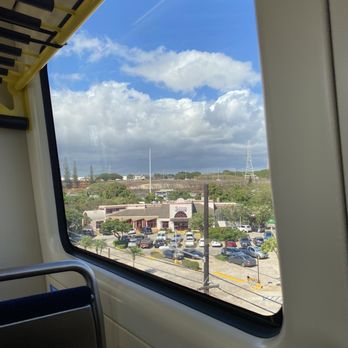


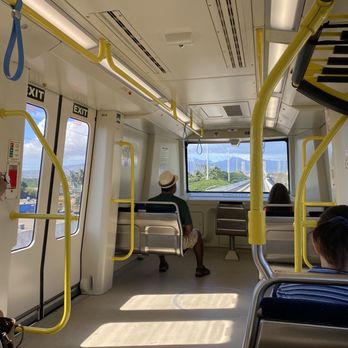

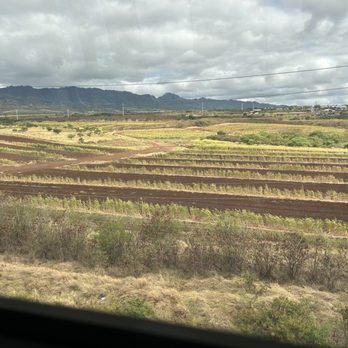
Mass transit on the Island of O'ahu... The controversial "Rail" system is up and running... Well - part of it is... Also known as "Skyline", "The Rail" has future plans for extending out to the airport, Chinatown, and Ala Moana. Right now, it runs from Halawa to Kapolei and back. I got my First Grade friend (who currently lives in Virginia) to go with me. It was a blind experiment because we both didn't know what to expect. We parked for free across the street from the Aloha Stadium and figured out where the entrance was. There weren't any obvious signs. Even the parking lot was a vague guess for us. I had purchased a Holo Card from Times Supermarket for $2. (Seniors, age 65 and older, can get a free Holo Card at a Satellite City Hall with State of Hawaii ID.) Times Supermarket advised me to add $3 on my card, so, I did. When we got to the Fare Machines at Halawa Station, there were no signs as to how much money we should add on to our Holo Card. The friendly staff answered our questions. Basically, $3 can get you Two and a half hours of ridership. If you leave the station, you will need to pay another $3 to get back on the Skyline. You may exit the train, but you should stay in the station if you don't want to pay an additional $3. We figured that we could ride two times round trip from Halawa Station. Common answers: Yes, the ride was jerking at certain points. No, there are no seat belts. Yes, you may stand at your own risk. No, you shouldn't eat or drink during the ride. Yes, it's kinda quick. It took about 25 minutes to get from Halawa to Kapolei. Yes, the compartments are clean and air conditioned. Tap the card to enter and exit the stations. We were amused by the spoken Hawaiian language along with the English announcements for each stop. We enjoyed the views of farmland, Pearl Harbor, shopping centers, KROC Center, Kāhi Mōhala, Diamond Head, etc. I'll probably be back to bring friends and family on "The Rail". It's similar to a Disneyland ride. LOL! Note: the escalators were not functioning on the day that we arrived. We used the elevators to get up to the platform- And later, used the stairs to go down to our car. read more


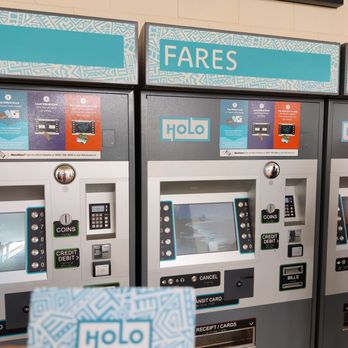


Thanks to Nadine C. for riding the rail with me today. It was better than I expected. It was pretty smooth except for a few bumps along the way. Once they build it to Ala Moana it'll be a lot faster to get to Kapolei. You no longer will have to sit in all that traffic. I know that some people feel that there's no parking at some of the rail stops. I believe that we can still make it work. I've travelled quite extensively in my life before Covid. I've taken the rail in many countries and can honestly say that none of them had parking. In Hong Kong and New York the metro was underground. In Chicago, Taiwan, Japan, London and Paris it was above ground. I didn't see parking at any of their stops. I am happy that they put a glass closure that opens and closes when the train arrives. So many rail systems just leave the platforms open. People are pushed or accidentally fall over and die. Don't hate on me if you don't like the rail. I'm a believer in rail. It made getting around so much easier for me in different cities. I didn't even have to rent a car. I just connected to the rail by bus or taxi depending on where I was. You'll need a HOLO pass to get on. It's $3 to get on every time, unless you get a daily pass. I'm not sure if they do a monthly or annual pass. We got on at the Halawa stop. They had machines where you could scan your card and deposit money. There weren't any instructions though and they didn't have a chart listing the fares. I was told that I needed to scan my card to exit the station, which I found odd. Usually, at most rails the entrances and exits are at different places. You don't need to scan to get out. Here the entrance and exit are at the same place. I guess you have to scan to get out, so people can't come in without paying. read more


Came for a ride on Ohana day. We were all excited to be one of the first public riders! Its been a long time coming... this project began around the time I had my youngest child and she is now pretty much a teen! I did say it probably wouldn't be until 2025 and beyond that it would finally be finished and technically its not quite reached its final anticipated destination. For now the rail will be able to board from the KROC center (Kualaka'i aka East Kapolei Station) to the Aloha Stadium (Hālawa station) with a total of 9 stops going through Waipahu and Pearl City. Each way took approximately 20m. About 2-5m between each stop. We boarded at the Aloha Stadium with lots of parking stalls available for commuters. There are 2 elevators, escalators and stairs to get up to the platform. Bathrooms were available with assistance from workers to open the doors. Wheelchair accessible, space for luggage, bikes and skateboards welcome. Unsure how the HOLO card will be used for this transit system yet. I believe July 1st will be the first day the HOLO card is required and will still be free from 6/30/23-7/4/23. Theres still lots of room for improvement as its still in its early stage of opening and operations. Unfortunately this line is not realistic for my family and I to utilize. Hopefully it will help some. For now I feel this is more of a novelty for locals. Still looking forward to seeing more phases of this project opening in the future. read more
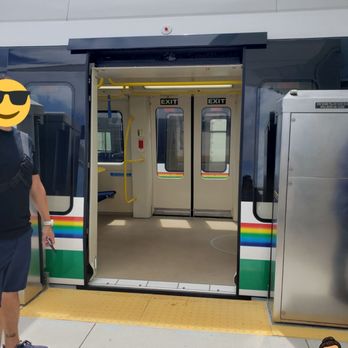


The Honolulu Skyline is a light metro system that consists of 18.9 miles of automated fixed-guideway line that was planned, designed & constructed by the HI Authority for Rapid Transportation, a semi-autonomous government agency. It is the largest public works project in HI. The plans for this mass transit line to connect Honolulu's urban center with its outlying areas began in the 1960's, but funding was not approved until 2005, & construction started on 2/22/11. Estimated cost is $12.4 billion & climbing higher. There are 21 stations from east Kapolei to the Civic Center in Honolulu. There are 3 main phases: * Phase 1: opened on 6/30/23, links east Kapolei to Aloha Stadium via 9 stations. * Phase 2: to open in mid-2025, links Pearl Harbor & Dan Inouye Intl Airport until just before Middle St, via 4 stations. * Phase 3: to open in 2031, links Middle St. to the Civic Center via 6 stations. This review is for Phase 1, which includes the following 9 stations: * Halawa ("curve") Station (Aloha Stadium). This station, built on a former stadium overflow parking lot, was planned to accommodate the many sports & entertainment venues held at the stadium; however, delays in building or renovating the stadium exist. New housing, retail businesses, restaurants & a hotel were being planned for this redevelopment project. There are 590 parking stalls in the park-&-ride lot. * Kalauao ("multitude of clouds") Station (Pearlridge). This rail segment is the closest station to Oahu's 2nd-largest shopping mall; however, the station exit is a 5 to 10-minute walk along Kam Hwy & Kaonohi St, & a planned pedestrian bridge was subsequently eliminated. * Waiawa ("milkfish water") Station (Pearl Highlands). Initially designed to connect riders from Central Oahu & the North Shore, plans have drastically been reduced for easy accessibility. There is no parking, so drop-offs only. * Halaulani ("heavenly halau, chief's house, name of a star") Station (Leeward Community College). The most isolated, light use is expected due to the low enrollment at the college & not much of a surrounding population. There is no parking or bus connections. * Pouhala ("Pandanus post or pillar") Station (Waipahu Transit Center). A bus transfer hub, the popular Highway Inn Restaurant is just steps away & Elena's is close by. There is no parking. * Ho'ae'ae ("to make soft or fine") Station (West Loch). This station serves Ewa Beach residents via TheBus & drop-and-ride connections. There are only 21 parking stalls. * Honouliuli ("dark boy") Station (Ho'opili). Located between UH West Oahu & western end of Waipahu, this station is surrounded by farmland, with Aloun Farms nearby. There is a temporary 344-stall park-&-ride lot. * Keone'ae ("fine, soft, powdery sand") Station (UH West Oahu). Known as "the train to nowhere," future planned development plans are still in discussion. There is a temporary 304-stall park-&-ride lot. * Kualaka'I ("to show the way, stand & lead") Station (East Kapolei). The station is isolated & not near many homes or businesses. Bus connections are necessary, & there is no parking. Introductory free rides were provided to the public from 6/30 to 7/4/23, & hubby and I were fortunate to try it out. As we live in HI Kai & far from the rail line, we parked at Aloha Stadium & caught the rail there. We got off at the Waipahu Station to have lunch at Highway Inn & continued our round-trip rail ride. In order to do this, I had to do a bit of research to determine what stop we would exit & how to get to the restaurant. My observations are as follows: * It is disappointing to see how initial plans were significantly scaled back, resulting in many stations that are isolated, have no parking & have no pedestrian bridges or accessibility to nearby business & retail centers. Major redevelopment plans to build new housing & businesses near to the train stations are still being discussed & will not be in fruition until many years from now. Only 3 of the 9 stations had park-&-ride lots: Halawa, Keone'ae & Honouliuli. * Riders need to be educated to make quick decisions to exit the train & allow others to exit before the automatic doors close. They need to learn the train stops & how far they need to walk or use the bus to get to their destination. * Riders sitting in elderly & disabled priority seating should offer their seats to the elderly & disabled if they are standing. * Get to know the Hawaiian names of the stations, as they are used frequently. * Recorded announcements of train stations are muffled & are difficult to understand. * Shaky & uneven rides at times. Have ridden on trains in Japan, the Skyline is not as technologically sophisticated; however, it's a beginning step for Honolulu to stay abreast in the world-wide developments in public transportation. I hope that local residents and tourists will support the Skyline to make it a success so that future developments may proceed and to keep maintenance costs at a minimum. read more




3 years ago
7-04-2023: I took the opportunity to ride the rail for free. I would like to congratulate the city for getting this first segment of Skyline up and running. It was a long and expensive journey. The city had promoted the views from the rail as a reason to ride the rail. Yes, the views were picturous. My wife dropped the three of us at the station. She entered from Salt Lake Boulevard, and I didn't see any kiss and ride drop off. My wife told me later that Sha saw kiss and ride signs as she exited. I guess we went in thru the wrong entrance . We got off in the parking lot and had to cross two bus lanes to get to the station. With a tap of the holo card, we were on our way. Up the escalators and a short wait, we boarded the train. Hold on if you're standing. Acceleration and deceleration weren't as smooth as other rail systems that I've been on. The ride was bumpy for the majority of the ride. There were a few short segments in which the ride was smooth. Well, that's my opinion. read more
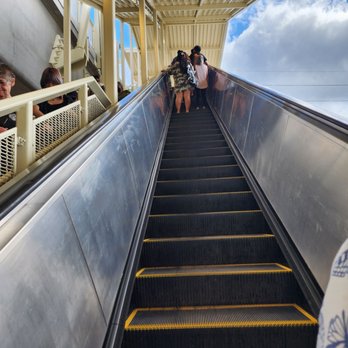


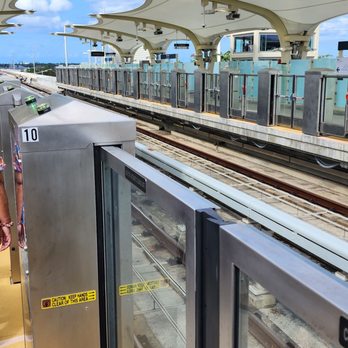


Halawa Station has alot of parking. We parked in the handicap stall. The Entrance was all the way on the other side from where the handicap stalls were. Not too smart in the planning process. Alot of people are disabled and have a hard time walking. The gate was closed to enter the building from the handicap parking side. It doesn't make sense that we had to walk all the way to the other side to enter. The view from the Rail was cool though. There is only one elevator for the platform and if busy you gotta wait for the next elevator. The elevator is too small to accommodate both strollers and wheelchairs at the same time along with people. The overall experience was ok. I was hoping it went all the way to Ka Makana Ali'i mall or water park or target in Kapolei at least. read more


The Skyline opened for business on June 30, 2023 with free rides until July 4. We rode on Sunday afternoon and parked at the Halawa station. We boarded the rail and went for a ride from Halawa to Kapolei. It was twenty minutes one way with stops every ten minutes. The views along the way are beautiful. It's a different perspective when looking from above and of course not driving in a car. There are some bumps along the way but overall the ride is fairly smooth and quick. This is only one part of the rail project as there will be more to come once completed. It will be interesting to see how many people will be using this transportation mode. But for today it was a fun experience. read more


Finally got to ride "The Rail" This weekend! We drove to Halawa station where it currently end/start all the way to the Kualaka'i start/end, depending on your frame of reference. There are only nine stations for now and some are conveniently located, some I'm not sure about. Currently the drive and park stations are free and seem convenient. What was confusing - after you park at the Halawa parking lot and walk towards the rail station there aren't signs telling you where the entrance is. But it's easy enough to figure out. Holo card kiosks were along the wall if you need to add funds. I think you can also purchase regular standard cards for $2. Seniors and other non-standard must be purchased else where with proof of age, or disability, etc. Card tap entrances into the station worked very well and smoothly. Hubby and daughter and I all used a different entrance and all went well for us. Ride was relatively smooth as long as you are sitting. View is nice. Rain is A/C'd so it's comfortable. Stations that seemed convenient (we didn't get off at any - we were just along for the ride): Halawa if you live in the area once the rail goes into town. Pearlridge station if you want to go to the West, or a Mauka side of the shopping center. (We contemplated getting off here to grab a bite to eat, since you can get back on for free if you do it within the time limit. But decided not to.) The Leeward Community College station looked convenient, as did the Waipahu stations if you want to shop in the stores near the stops. Some seem to need a transfer to a bus. If you are a bus rider, that's probably ok. If you are not, then probably not convenient. Would have loved to have a station closer to Ka Makana'ali'i shopping center. The Kualaka'i station doesn't seem convenient except for those wanting to ride into town or perhaps UH once there are stations there. Stations are clearly marked, recorded voice announcing the stops was easy to understand. Signs in the train make it easy to see what stop us next. There was also a nice map of the rail route in the train. Oops - didn't see the sign saying no photos of the station. (You have to go rather close to read the signs if you don't have good eyesight) Because we didn't get off at any station we only paid $3 for the entire ride. Would ride again if we have visitors who would like to see the west side of the island. read more


3 years ago
Quick sum: Honolulu skyline was overall a pleasant ride, but a little bumpy when approaching Kapolei. The multiple types of seats was interesting, and there was sufficient security features (security cameras, fire hydrants, button for ladder escape, intercoms) in place for my likings, +1. The four rail cars are also quite spacious, and enough for my family members to ride in, and the light rail I believe was running optimally overall. +2 Additionally, at the stops we found Skyline Staff actively cleaning benches, and sanitizing the many areas, +1. To rank the Stadium's Transit Center, it's relatively good for elderly since there's an elevator available, and escalator for accessibility. However, as there is currently NO " easy accessible public bathrooms" available. The portable ones are a bit difficult for the elderly accompanying me this morning. -1 4/5 Overall. read more


3 years ago
More info about Honolulu Skyline
99-232 Kamehameha Hwy
Aiea, HI 96701
Directions
Hours
Other Amenities
Ask the Community - Honolulu Skyline
You might also consider





















Why does Yelp recommend reviews?
1 review that is not currently recommended
The reviews below are not factored into the business's overall star rating.
6 months ago


