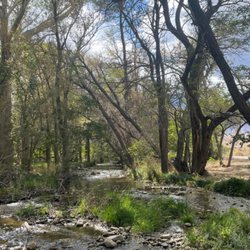
Located in California's beautiful Eastern Sierra, the Inyo National Forest offers clean air,…read morecrystal blue skies, mountain lakes and streams, challenging trails, high mountain peaks, and beautiful views. With over two million acres, the Inyo National Forest is home to many natural wonders, including Mt. Whitney, Mono Lake, Mammoth Lakes Basin, and the Ancient Bristlecone Pine Forest, as well as seven Congressionally-designated Wildernesses, comprising over 650,000 acres of land.
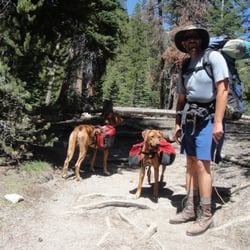
This is a 3 nights 4days backpacking trip totaling 22.5 miles in the Ansel Adams WIlderness and the setting is amazing.
We started at Agnews Meadow to John Muir Trail looping back thru Pacific Crest Trail.
John Muir Trail Section:
The John Muir Wilderness is massive in length - over 100 miles at its longest point. It covers the central/south portion of the Sierra Nevada range, on both the west and east side. The west side offers access from California's Central Valley and has many small towns and camper facilities. The east side is steep, very steep, and is accessible from the Owens Valley. Named after the father of environmentalism and champion of the national park system, this Wilderness has everything the Sierra Nevada has to offer -- lakes, meadows, streams, mountain peaks, forests and more.
The John Muir Trail travels about 53 miles in the John Muir Wilderness. In terms of the John Muir Trail, this Wilderness essentially covers the area between National Parks/Monuments. The mid-point for the Trail lies here. Typically, it is at (or near) Edison or Florence Lakes that the through hiker will take a brief break and re-supply. The John Muir Wilderness also affords the hiker spots to soak their feet in hot springs, grab a warm meal, and "traverse" from "easy" east side access points to west side access points for the trail.
As the trail begins a long set of switchbacks, one of the most panoramic views along the entire John Muir Trail is gained. Between the trees one can see the Minarets, Mt. Ritter and Banner Peak.
Summer is an excellent time to see wildflowers along the trail. At higher elevations, even in late Summer the wildflowers are blooming due to the late snow melt.
The order of the Lakes as we hiked in is as follows:
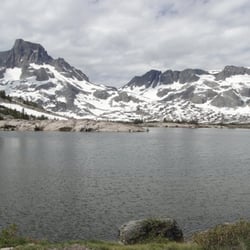
Shadow Lake, Clarice Lake, Garnett Lake, Ruby Lake, Emerald Lake, Badger Lake and Thousand Islands.
I can not choose which lake to mention as my favorite. They're all breathtaking. But Garnett Lake and Thousand Island stays in my mind the most.
Ruby Lake is mysterious looking and Shadow Lake is rewarding in a sense since this is the first lake you will see after the final push in a difficult steep switchback leading to it. Mosquitoes are abundant during summer here that makes it not my favorite :( but it is beautiful nevertheless.
As you ascend to over 9500 feet mosquitoes get lesser and you're back in a cooler condition.
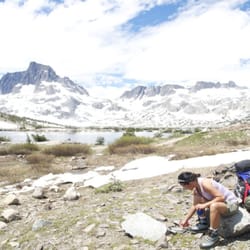
There are definitely snow on the trail and in some areas more than others as we started on the JMT above 9600 feet. One section between Ruby Lake and Garnett Lake the whole1000 feet of trail was covered in snow.
I would recommend a trekking pole and crampons for faster crossing. You could definitely do it without but the snow will slow you down. Some areas are as deep as 5 feet of soft snow.
Clarice Lake at 9600 was about 80% frozen. We took a break here and listened to the frogs complain :)
The trail from Clarice Lake to Garnett Lake was covered with snow. I decided to throw my pack down and follow it by sliding down the hill on my behind. It was fun!
The majestic beauty of both the Minarets, Banner Peak(12,936 ft) and Mt Ritter (13,143 ft) is the backdrop on most of my pictures of Shadow Lake. Awesome!
Lots of wild flowers on the way down thru the PCT.
Had a semi encounter with a bear on the trail. We heard him but never got to see him from about 20 feet from us.
Hope this review will somehow encourage Yelpers to explore Ansel Adams Wilderness!
Enjoy my pictures. I walked uphill to 10,1000 feet and and a total of 22.5 miles to snap them :)!