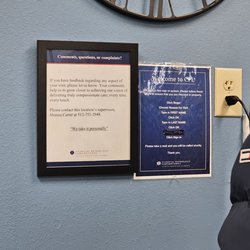
On 8/21/15, I went in to see Dr. Julie Bingham, my (former) primary care physician. I was born with a heart condition. I know my medical history, and one of the symptoms of my condition is an unusually low blood oxygen saturation. When Dr. Bingham read my blood oxygen levels, she immediately ordered me to go to the emergency room in an ambulance. That was it. No discussion.
Dr. Bingham failed to discuss the risks or benefits of going to the ER versus not going. She did not treat me like a reasonable adult of sound mind. Under the Medical Liability Act, a physician can be liable for lack of informed consent if they do not disclose risks associated with particular treatment (O'Connor 676).
I told her I did not want to go to the ER, especially in an ambulance. I tried several times to tell her about my heart condition, and that low blood oxygen saturation is a symptom of my condition. This is normal for me. She even tried to convince me that I had an additional symptom-that my lips and fingers were turning blue. They were not. I held up my hand next to her hand, and pointed to both our fingers. I showed her how mine was pink, similar to hers. She had nothing to say to that, but she did wave her hand in a very dismissive manner.
She was disregarding everything I was trying to tell her. She even told me that it would be illegal for her to let me leave on my own. I believe that is a lie. I can reference legal precedent and published medical opinions on the issue of Informed Consent:
1. In Union Pacific Railway Co. v. Botsford the US Supreme Court ruled that "no right is held more sacred or is more carefully guarded by the common law than the right of every individual to the possession and control of his own person" (Union Pacific Railway).
2. The American College of Physicians states "patients reserve the right to make informed decisions about their care, even if what they ultimately decide to do, or not to do, runs counter to medical advice" (D'Arrigo, "Look for Reasons").
When I refused to go to the ER, she brought in a large, male nurse to coerce me. One of the first things he said when he walked into the room was "I know it must be scary for you to be sitting there half naked, and in walks this huge man, but you really need to..." Even the nurse himself realized that this was an intimidation tactic.
A medical professional's job is to clearly communicate medical advice with her patient. Instead, she brought in Matthew Puckett to intimidate me into getting into an ambulance, and left the room. She left me alone, half-naked with a large intimidating man. I felt afraid, withdrawn, and violated, which is why I finally agreed to get in the ambulance. After all, at this point, I was fighting two members of the medical staff. This decision was made under duress, contrary to documented ethical standards for medical care:
3. The Texas Civil Practice & Remedies Code states "the duty to secure the patient's informed consent rests on the physician treating the patient...not with a hospital, consultant, technician...who does not participate in the treatment" (O'Connor 677).
4. "Consent must be given without coercion or undue influence" (Informed Consent Requirements).
5. The American College of Physicians admit "physicians themselves can be guilty of coercion by offering only one option for care" (D' Arrigo, "Look for Reasons").
After 6 hours in the ER and a bill totaling $9,095, I was released. The ER doctor concluded that the low blood oxygen is normal for me, and this is exactly what I told Dr. Bingham in that office.
The issue I originally made the appointment for was never addressed, and am still waiting to receive medical treatment for it.
I am writing this with the hope that it might help those in a similar situation. Remember the doctor works FOR YOU, not the other way around. YOU need to educate yourself on your own healthcare. YOU need to become your own medical advocate. Yes, the doctor has superior medical knowledge, but they ARE NOT an authority figure. Modern healthcare is entrenched in a business model that prioritizes profits over patients, and doctors are too often focused on speed over care, and rarely spend more than 15 minutes with a patient. How can they possibly get to know the intimate details of your body in fifteen minutes once a year?
No one should have to feel violated by someone who is supposedly a trusted professional.
1. D' Arrigo, Terri. "Look for Reasons If Patients Refuse Advice." ACP Internist. 2014. American College of Physicians. Web. 10/5/15.
2. "Informed Consent Requirements." Informed Consent Requirements. The University of Tennessee Office of Research Integrity. Web. 10/5/15.
3. O'Connor, Michol. "Causes of Action: Medical Malpractice-Informed Consent." O'Connor's Causes of Action. Jones McClure, 2014. pp 676-680. Print.
4. Union Pacific Railway Co. v. Botsford. U.S. Supreme Court. 25 May 1981. Justia US Law. Justia, 2015. Web. 9/29/15. read more