I don't always hang out in 55+ communities, but when I do, they better have Pickleball…read more
I, my family, cousins and friends have been in thrall to Pickleball for a year now
We now travel with Pickleball paddles, balls and net
We met a nice class of people here
Here is a welcoming and friendly clientele
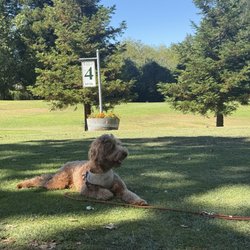
Dog-friendly
There can never be too many Pickleball courts
Beginners to experts are welcome here
Never underestimate an old woman or old man here with a Pickleball paddle
Everyone's sweet and helpful here
Here is fun, fun, fun
Sometimes a gust of wind here brings your Pickle / wiffle ball to a halt or makes it completely change direction
Lessons, clinics and skill-based ladders play, organized drilling sessions, and more are available
FREE beginners clinics twice a week and accommodates OPEN PLAY for all ages and ability every day from 8 to Noon
We left happier than we arrived. Let no one ever come to you without leaving happier. --Mother Teresa
I rate here 3 stars. According to Yelp ratings' definitions, that's "Ok". That to me is an acceptable rating of something that does day in and day out what it is there to do. It's NOT a negative review because doing day in and day out what it is there to do is NOT an easy thing to accomplish.
February is Black History Month
Future US Army officer and future baseball legend Jack Roosevelt Robinson was born 31 January 1919, in Cairo, Georgia, to a family of sharecroppers. Robinson never drank and was a life-long Civil Rights Activist.
Growing up, he excelled at several sports and attended the University of California at Los Angeles, where he was the first athlete to letter in four varsity sports: baseball, basketball, football and track. After financial difficulties forced Robinson to drop out of UCLA, he joined US Army in 1942, assigned to a segregated Army cavalry unit in Fort Riley, Kansas.
Having the requisite qualifications, Robinson, and several other black soldiers, applied for admission to Officer Candidate School (OCS) then located at Fort Riley. Although the Army's initial July 1941 guidelines for OCS had been drafted as race neutral, the applications of Robinson and his black colleagues were delayed for several months. After protests by heavyweight boxing champion Joe Louis (then stationed at Fort Riley) and with the help of Truman Gibson (then an assistant civilian aide to the Secretary of War), the black soldiers were accepted into OCS.
Robinson was commissioned an Army 2nd Lieutenant January 1943, and assigned to Fort Hood, Texas, where he joined the 761st "Black Panthers" tank battalion.
6 July 1944, he boarded an Army bus. The driver ordered officer-and-a-gentleman Robinson, who was in uniform and the only black, to move to the back of the bus although the Army had commissioned that unsegregated bus line service. Robinson refused. The driver called the military police, which took Robinson into custody. He was subsequently court-martialed for two counts of insubordination during questioning. An all-white panel of nine officers acquitted Robinson.
He was then transferred to Camp Breckinridge, Kentucky, where he served as a coach for Army athletics until receiving an Honorable Discharge in November 1944.
Robinson became the first black player in Major League Baseball.
Despite his talent and success as a player, Robinson faced and overcame tremendous racial discrimination and hatred throughout also his baseball career, from the public and some fellow players. While playing in the south, Jim Crow laws prevented Robinson from using the same hotels and restaurants as his teammates.
In 1947, Robinson was the National League's Rookie of the Year. In 1949, he was named the National League's Most Valuable Player and League Batting Champ. A six-time All-Star, Robinson played on the National League All-Star team from 1949 through 1954 and led the Dodgers to six National League pennants and a 1955 World Series champion.
He was inducted into the Baseball Hall of Fame in 1962, his first year of eligibility.
In 1950, Robinson played himself in the movie "The Jackie Robinson Story."
1957 to 1964, Robinson was the Vice President for Personnel at Chock full o' Nuts, a coffee brand, making him the first black person to serve as a vice president of a major U.S. corporation. The chain was already known for regularly hiring black employees in its lunch counters as both cooks and waitstaff.
4 June 1972, the Dodgers retired Robinson's uniform number, 42.
He died 24 October 1972, at age 53, in Stamford, Connecticut.
28 October 1972, best-seller I Never Had It Made: An Autobiography of Jackie Robinson, released. It's not about baseball: it's about the deep commitment that Robinson made to achieve justice for himself and all Americans.
15 April 1997, No. 42 was retired from all of MLB; Robinson is the only player ever to receive this honor.
The 2013 film 42 is an American biographical sports film about Robinson.