I had a great appointment with Michael Mendsen, OD. He gave me the most thorough eye exam I've…read moreexperienced, dating back to my earliest eye doctor appointment that I can remember, circa 1992.
Dr. Mendsen was highly recommended to me by my wife who also works in eye and vision care. It was hard to get an appointment with this guy! He, and I believe UNC Kittner Eye Center in general, is very busy. Dr. Mendsen told me he sees 17 patients a day, nine in the morning and eight in the afternoon. As a new patient, the earliest I could see him was seven weeks out. Based on my wife's strong recommendation and Dr. Mendsen's stellar reviews online, I thought the wait would be worth it - and it was.
So, if you'd like to see Dr. Mendsen as a new patient, be prepared to wait at least several weeks, if not, months. If you can afford to wait, I think it's worth it. Once you're in, though, I think it gets easier to schedule an appointment with him.
I went in for a routine eye exam, to get current prescriptions for glasses and contacts, and I wanted a good check of my eye health because I'm higher-risk for glaucoma due to my myopia (nearsightedness) and family history. As a new patient who was getting to know Dr. Mendsen for the first time, my entire visit lasted almost two hours. This time included my check-in time, time with the ophthalmic technician Megan, time with Dr. Mendsen, time alone while the dilating eye drops took effect, and time with Kelly Atkins, the contact lens lady. All staff I interacted with, from the COVID-19 protocols lady at the entrance to Dr. Mendsen's team, were terrific.
I was seen promptly by Megan at my 1:00pm appointment time. I was told that 1:00pm is a good appointment time to get because it's the first appointment of the afternoon. However, I'm actually not sure that I'll book this appointment slot again because of how badly my vision was affected from the dilation. When I returned home from my appointment, I couldn't work. I couldn't read my phone screen and I really struggled to read the text on my computer screens. I ended up having to take the rest of my workday off sick, which fortunately wasn't a big deal. For my next appointment, I'll probably ask to book the last or a later appointment in the day so my workday is less affected.
I was told that Kittner does a "full" dilation. I don't know exactly what that means, but I know I've never been affected from a dilation as much as the one I got from here. Not only were screens super blurry for me, but I was also quite light-sensitive. I really hadn't experienced that until now. In fact, Dr. Mendsen put some roll-up sunglasses underneath my regular glasses before I left so I could leave the office and drive home safely. When I got home, I had to close the blinds in my office, which I normally have wide open. That's how much light was affecting me. I even left the roll-up sunglasses on while I attempted to work on the computer. The blurriness left me feeling a bit nauseated. I think most of the dilation had subsided by around 6:00-7:00pm. I was mostly back to normal by then.
Dr. Mendsen used two sets of eye drops to dilate me. The first set of drops burned. The second set of drops did not. He also used another set of drops on me for a different purpose: to see my tear dispersion / how dry my eyes were. This set of drops was a yellow dye. If I recall correctly, after these drops, he looked closely at my eyes as I blinked to see how fast my tears dispersed. My tears had a dispersion time of about five seconds when normally it should be 10. Therefore, I had dry eye. Dr. Mendsen was the first eye doctor to ever tell me this. Maybe it's a recent development. I hadn't noticed my eyes being dry. I understood Dr. Mendsen telling me that my dry eye condition wasn't a big problem and that we could treat the symptoms with lubricating eye drops. My wife regularly uses drops for her dry eye, but I still haven't found the need to use them (my eyes feel fine).
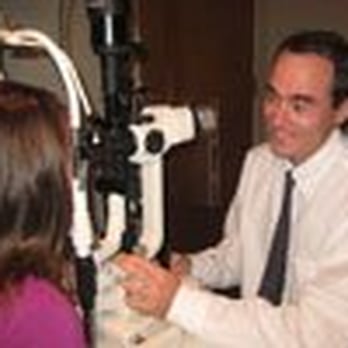
Along with the usual reading letters off a screen through different lenses ("one or two?"), sticking my face in at least a couple different pieces of equipment, looking in pretty much every single direction and having lights shined into every part of my eyeballs, Dr. Mendsen also carefully inspected both sets of my upper and lower inner eyelids. When he flipped open the uppers, it was uncomfortable. I think my small eyelids are harder to work with. By the time it was all over, not gonna lie, my eyes felt beaten-up and fatigued. However, I really appreciated Dr. Mendsen's thoroughness and I'm happy to do it every year for my long-term eye health and vision preservation. Thank you, Dr. Mendsen!
I also have to mention that before Dr. Mendsen saw me, Megan read my eye pressure, a.k.a. interocular pressure (IOP), with a device that looked like a gun. It was way better than what I was used to - those big, clunky, air-puff machines. I was told the new IOP measuring devices are significantly better.