We had come a long way for the tasting menu at The Waterside Inn, a Michelin three-star restaurant…read morethat has held its crown for 40 consecutive years. We walked away deeply satisfied, carrying with us an unforgettable memory.
Had I not come to The Waterside Inn, I might never have known foie gras and scallop at their most extraordinary. Had I not traveled to Bray, a small town just outside London, I might never have realized that another world-renowned restaurant, The Fat Duck, sits only a short walk away. And had I not made it to London, I might still believe the tired cliché that British food is poor.
In 1985, when I was still a college student, I heard a joke from a British student to a Chinese friend: If you want a good life, eat Chinese food, earn an American salary, marry a Japanese wife, and live in London. For a poor life, make a Chinese wage, marry an American wife, live in Tokyo, and eat British food. It was that same year, 1985, that The Waterside Inn first earned its Michelin three stars--and it has kept them ever since. That alone disproves the joke. Forty years later, sitting at its tables, I could testify personally: British cuisine can be just as exquisite as any in the world. The secret, I think, lies in the best ingredients, sourced close to home, prepared with simplicity, and served without pretension.
The foie gras was unforgettable. A thick cut, lightly grilled until diamond grill marks appeared, offered a bite that was creamy, rich, and succulent, yet never heavy. The charred surface added a subtle contrast, like the delicate skin formed on warm milk--different textures melding into one coherent experience. I told the waiter simply: "It melts in the mouth." It was also a special indulgence: in California, where I live, foie gras has been outlawed for years.
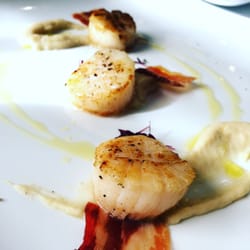
The scallop, harvested from the Orkney Islands, was equally revelatory. Cold, pristine waters yield scallops as sweet as those from Hokkaido--considered the best in Japan. Raw, they are creamy and fresh; grilled, their tightened muscle fibers concentrate the sweetness even more. Each bite broke apart into strands that released a briny-sweet burst, filling the mouth with the taste of the sea.
And then there was the raspberry soufflé. When the waiter pierced it and poured in the sauce, the soufflé trembled and rose as if alive. I couldn't resist exclaiming, "It's alive!" before plunging my spoon into the airy pink cloud. Light, tangy, and fluffy, it was a final note of delight.
Had I not traveled to Europe, I would never have experienced the contrasts and connections between Britain and the US. And had I never left China, I might never have discovered the vastness of the world beyond my imagination.