As is my wont to do and MO, if there is a door slightly open or ajar of an interesting or…read morehistorical looking place, I will go in like I belong. I have never been shot nor hardly ever told to leave. I have wandered into
Courtyards, sacred sites in Old Jerusalem and all kinds of buildings that I'm not supposed to go into.
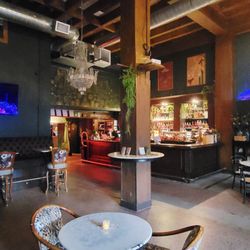
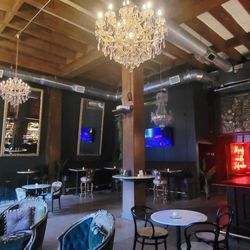
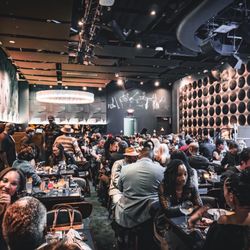
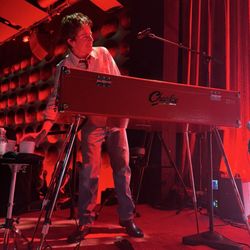
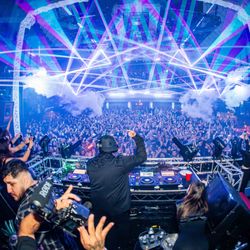
Tonight I was invited to my old twin friends birthday party at the Lemon Grove at the Astor Hotel rooftop and I was a tad early. As I crossed the street there was a metal stanchion blocking most of the entrance to the Avalon Club with one door open. I wandered in and people were milling about setting up for an Emo night with the band called Waiting For April. I had seen this club change over the years but I had no idea it was still operating and it's a beauty with tremendous history and cavernous rooms with bars and side rooms. I wandered around and upstairs I found a merch table and a drum kit with guitars and some guys warming up.
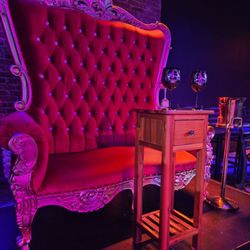
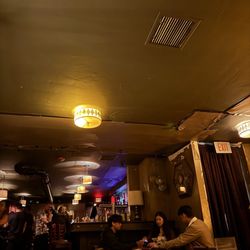
I started talking to them and it turns out that is the headlining band. We talked music and the struggles of a young band, I gave them some insight from my experience, they gave me their CD which is quite nice and I proceeded to check out the historic place. I wandered through every part of the club while the band was doing sound check including the Bardot room and unlike many clubs, you really feel the history here in the design and architecture of this historic venue.
Here is the fascinating history:
The Avalon Hollywood (also known simply as Avalon) at 1735 N. Vine Street in Hollywood, California, near the intersection of Hollywood Boulevard and Vine Street (across from the Capitol Records Building) was built in the Spanish Baroque (Churrigueresque) style by architects Henry L. Gogerty and Carl Jules Weyl, with decoration by Steffan Horbaczek, it has operated continuously as a live performance space since opening--never as a movie theater. It was added to the National Register of Historic Places in 1985 as part of the Hollywood Boulevard Commercial and Entertainment Historic District.
It started as the Hollywood Playhouse (1927-1930s). In 1942, the theater was purchased (reportedly for around $105,000) and renamed the El Capitan Theatre (distinct from the more famous one on Hollywood Boulevard).
NBC acquired or leased the building in the early 1950s and converted it into a television studio. In 1963, ABC invested heavily (around $400,000) in renovations--including extending the stage, adding camera equipment, control booths, and other TV infrastructure--and briefly renamed it the Jerry Lewis Theatre for Jerry Lewis's short-lived (13-week) ABC variety series. From
1964-1970: it was The Hollywood Palace. From 1970s-1990s: The Palace Music Venue.
ABC sold the theater in 1978 to businessman Dennis Lidtke, who restored it and reopened it in 1982 (or around 1987 per some accounts) as The Palace (sometimes called the Hollywood Palace). Seating was reconfigured for concerts (raked floor leveled, bands on stage), and it became a music club and event space. It hosted rock concerts, HBO specials (e.g., Sheena Easton, Bruce Willis), the Ramones' final show (1996), the American Music Awards, and film appearances. It operated as a live music venue through the 1980s and 1990s.
2002-Present: Avalon Hollywood Nightclub with a major renovation that transformed it into a modern nightclub, concert hall, and event space with standing-room/dance floor capacity (around 1,250-1,500), state-of-the-art sound, lighting, and visuals. It emphasizes electronic dance music (EDM), DJ sets, and live performances, with upstairs space later becoming Bardot, an intimate lounge/restaurant/club opened around 2008.
Notable modern acts have included Tiësto, Sasha, John Digweed, Paul Oakenfold, Skrillex, Swedish House Mafia, Eric Prydz, Armin van Buuren, Kaskade, and many others in the EDM scene. It has also hosted award shows, benefits, screenings, political fundraisers, and private events. In recent years (2024-2025), Insomniac Events (founded by Pasquale Rotella) partnered with and then acquired the joint marking the first ownership change in about 50 years and ensuring its continued role in dance music culture.
The Avalon has adapted remarkably over nearly a century--from legitimate theater and WPA productions to burlesque, TV studio, variety show epicenter, rock club, and EDM nightclub--while retaining its core as a live entertainment landmark in the heart of Hollywood. Its architecture and location have contributed to its enduring appeal. I definitely will return.