Cancel

    Open app

    Search

    Waylands Smithy Photos
    Recommended Reviews - Waylands Smithy

    Your trust is our priority, so businesses can't pay to alter or remove their reviews. Learn more about reviews.
    Yelp app icon
    Browse more easily on the app
    Review Feed Illustration

    18 years ago

    Helpful 0
    Thanks 0
    Love this 0
    Oh no 0

    Verify this business for free

    Get access to customer & competitor insights.

    Verify this business

    Bibury

    Bibury

    5.0(2 reviews)
    17.1 mi

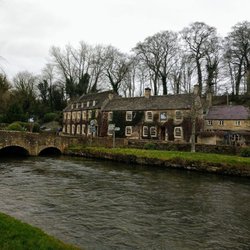
    Bibury is a charming, typically Cotswold. It's easy to see why William Morris called Bibury 'The…read moremost beautiful village in England' - wonderful stone buildings strung out along the banks of the River Coln. Arlington Row, owned by the National Trust, is one of England's most iconic and photographed sites - it even appears on the inside cover of UK passports! Originally built in the 14th century as a monastic wool store, it was converted in the 17th century into a row of weavers' cottages. The River Coln flows through Bibury sandwiched between the main village street and an expanse of boggy water meadow known as Rack Isle, so called because wool was once hung out to dry there on racks after it had been washed in Arlington Row. You can even see some trout in the river, which the trout farm owners told us they are the escape artists! With Arlington Row as a backdrop, it makes one of the most picturesque scenes you will find in the Cotswolds. Other attractions in Bibury include: Bibury Trout Farm, (see my other review) one of the oldest and most attractive trout farms in the country covering almost 15 acres, where you can learn about trout or event catch your own dinner. This village is stunning, perfect photographers dream. Do come you will not be disappointed.

    If traveling past Oxford don't miss out on this picturesque little town, offering a prime example…read moreof the Cotswold way of living. Houses are maintained in much the old fashion, offering not just wonderful photo opportunities but also a glimpse into housing of the past . You will find several small tea houses and shops here, as well as a trout farm and hotel. Well worth a visit or even a relaxing weekend.

    Photos
    Bibury
    Bibury - Biburys river and hotel and pub

    Biburys river and hotel and pub

    Bibury

    See all

    Avebury Stone Circle - Roof of a pigeon and dove barn. 15th century when they bred birds for food.

    Avebury Stone Circle

    4.8(38 reviews)
    15.3 mi

    Avebury Stone Circle is one of the world's greatest prehistoric monuments: older than Stonehenge,…read moreit is the largest megalithic stone circle (henge) anywhere, and part of what was once an enormous megalithic complex stretching for miles. To me, it's more impressive and more spiritual a place than Stonehenge, despite the fact there's a road and village within its structure. History As ever with such sites, our knowledge is limited, but like Stonhenge, it is likely to have been built in phases. The best guess is that construction began around 2600BC with the inner circles, with the great ditch and outer circle completed around 2500BC, making it contemporaneous with the Pyramids at Giza. When completed, these circles included about 154 stones (only 36 remain today) and it also had two avenues 50 feet wide on either side, extending another one and a half miles. Excavations indicate it was probably used as a ritual site for some 2,300 years. A mile to the south is the artificial Silbury Hill, which must also have formed a related part of this complex, although its purpose is now unkown. Nearby Windmill Hill - an important settlement in Neolithic times - also has some burial mounds from the Bronze Age. As well as natural degradation, the monument suffered hugely during the mediaeval period when the Christian authorities actively encouraged demolition of what was regarded as a Pagan monument. This process accelerated in the 17th and 18th centuries, when local people also broke up the stones for building material. But as late as the 1720s, the great antiquarian Dr William Stukeley was able to trace the original plan, including the avenues: although his interpretation of this as a Druid site is now regarded as inaccurate, his drawings and surveys provide our best record of what it looked like. Alas, the destruction of the stones by local farmers continued unabated into the 19th century. The 20th century showed a greater interest in and respect for the site, and - rather controversially - many of the stones were re-erected in the 1930s by the archaeologist Alexander Keiller. This involved in some cases demolition of later buildings, themselves of some historical interest. I happen to think he was right to try and preserve what was left, but many contextual historians disagree. Whatever the rights and wrongs, the site is now safely in the hands of the English Heritage and managed by the National Trust. The site Today, the most impressive feature is the great ditch and its banks: the excavation of this feature - nearly 0.5km in diameter - involved moving 200,000 tonnes of soil and rock. It may even once have been filled with water to make the interior and island. Even now, the ditch and bank together are impressive, but originally they were even deeper/higher (at around 50ft). Inside this are the remains of the outer circle, which is nearly complete in the north west and south west corners. The remains of the two inside circles are more fragmentary. Unlike Stonehenge, here you can walk right up to the stones, so allow at least a couple of hours to visit properly. Don't miss walking south from the main henge monument along the West Kennet Avenue - around 30 standing stones arranged in pairs (to the form the avenue). Practicalities There is a gift shop and museum in the nearby Barn and Stables (themselves 17th century buildings) with interactive displays to put everything into context. The museums are fully accessible, but the main site has undulating grassy terrain (without footpaths) which are accessed through "kissing gates". The ground can get soft and rather boggy underfoot if it has been raining, so you will have to judge for yourself. There is a drop-off point in the village. Parking is the main problem: there is a pay and display car park (free for motorcycles and National Trust Members), on the A4361 road between Beckington and Avebury about 400m from the edge of the henge. This can become packed very quickly in the summer. There's a more central car park for those with disabled parking badges - the Red Lion car park is only for patrons. The village of Avebury itself is worth a wander around (Avebury Manor - see separate review - and the Red Lion especially, although it does get terribly busy at weekends in summer). For the most part, you'll still be inside the monument itself!

    I almost feel educated!‍ We enjoyed this pre Stonehenge!…read more Keeps getting ! Keeps getting stranger!

    Photos
    Avebury Stone Circle
    Avebury Stone Circle
    Avebury Stone Circle - Red Lion pub

    See all

    Red Lion pub

    The Magic Roundabout - Forget what Buffy told you, this is the true location of The Hellmouth.

    The Magic Roundabout

    3.8(4 reviews)
    7.8 mi

    Have you ever been on vacation, driving merrily along minding your own business, when whoopsie, you…read morehave to hit the brakes as you've unknowingly entered a gateway to the Nightmare dimension? The Magic Roundabout, a godforsaken collection of mini-roundabouts (or minibouts) that connect 4 main artery routes and a relatively minor road (sorry Shrivenham Rd.), was physically built in 1972, but conceived far earlier way back in 1937 by H.P. Lovecraft while languishing on his deathbed, emotionally distraught by the realisation that Cthulhu wasn't the ultimate evil after all and he simply had to jot down his maniacal design on paper. The fact that the layout of the minibouts of the Magic Roundabout form the basic outline of an upside down pentagram is as blatant a calling card of evil as you could ever expect to see The MR is apparently a 'landmark that Swindon is famous for', which should tell you everything you need to know about Swindon in 6-words and exactly why you should consider investing an additional 10-hours to driving around it instead of through it. Throw in the fact that I traversed this mess with a stunned, wide-eyed American in the car, unused to both roundabouts (they're quite the tourist attraction in the USA and all seem to require a mandatory 3-miles of warning signs to mentally prepare a driver to tackle one) and driving on the left side of the road, which only added to the overall sense of panic and impending doom. We survived the Magic Roundabout, which is more than some can say. Legend has it that Dave Bailey from Oxford failed to sacrifice a chicken or say the appropriate prayers before entering the roundabout back in 1983 and remains there to this day, his white van driving in endless futile circles, doomed for eternity to try and find the exit for the M4.

    I don't drive. I usual encounter this when in the car with my Mum, who can be a little worried…read more Invariably as we approach she starts telling me to keep quiet until we are past, at length, until I'm really wishing she'd stop talking and drive, but my mouth is, of course, tight shut. Actually I think she's probably a lot better at it than she thinks. And Marg2k8's explanation makes some sort of sense! It still remains a little scary, with traffic coming at you from what seems like all directions! If you'd like a look before tackling it, then on the map top right go to 'explore this area', then switch to satellite, and zoom in. It's sort of two rings, one going clockwise, one anti, with four islands and four smaller roundabouts in between. I can't help wondering if they've ever built one of these elsewhere since?

    Magna Carta Memorial - On US soil in the middle of Runnymede...  the JFK Memorial at the Magna Carta site

    Magna Carta Memorial

    4.3(3 reviews)
    45.8 mi

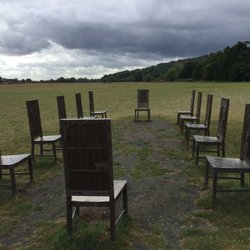
    No one is above the law…read more Have you heard that phrase lately? It reminded me of my recent visit to Runnymede, where this principal was first established with the signing here of the Magna Carta. If, like me, you slept through World History class you may be forced to ask "what's the Magna Carta?" even though you know you knew the answer sometime in your past. One visit here and you'll never again need to be reminded. The Magna Carta is one of history's most important documents, executed in Runnymede (in the 1200s), for the purpose of establishing that everyone is subject to the law and no man is above it. It also established one's right to justice and a fair trial. Timely, eh? Though this particular yelp listing is for the Magna Carta Memorial (established on site by the American Bar Association) it's really the whole of the Magna Carta site that you'll experience here and this particular memorial is the least interesting of the four main components. There's also a JFK Memorial, a mid-field art installation, and an Air Forces Memorial (which I didn't see). The JFK Memorial is compelling for a single reason: The acre of land it sits on is US land. What? The Queen granted this land to the US in memory of JFK following his assassination. So, you can stand on this charming piece of US soil in the middle of the UK. Watch the "Dear Mrs. Kennedy" (season 2) episode of Netflix' "The Crown" for background info on the relationship between the Queen and the Kenendys. More compelling for me was an outdoor art installation of 12 sculpted chairs, each depicting some struggle for rights that's gone on since the signing of the Magna Carta. I was moved to see Harvey Milk's fight for LGBTQ+ rights depicted as one of the featured struggles. If you find yourself in Eton or Windsor a visit to Runnymede's Magna Carta Memorial site is worth your time as it gets you thinking about things we often don't, but should. No one is above the law.

    Well this wonderful memorial might be part of the American Constitution, but it was ours first!…read more Some people, even the P.M. recently stated that it should be part of our own ethos. Other people think we have lost sight of the original principles, and only parts of the meaning have either been hijacked or watered down to every petty conveniences. Take your pick ?

    Photos
    Magna Carta Memorial - Walk thru a gate and you are on US soil!  This acre of land was granted to the US by the Queen in memory of JFK

    Walk thru a gate and you are on US soil! This acre of land was granted to the US by the Queen in memory of JFK

    Magna Carta Memorial - Art installation; each chair depicts a struggle for rights post-signing of the Magna Carta.

    Art installation; each chair depicts a struggle for rights post-signing of the Magna Carta.

    Magna Carta Memorial - No one is above the law: that is what the Magna Carta established, one of the most important documents in history

    See all

    No one is above the law: that is what the Magna Carta established, one of the most important documents in history

    Waylands Smithy - landmarks - Updated May 2026

    Loading...
    Loading...
    Loading...