
Silbury Hill Photos


Recommended Reviews - Silbury Hill
Start your review...



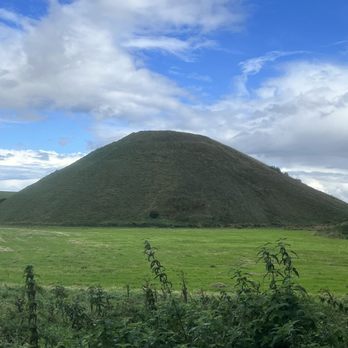
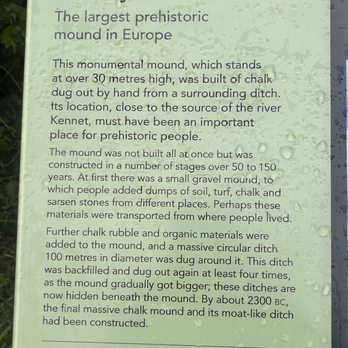
Okay, so at one level this is just an artificial mound. But it happens to be nearly 4,500 years old and, at over 30m in height, is the largest prehistoric artificial mound in Europe. So it something special. It forms part of the Avebury UNESCO World Heritage Site, along with the nearby West Kennet Long Barrow, and the Avebury Stone Circle and adjacent avenues (see separate reviews on Yelp), and can be visited as part of a day trip around all of the sites. Excavation has shown the mound was not built in one go, but in a series of enlargements, undertaken between about 2470 and 2350 BC. These included excavation of a series of increasingly larger outer ditches (one of which was water filled), and placing the chalk rubble onto the mound. It is not known what the mound was used for, but it was clearly something of great significance to the Neolithic people, and forms part of the wider Neolithic landscape of henge monuments and burial mounds. Over the course of the following years, a small Roman settlement was built next to the mound, and in mediaeval times, the top of the mound was flattened, possibly for defensive use. Inevitably, over the years, the mound has become the subject of a number of myths and legends. There have been three major campaigns of excavation. The first was financed by Hugh Percy, Duke of Northumberland, in 1776. Overseen by Edward Drax, miners were employed to dig a vertical shaft from the summit to the centre of the hill. They had hoped to discover a burial in the centre, but found nothing. The next attempt in 1849 saw John Merewether, the Dean of Hereford Cathedral, excavating a horizontal tunnel into hill from its base. Again, no burial was found. It is possible that these earlier excavations may have damaged fragile organic remains. I am old enough to remember the third major investigation, which was undertaken between 1968 and 1970. Televised by the BBC, it was a major and regular item on the news. Professor Richard Atkinson excavated a new tunnel on a similar line to Merewether's, and identified three phases of construction. Further work was undertaken in 2000, when it was found necessary to restore part of the mound, which had begun to collapse because of the earlier excavations. This has added significantly to understanding of the complex process of construction. Located alongside the modern A4 road, there's a decent sized car park just west of the site, with a path to a viewing area with information boards. You are no longer allowed to scramble over the mound itself, but a footpath to the north allows a different perspective. You can get another close view from the nearby A4 road if you can brave the traffic (there is a narrow pavement, but with vehicles whizzing close by at 60mph, it is not very pleasant, nor safe for those with children). read more

3 years ago
This is a sight to see. No solid reason why the Neolithic population spent decades raising a hill this high. Science has done 3 tunnels over 150 years for discovery, but no result. Each 50 years apart. Why? Another religion or astronomy guess. Done by hand over decades. That would involve generations and continued guidance and a firm purpose. No one is allowed on the hill. Privately owned by one family for many generations to preserve its history. There are sheep trails on it. All done by hand, a basket at a time. . Who decided when it was done. ? read more


9 years ago
We visited Silbury Hill as part of a private day tour that included stops at Stonehenge, Avebury Stone Circle, Lockeridge Dene, West Kennet Long Barrow, Woodhenge, and Durrington Walls. We felt these stops helped give us context and a better understanding of the time period. Silbury Hill is the tallest pre-historic man-made hill in Europe. Its purpose is not known. read more


18 years ago

18 years ago
There's a good car park right next to the hill where you can walk closer to it for an excellent view. Newly erected information boards explain how Silbury has been restored after a cave-in near the top. Speculation for its construction and meaning are also explored. With such constant additional construction to the hill in ancient times, and its clear visibility for miles around, this must have had the highest degree of significance to the society which built it. As mentioned in the previous review, it is not possible to climb the hill, but the atmosphere around this area makes it an important and interesting place to visit. read more


18 years ago
18 years ago

14 years ago


