Cancel

    Open app

    Search

    The Magic Roundabout Photos

    Recommended Reviews - The Magic Roundabout

    Your trust is our priority, so businesses can't pay to alter or remove their reviews. Learn more about reviews.
    Yelp app icon
    Browse more easily on the app
    Review Feed Illustration

    11 years ago

    Helpful 2
    Thanks 0
    Love this 4
    Oh no 0
    Photo of Helen M.
    0
    422
    835

    17 years ago

    Helpful 1
    Thanks 0
    Love this 1
    Oh no 0

    17 years ago

    Helpful 0
    Thanks 0
    Love this 0
    Oh no 1

    18 years ago

    Helpful 1
    Thanks 0
    Love this 2
    Oh no 0

    Verify this business for free

    Get access to customer & competitor insights.

    Verify this business

    Bibury

    Bibury

    5.0(2 reviews)
    22.9 km

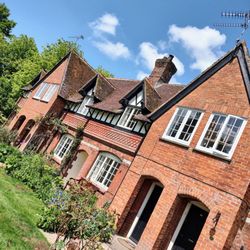
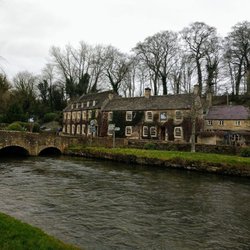
    Bibury is a charming, typically Cotswold. It's easy to see why William Morris called Bibury 'The…read moremost beautiful village in England' - wonderful stone buildings strung out along the banks of the River Coln. Arlington Row, owned by the National Trust, is one of England's most iconic and photographed sites - it even appears on the inside cover of UK passports! Originally built in the 14th century as a monastic wool store, it was converted in the 17th century into a row of weavers' cottages. The River Coln flows through Bibury sandwiched between the main village street and an expanse of boggy water meadow known as Rack Isle, so called because wool was once hung out to dry there on racks after it had been washed in Arlington Row. You can even see some trout in the river, which the trout farm owners told us they are the escape artists! With Arlington Row as a backdrop, it makes one of the most picturesque scenes you will find in the Cotswolds. Other attractions in Bibury include: Bibury Trout Farm, (see my other review) one of the oldest and most attractive trout farms in the country covering almost 15 acres, where you can learn about trout or event catch your own dinner. This village is stunning, perfect photographers dream. Do come you will not be disappointed.

    If traveling past Oxford don't miss out on this picturesque little town, offering a prime example…read moreof the Cotswold way of living. Houses are maintained in much the old fashion, offering not just wonderful photo opportunities but also a glimpse into housing of the past . You will find several small tea houses and shops here, as well as a trout farm and hotel. Well worth a visit or even a relaxing weekend.

    Photos
    Bibury
    Bibury - Biburys river and hotel and pub

    Biburys river and hotel and pub

    Bibury

    See all

    Waylands Smithy

    Waylands Smithy

    5.0(1 review)
    12.6 km

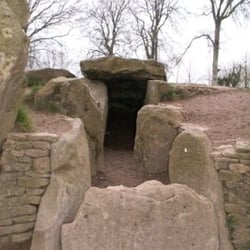
    Wantage (12km ENE) (map may be wrong)…read more Wayland Smith, Wayland Smith here is a horse for you to shoe. According to legend, a traveller whose horse has lost a shoe can leave the animal and the smallest silver coin (a groat) on the capstone at Wayland's Smithy. When he returns next morning he will find that his horse has been re-shod and the money gone. It was dusk..3 chidren with me..I took a 5p out and placed it on the stone..I said Wayland Smith, Way and the children were gone in a cloud of dust! I finish the verse and suddenly my dust was added as I ran in the increasing gloom of early evening..so fast I caught up with them and we fell in a heap giggling They do say if you look at him you are immediately struck blind Ok so combined with the rest of the area it is a good day out..take a picnic..and I used to work in archeology (as the historian) so heres the history bit :) It is conjectured that the invisible smith may have been linked to this site for many centuries before the Saxons recognized him as Wayland. The Ancient Britons may have been accustomed to making votive offerings to a local god. Wayland's Smithy is a Neolithic long barrow and chamber tomb site located, near the Uffington White Horse and Uffington Castle, at Ashbury in the English county of Oxfordshire (formerly in Berkshire).Wayland's Smithy is one of the most impressive and atmospheric Neolithic burial chambers in Britain. Somehow this ancient grave became associated with Wayland, the Saxon god of metalworking, from whom it takes its name. The later mound was 185 feet long and 43 feet wide at the south end. Its present appearance is the result of restoration following excavations undertaken by Stuart Piggott and Richard Atkinson in 1962-1963. They demonstrated that the site had been built in two different phases, a timber chambered oval barrow built around 3700 BC and the second stone chambered long barrow in around 3400 BC. The wooden mortuary house mainly consisted of a paved stone floor with two large posts at either end. A single crouched burial had been placed at one end and the mostly disarticulated remains of a further fourteen individuals were scattered in front of it. Analysis of these remains indicated that they had been subjected to excarnation prior to burial and deposited in possibly four different phases. Postholes at one end have been interpreted as supporting a timber facade. The whole monument was covered by an earth barrow with material excavated from two flanking ditches and measured around 20m in length. The later stone tomb consists of two opposing transept chambers and terminal chamber, along with the longer entrance chamber, this gives the burial area a cruciform appearance in plan. It is classified by archaeologists as one of the Severn-Cotswold tombs. The large trapezoidal earth barrow erected over it was revetted with a stone kerb and its material was again excavated from two large flanking ditches. Excavation in 1919 revealed the burials of seven adults and one child. Bones found at a prehistoric burial site indicate they belonged to victims of an ancient massacre, say scientists. The site is important as it illustrates the transition from timber chambered barrows to stone chamber tombs over a period which may have been as short as 50 years.

    Photos
    Waylands Smithy

    See all

    Silbury Hill

    Silbury Hill

    4.5(8 reviews)
    17.4 km

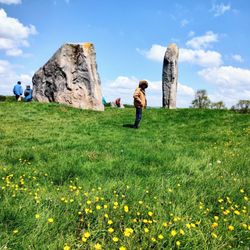
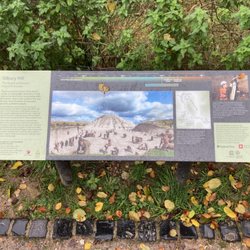
    Okay, so at one level this is just an artificial mound. But it happens to be nearly 4,500 years old…read moreand, at over 30m in height, is the largest prehistoric artificial mound in Europe. So it something special. It forms part of the Avebury UNESCO World Heritage Site, along with the nearby West Kennet Long Barrow, and the Avebury Stone Circle and adjacent avenues (see separate reviews on Yelp), and can be visited as part of a day trip around all of the sites. Excavation has shown the mound was not built in one go, but in a series of enlargements, undertaken between about 2470 and 2350 BC. These included excavation of a series of increasingly larger outer ditches (one of which was water filled), and placing the chalk rubble onto the mound. It is not known what the mound was used for, but it was clearly something of great significance to the Neolithic people, and forms part of the wider Neolithic landscape of henge monuments and burial mounds. Over the course of the following years, a small Roman settlement was built next to the mound, and in mediaeval times, the top of the mound was flattened, possibly for defensive use. Inevitably, over the years, the mound has become the subject of a number of myths and legends. There have been three major campaigns of excavation. The first was financed by Hugh Percy, Duke of Northumberland, in 1776. Overseen by Edward Drax, miners were employed to dig a vertical shaft from the summit to the centre of the hill. They had hoped to discover a burial in the centre, but found nothing. The next attempt in 1849 saw John Merewether, the Dean of Hereford Cathedral, excavating a horizontal tunnel into hill from its base. Again, no burial was found. It is possible that these earlier excavations may have damaged fragile organic remains. I am old enough to remember the third major investigation, which was undertaken between 1968 and 1970. Televised by the BBC, it was a major and regular item on the news. Professor Richard Atkinson excavated a new tunnel on a similar line to Merewether's, and identified three phases of construction. Further work was undertaken in 2000, when it was found necessary to restore part of the mound, which had begun to collapse because of the earlier excavations. This has added significantly to understanding of the complex process of construction. Located alongside the modern A4 road, there's a decent sized car park just west of the site, with a path to a viewing area with information boards. You are no longer allowed to scramble over the mound itself, but a footpath to the north allows a different perspective. You can get another close view from the nearby A4 road if you can brave the traffic (there is a narrow pavement, but with vehicles whizzing close by at 60mph, it is not very pleasant, nor safe for those with children).

    This is a sight to see. No solid reason why the Neolithic population spent decades raising a hill…read morethis high. Science has done 3 tunnels over 150 years for discovery, but no result. Each 50 years apart. Why? Another religion or astronomy guess. Done by hand over decades. That would involve generations and continued guidance and a firm purpose. No one is allowed on the hill. Privately owned by one family for many generations to preserve its history. There are sheep trails on it. All done by hand, a basket at a time. . Who decided when it was done. ?

    Photos
    Silbury Hill
    Silbury Hill - The trench and the  mound  Decades to make.

    The trench and the mound Decades to make.

    Silbury Hill - Silbury Hill from West Kennet Long Barrow

    See all

    Silbury Hill from West Kennet Long Barrow

    The Magic Roundabout - landmarks - Updated July 2026

    Loading...
    Loading...
    Loading...