Cancel

    Open app

    Search

    Corsham Court Photos

    Recommended Reviews - Corsham Court

    Your trust is our priority, so businesses can't pay to alter or remove their reviews. Learn more about reviews.
    Yelp app icon
    Browse more easily on the app
    Review Feed Illustration
    Photo of Fiona G.
    0
    328
    589

    15 years ago

    Helpful 0
    Thanks 0
    Love this 0
    Oh no 0

    Verify this business for free

    Get access to customer & competitor insights.

    Verify this business

    Pulteney Bridge - Pulteney Bridge, Bath_Yelp_Sanju-2

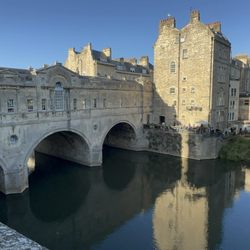
    Pulteney Bridge

    4.4(40 reviews)
    13.0 km

    The Pulteney Bridge in Bath is one of only four bridges in the world to have retail shops spanning…read moreboth sides of the bridge. Construction of the stone arch bridge was completed over the River Avon in 1774. Crossing the bridge (I was on a bus) has a very Old World feel. I was excited by the history and seeing the little shops on the bridge. The shops were packed with tourists.

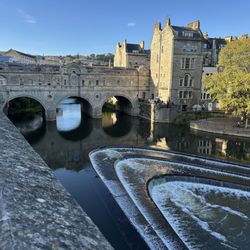
    Bath's iconic architecture is one of the many reasons why the city is a designated UNESCO World…read moreHeritage site, from its Roman origins to the fashionable eighteenth-century designs that form many of the city's most recognizable buildings. The guide informed us that the historic bridge is one of only four bridges in the world to have shops across its full span on both sides. (he meant Inhabited Bridges where shops/houses are built on the bridge) 1. Ponte Vecchio, Florence 2. Krämerbrücke, Germany 3. Pulteney Bridge, UK 4. Ponte di Rialto (Venice) I had been to #1,3,4 now. Pulteney Bridge is an impressive structure, its three arches sitting astride the River Avon, a splendid backdrop to the crescent-shaped river weir. The bridge in Bath is one of the most photographed examples of Georgian architecture in the city. it was designed in 1769 by Robert Adam and named after Frances Pulteney, wife of William Johnstone Pulteney. He had grand plans to create a 'new town' to rival that of John Wood's on the west side of the city. His grand scheme needed a new bridge, and he didn't want just any old bridge; he wanted a spectacular bridge, one which everyone would talk about, and that's how this came into existence.

    Photos
    Pulteney Bridge - Pulteney Bridge, Bath_Yelp_Sanju-5

    Pulteney Bridge, Bath_Yelp_Sanju-5

    Pulteney Bridge
    Pulteney Bridge

    See all

    Church of St Cyriac, Lacock - St Cyriac's Church, Lacock_Yelp_Sanju-6

    Church of St Cyriac, Lacock

    4.3(3 reviews)
    4.7 km

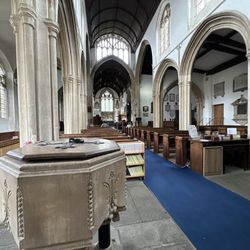
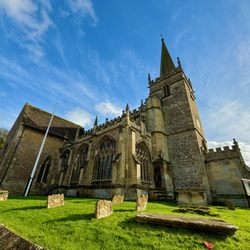
    At the eastern end of what must be one of the most picturesque streets in England stands the…read moremedieval parish church of Lacock, dedicated to St Cyriac. Cyriac was a three-year-old child executed by the Roman Governor of Cilicia in 313 AD for refusing to recant his Christian beliefs. Churches dedicated to Cyriac are common in Normandy, emphasizing Lacock's strong links to the region in the aftermath of the Norman invasion. You enter the church through a west porch, built in the late 15th century. The porch gives access to the base of the tower, built a century earlier. At the east end of the north aisle is a double squint. One opening allowed worshippers in the aisle to view the high altar while the other gave them a view of the Lady Chapel. HP fans: just behind the church, there is a house where HP's parents got killed in the movie. yup..!!

    It's only to be expected, being in Lacock, that this church is rather pretty. It's also…read moreinteresting, having a cruciform layout which goes a little beyond the standard and includes an area off to the side. There's nice stuff to look at everywhere: big old fashioned pews, stained glass windows, memorials It's possible there was a Saxon church on this site, but the first definite church was Norman, built at the end of the 11th century. Since then there have been a number of rebuildings, additions and remodellings, leading to some mixing of styles and unusual features in what's there today (see website for more details). St Cyriac was a popular dedication in Norman times. There's two possible sources for the name: one is a young Christian deacon, who was martyred by the Emperor Diocletian. A perhaps more popular story is that Cyriac was a 3 year old child. His mother Julitta was crucified for her faith in 303 ad. During her interrogation the child sat on the knee of the governor of Silicia. Cyriac also confirmed his faith and boxed the governor's ears. Enraged, he threw the child onto the marble floor, killing him instantly. His saint's day is July 15th.

    Photos
    Church of St Cyriac, Lacock - St Cyriac's Church, Lacock_Yelp_Sanju-3

    St Cyriac's Church, Lacock_Yelp_Sanju-3

    Church of St Cyriac, Lacock - St Cyriac's Church, Lacock_Yelp_Sanju-1

    St Cyriac's Church, Lacock_Yelp_Sanju-1

    Church of St Cyriac, Lacock - St Cyriac's Church, Lacock_Yelp_Sanju-2

    See all

    St Cyriac's Church, Lacock_Yelp_Sanju-2

    The Church of St Laurence - Anglo-Saxon Church of St. Laurence in Bradford on Avon.

    The Church of St Laurence

    5.0(3 reviews)
    10.4 km

    Bradford on Avon has a wel-preserved Anglo-Saxon (i.e., pre-Norman /pre-1066 English) Church of St…read more Laurence, also referred to as the Saxon Church. It was supposedly founded in the early 8th century and the surviving building is over 1000 years old. It has preserved a typical Anglo-Saxon style and decor and is both charming and interesting.

    Bradford-on-Avon is a lovely historic town close to Bath, with a handsome mediaeval bridge, an…read moreimpressive 14th Century tithe barn and a lovely parish church of Norman foundation. But the most famous building in Bradford-on-Avon is undoubtedly the diminutive church of St Lawrence which, by an accident of history, is Britain's most perfectly preserved Saxon church. A church was founded on the site in AD 705 by St Aldhelm, although most archaeologists agree that the present building dates from the reign of King Aethelred II (978-1016). A charter granted Bradford to the nuns of Shaftesbury in 1001, and the church may date from this grant. It has been suggested that the richness of this small church implies that it was intended partly to house the relics of Aethelred's brother, Edward The Martyr. Its subsequent history is rather obscure, but appears quite early on to have been converted into secular use, with other buildings growing up around it, and extra floors inserted into its nave and chancel. These were removed when it was rediscovered and restored in 1856, although the walls still show evidence of them. There are no remaining additions from later periods, so the building we now see is purely Saxon. The church is tiny the nave is just 25ft long and the chancel is 13ft long, although it feels larger as it considerably taller than it is wide. A north porticus is still intact, but the south has been lost, although it is clear from the exterior where it stood. The robust Victorian buttresses on the south side were erected when the school-master's house, which had bee built on this side against the church, was demolished. Decoration is restrained: the exterior has Romanesque blind arcading, and the interior has simple mouldings around the narrow door arches, but the most interesting carvings are those of two bearded flying angels on the east wall of the nave. There are only a few, small windows, giving a dusky light. Although the interior is bare of furnishings, it is nevertheless an ancient and atmospheric space.
    Photos
    The Church of St Laurence - Anglo-Saxon Church of St. Laurence in Bradford on Avon.

    Anglo-Saxon Church of St. Laurence in Bradford on Avon.

    The Church of St Laurence - Anglo-Saxon Church of St. Laurence in Bradford on Avon.

    Anglo-Saxon Church of St. Laurence in Bradford on Avon.

    The Church of St Laurence

    See all

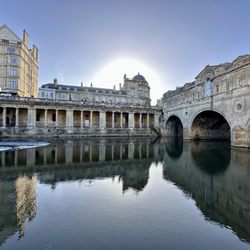
    Pulteney Weir - The Weir at its best: on a sunny day with low, good quality water.

    Pulteney Weir

    4.2(9 reviews)
    13.1 km

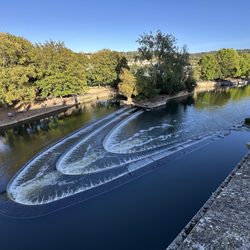
    If you're visiting Bath for the first time, this is where you get one of a whole list of photo…read moreopportunities, particularly if it's sunny and the seagulls aren't hungry for your sandwich. There are a few ways to see the Weir, one of which involves catching a boat to the apex of the horseshoe, another is along the embankment having navigated your way down the steps from Pulteney Bridge, and the other overlooking the Weir from the street above. All are different and wonderful in their own way. Speaking of boats, you can catch a boat from the embankment all the way to Bathampton Mill along the River Avon (about £8 return for adults), and if you don't fancy that, there's a couple of nearby pubs and restaurants. The Weir really is one of Bath's special places, except for when it's doing its job of protecting the city from floods. This is when the water is so high, the Weir itself is almost hidden. It becomes a muddy torrent of fast-flowing water and large, heavy debris. Here's hoping you get a nice day!

    I recommend treating the Pulteney Bridge and Weir the way you treat Tower Bridge in London: see it…read moreevery chance and in every way you can. Cross it in a cab, walk across it as a pedestrian, see it at day, see it at night, see it from both sides, see it by boat trip. And, unlike Tower Bridge, you've got that great water-wooshing effect of the stair-step waterfalls. I only wish there was a small visitor center/view from the inside open to the public!

    Photos
    Pulteney Weir - Top: The Weir and bridge in 1983 Bottom: 2017

    Top: The Weir and bridge in 1983 Bottom: 2017

    Pulteney Weir
    Pulteney Weir

    See all

    The Roman Baths - Part of the Roman bath

    The Roman Baths

    4.4(248 reviews)
    13.2 km

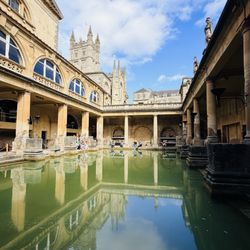
    So, when I knew I was planning a trip to London, I knew I had to schedule a tour to this location…read more The Roman Baths are located in the city of Bath. A beautiful city with so many breathtaking views. The site is located in the middle of the city surrounded by stores, restaurants, and other must see locations. I highly recommend booking this tour because you can learn so much and will learn about the Roman history of the baths. There is a self-guided tour that you can go as you wish. There is so much to see and so much information along the walls. Make sure to bring comfortable shoes since the ground can get a bit uneven throughout the tour and make sure you see the beautiful baths throughout the tour. Such an impressive experience and if you are in London, I recommend taking a day trip or two to visit. You will be mesmerized and taken back in time.

    We came here as part of a tour and are glad we did. I didn't know much about the Roman Baths…read morebeforehand, but now I do. It is set in the middle of a quaint town named Bath. We had pre-bought tickets for a specific entry time, but there were tickets available at the door as well. I wouldn't chance it though. The line was short to get in at our time and the audio guide is included as part of the admission price. made the tour interesting and the facts provided were the perfect amount of detail. There was a kid's version too which was great! We were there a little over an hour and at the end you can taste some of the bath water, which was disgusting!!
    Photos
    The Roman Baths - Outside entrance

    Outside entrance

    The Roman Baths - Roman baths of Bath

    Roman baths of Bath

    The Roman Baths - Ticket

    See all

    Ticket

    Corsham Court - landmarks - Updated May 2026

    Loading...
    Loading...
    Loading...