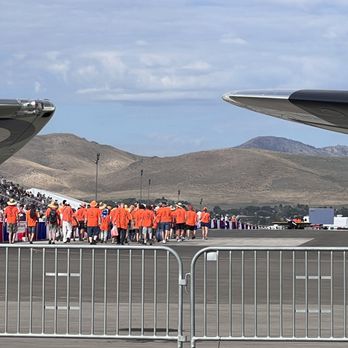
The Reno-Stead Airport is another of our favorite and premier local places to regularly visit. The Planes. The events. The facilities. The Aviation Enthusiasts. The history. The Biggest Little Air Attack Tanker Base. The museum. We make these treks of homage to those who Serve and who have Served because it means that those who wear the U.S. Armed Forces uniform or did wear the uniform were and are remembered
The Reno-Stead Airport is a 5,000 or so acre lead general aviation facility owned and operated by the Reno-Tahoe Airport Authority. It began in response to the deadly attack against the United States Naval Base Pearl Harbor in Hawaii Territory, on December 7, 1941. In 1942, the U.S. Army Air Corps started construction of the now clearly strategically located Reno Army Airport and Air Base.
In 1951, the air base was renamed Stead Army Air Base to honor Nevada Native Lt. Croston Stead of the Nevada Air National Guard, who dies at age 27 on December 11, 1949, while training in a mock dog fight in a North American Aviation P-51 Mustang. The P-51 Mustang is an elegant American long-range, single-seat fighter and fighter-bomber used during World War II and the Korean War, among other conflicts.
July 15, 1958, the 3635th Crew Training Wing was redesignated as the 3635th Flying Training Wing (Advanced), concurrent with the relocation of the USAF Helicopter Pilot School to Stead.
The airbase served as the U.S. Air Force Strategic Air Command's Survival School, Flying Training Wing and Reno Air Defense Sector, a training center for some 80,000 U.S. Army, Navy, Marine, Air Force, and foreign officers, as well as most of the pre-1965 NASA astronauts. The military officers attended classroom instruction on basic survival, evasion and escape. Their field training was to learn to survive with instructors simulating enemy trying to capture the students. The Survival classroom and field training lasted 15-21 days.
In the 1960's inventor and promoter Bill Lear, founder of Lear Aviation and the Lear Jet, established operations at Stead which continued until the end of his life in 1978.
In 1963, the U.S. Congress scheduled the base to close, along with 25 other military bases throughout the country. In 1966, the base was transferred to civilian ownership, and in June of 1966, it began operating as Reno-Stead Airport.
In 1967, Maj. Robert E. Schricker, Purple Heart and Air Medal recipient, retired from a 27 year career as a USAF fighter pilot and became Chief Pilot for the AG Academy, now moved to Stead. Actress and air race pilot Susan Oliver, got her multi engine pilot license there in 1968. Susan Oliver played the female lead character Vina in "The Cage" (1964), which was the first pilot of Gene Roddenberry's then new show, Star Trek. The FAA Registry shows her to have earned commercial pilot ratings for airplane single engine land, airplane multiengine land, instrument airplane, and private privileges for glider.
Here was the launch site of "Earthwinds" meteorological balloon system in the early 1990s, which attempted and failed multiple times to circumnavigate the globe.
Since 1966, Reno-Stead Airport has been home to military operations including but not limited to Army Aviation Support Facility, and the 189th General Support Aviation Battalion of the Nevada Army National Guard, flying CH-47 Chinook helicopters. It is the birthplace of the Lear Fan, and home to the National Championship Air Races. It is home to several hundred tenants. It is home to U.S. Bureau of Land Management's Stead Air Attack Base aka Biggest Little Tanker Base aka Biggest Little Air Attack Tanker Base, that provides the required air support during regional wildfires. With Global Warming creating significant Climate Change, the importance and value of the Biggest Little Air Attack Tanker Base increases each year.
On December 16, 2013, the new Reno-Stead Airport Terminal Building, The Freedom Flight Terminal which is dedicated to America's Veterans who Serve or have Served in the U.S. Armed Forces, opened to serve the General Aviation community. The two-story, 12,000 sq ft building provides an Emergency Operations Center, Administrative Office, Community Conference Room, a Pilot's Lounge, and a museum.
The museum, named "Reno-Stead: A Proud History," has some 65 pieces of memorabilia and hundreds of photographs, collected from Service Members and their families. A video also depicts the training that took place at the survival school and pays tribute to the some 80,000 men and women who trained here.
The museum is open to the public Monday through Friday from 8 a.m. until 4 p.m. It is free of charge. read more