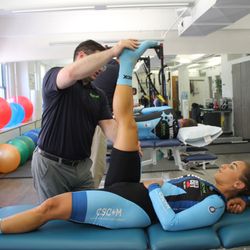
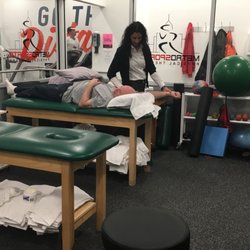
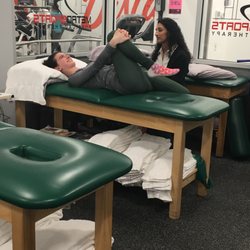
My endocrinologist told me that all of her patients love Megan, so I had high expectations, even…read morebefore our first session. I wasn't disappointed. I came to her in an attempt to cure my osteoporosis without hormones or bisphosphonates. My internist had been skeptical about exercise as a workable cure, but for several reasons, I didn't want to be on medication.* Too much medication had gotten me into this predicament in the first place. I had been on high doses of steroids for asthma as an adolescent and even higher doses of thyroid hormone (unnecessarily) for seven years, into my mid to late twenties.
The first PT I had seen following problems with a meniscus tear started me on a routine of exercises and stretches to strengthen the muscles around my knee and to ease a pulled hamstring muscle from a former attempt to fix the knee myself. I needed to be as mobile as possible to maintain and improve the density of my bones, so I assiduously followed the routine this first PT laid out for me. Indeed, the meniscus began to improve but the results of my bone density test were mixed and not very encouraging. While my hipbone density appeared to have improved, the density of my spine had worsened and was becoming dangerously low, and my forearms had appreciably worsened as well.
Megan carefully analyzed the exercise program I had been given, maintaining most of the former meniscus exercises with some minor adjustments, and went to work developing an exercise plan that we hoped would address the low bone density. She was careful to work with me on improving the alignment of my spine when doing all exercises, as that would help to develop stronger vertebrae as well as prevent spinal injury from the weakened bones.
Because of my age (approaching 70, now), several previous injuries, and some mild body deformities, Megan had to work around a lot of problems. Her thorough knowledge of anatomy proved truly inspiring, as we devised creative solutions to various abnormalities that enabled me to stress the bones that needed to be stressed in order to build bone without causing injury or pain. We developed a wonderful working relationship whereby I emailed her whenever necessary to report on problem areas or pain or if I was confused about how to do an exercise or how often. Each actual session was built around what I needed at the time to continue my progress. She used my iPhone to take pictures of me doing certain exercises so I would have them as a guide.
Balance is crucial to preventing falls, and since this takes on even greater importance when one has weak bones, Megan and I spent a fair amount of time on various exercises to improve my balance. The extent of her anatomical knowledge reached to the tips of my toes, as I worked on ways of strengthening my feet (despite bunions, a very high arch, and a hammertoe), resulting in far better balance than I previously had. She provided me with strengthening exercises to compensate for a once-splintered shoulder, allowing me to strengthen my arms more than had been possible before.
From my following bone density test, we were pleased to see further improvement in my hips and at last an end to the downward spiraling of my spinal bone density; it appeared to have stabilized. But the forearms still presented a problem, so Megan had me buy a set of pushup bars to work on the forearms more aggressively. This new equipment enabled me to compensate for a tendency toward wrist and elbow pain following rigorous workouts.
Through all of these trials, Megan remained upbeat and willing to challenge me where possible, for growth, but always wary of my doing more than I should, which seems to be my natural tendency. I learned a lot about balancing workouts and rest from her, and listening to my body's signals. Had it not been for her continuing interest, I would very likely have given up.
*I am quite hard of hearing, and it is not entirely known if or how severely many of the hormone fixes used for strengthening bones can have ill effects on women's hearing.