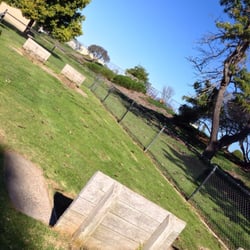
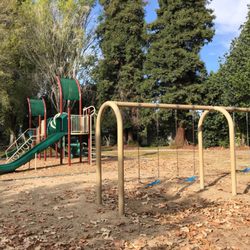
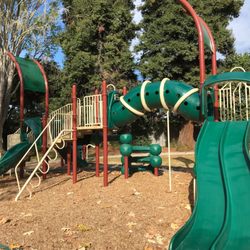
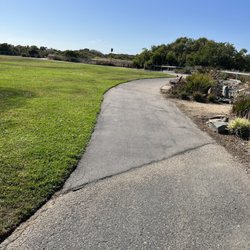
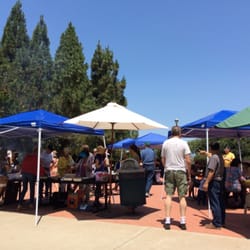
BEWARE of a multitude of STINGING NETTLE-like toxic plants, minus warning signs, in the "hidden"…read moreChumash Historic area by AG creek.
[Result: Horrid pain in my hands! OMG!!!]
The park would have been an easy 3-4 star, but had to downgraded to 2 star, since there are
NO WARNING SIGNS,
while other parks [Chumash Park in Pismo] have ample signs to warn of these dangers. While adults can be careful, kids and dogs, would likely not realize the danger of the tri-leafed needled branches over-hanging a tempting scenic path to the serene babbling brook.
In this little visited back area of this "pleasant park", it was amazingly peaceful, relaxing, serene, verdant & pleasant, until I foolishly decided to check out the Arroyo Grande Creek, for signs of aquatic life. I hoped to get a bottle of creek water & mud to explore for Protozoa, Rotifiers, Nematodes, etc., with my "new" lab grade vintage Microscope.
The short path to the creek was covered with some leaves.
Whoops!!
While in the process of falling, in front of my eyes, there appeared to be a rather large branch to grab. It also appeared to be "hairy"& my brain made a rapid calculation of the risks vs. benefits of such a grab. My brain miscalculated, since it was too fast for my higher cognitive functions to properly evaluate.
Should I risk grabbing a solid looking branch that looked suspiciously "hairy", but may break my fall? It did not slow my fall, since it was a vine that moved freely. I immediately regretted grabbing it since I could feel 100's of tiny needles puncture my fingers & hands. As I scampered up, I had immediate severe searing pain.
I immediately called for my wife's help and even thought of going to the ER. We walked over to a bench, where we tried to pick off many dozens of these super-fine hair-like broken off needles [which I later found out to be called Trichomes per Wikipedia { https://en.wikipedia.org/wiki/Trichome }]. While this likely helped limit the severity, the pain became more intense, as the toxins injected themselves.
Even with hours of Internet searching on the amazing plethora of various toxic or needle plants, complete with both my pics and internet pics, I am still not sure what this plant was.
Trichomes are amazingly intricate plant defenses that reappear in diverse species all over the world. They function as micro-hypodermic needles that are designed by evolution to discourage foraging by animals or humans, and are highly effective, since no creature will ever forget an encounter.
The Trichomes are complex systems & the needles are reinforced with glass or bone-like substances. The are not only designed to penetrate the skin, but are also designed to inject various toxins, while breaking off too!
The real problem is there is a wide range of either known or poorly classified toxins/irritants in the fluid [in nano-liters], which not only immediately evoke severe pain, but persist for hours to even months! The fluid can include a range of substances that can include acids, Neurotoxins, & even anti-Cancer compounds!
Treatment is perplexing, even after a consult with a pharmacist. She recommended a topical anti-histamine & steroid. Neither helped much. Other sources recommend washing, assuming a topical exposure to the irritant [e.g. Urushiol] like those in Poison Ivy/Oak/Sumac, which is not the case with Trichome injuries, which are injected/embedded toxins.
As a kid, I did have one painful unforgettable run-in with a Stinging Nettle type plant on my cousin's farm in Leighton, PA. In those days, there was no Urgent Care!
Anyway, after tons of pain, steroid, & antihistmine Rx, the situation improved. There was no visible rash, but various pains, itching, & even neuropathy lasted a few days!
In any case, BEWARE of the many plants of that line this Creek's bank.
Nettles have been used throughout history ranging from food to medicine. Some compounds are effective against some cancers!
Ref.: https://wildflowerfinder.org.uk/Flowers/N/Nettle(Stinging)/Nettle(Stinging).htm : "...It is claimed by some texts that the bicyclic octapeptide moroidin is also found in nettle stings, and that it is this compound that is responsible for most of the pain and redness of nettle rash. It was first discovered in the trichomes of Laportea moroides (hence the name), otherwise known as the Gympie Bush, with which contact is a far more terrifying ordeal than is Stinging Nettle, for the painful rash can last for months, or even forever, and there is no cure. Moroidin has anti-mitotic activity because it strongly inhibits the polymerization of tubulin, meaning it interferes with cell division."