East Bay Koi Photos


You might also consider


More like East Bay Koi
Recommended Reviews - East Bay Koi
Start your review...


Reviews With Photos

Their website states that they are open 7 days a week and so we did not think to call on a Monday afternoon at 3 pm. We drove 3 hrs to get here to see their new inventory they received and was excited to see what they had but when we got here the gate was locked. Their place is in a neighborhood in a sketchy part of town in the middle of residential homes. I'm not sure is this is their resident and they're just selling from their backyard as they wouldn't allow us in. It was gated and locked and there's a door bell for you to ring. A lady came out and told us we couldn't go in. She continued to point to the sign as she didn't speak much English and walked away. So we called and spoke to someone who also said they were closed and that we couldn't see the kois. Told him that's not what it says on their website and that we drove a long way to get here but he just told us no. Wouldn't recommend and will not make the drive out anymore.
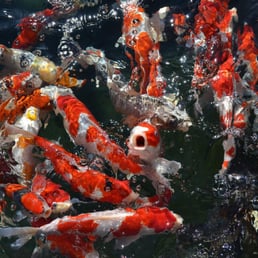

I just wanted to say there's something about fish that you shouldn't eat that makes my mouth water, lol. I was there for their grand opening and it was mouth-watering dropping gorgeous fish everywhere! I honestly don't like pets but if I were to get pet(s), they would be fish as I don't have to walk them (they swim), bathe them (they swim) or have bags around to pick up their poop 2-3 times a day or worse if they get the runs (their droppings are in the aquarium). Fish are great pets and as a meal. I mean other pets are only accepted meals outside developed countries. So I stick with fish or fish on a a stick! Sadly, the workers there were nice enough to give me a little lesson about Koi fish. They told me that I shouldn't eat Koi fish because they are like other bottom-feeding carps. I beg to differ as I love me bottom-feeding catfish! We shall agree to disagree on what I can and cannot eat. We can agree that the place is ultra-cool even just to go and look at the huge ass Koi Fish!


I've visited several koi fish stores all over the Bay Area and this is by far my favorite! I love visiting this place on the weekends after a long work week. The owners Andy & Tony are very friendly and knowledgeable. They actually took their time to explain how to pick and choose affordable, quality koi fish. Highly recommend visiting this place even if you aren't a koi pond owner!


3 years ago
This place is the real deal. Range of koi both in type and price, with tons of lilies to choose from too. Cool spot to visit. read more



2 years ago
Business owner information

Tony L.
Thank you so much Janine! Glad to hear that your koi fish are…
3 years ago
Their website states that they are open 7 days a week and so we did not think to call on a Monday afternoon at 3 pm. We drove 3 hrs to get here to see their new inventory they received and was excited to see what they had but when we got here the gate was locked. Their place is in a neighborhood in a sketchy part of town in the middle of residential homes. I'm not sure is this is their resident and they're just selling from their backyard as they wouldn't allow us in. It was gated and locked and there's a door bell for you to ring. A lady came out and told us we couldn't go in. She continued to point to the sign as she didn't speak much English and walked away. So we called and spoke to someone who also said they were closed and that we couldn't see the kois. Told him that's not what it says on their website and that we drove a long way to get here but he just told us no. Wouldn't recommend and will not make the drive out anymore. read more

Business owner information
Tony L.
Hello there! I’m so sorry for your experience coming out to our koi…


4 years ago

I just wanted to say there's something about fish that you shouldn't eat that makes my mouth water, lol. I was there for their grand opening and it was mouth-watering dropping gorgeous fish everywhere! I honestly don't like pets but if I were to get pet(s), they would be fish as I don't have to walk them (they swim), bathe them (they swim) or have bags around to pick up their poop 2-3 times a day or worse if they get the runs (their droppings are in the aquarium). Fish are great pets and as a meal. I mean other pets are only accepted meals outside developed countries. So I stick with fish or fish on a a stick! Sadly, the workers there were nice enough to give me a little lesson about Koi fish. They told me that I shouldn't eat Koi fish because they are like other bottom-feeding carps. I beg to differ as I love me bottom-feeding catfish! We shall agree to disagree on what I can and cannot eat. We can agree that the place is ultra-cool even just to go and look at the huge ass Koi Fish! read more


12 years ago
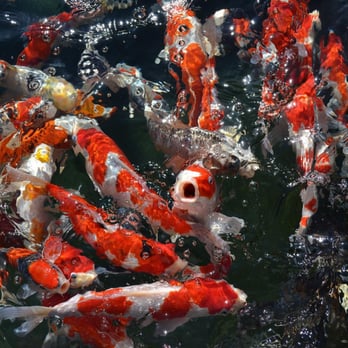
I've visited several koi fish stores all over the Bay Area and this is by far my favorite! I love visiting this place on the weekends after a long work week. The owners Andy & Tony are very friendly and knowledgeable. They actually took their time to explain how to pick and choose affordable, quality koi fish. Highly recommend visiting this place even if you aren't a koi pond owner! read more

5 years ago
Let me start out with the good: We had a great experience at the store! When doing my research on reputable koi stores. I really appreciated that they quarantined their fish from Japan and make sure they are disease-free before selling. For this reason, we drove a little under 2 hours to pay them a visit. When we arrived there, Kelvin was there. He was ready to help, but not intrusive or hovering at all. When we visited most of the young koi were all $85, with one small section that was $75, the one's in the main tub were over $100. We were able to take our time picking out our koi. When we express interest he patiently caught the koi fish we liked and allowed us to observe them close up in a blue tub. There was no pressure to buy at all, we had a great time. We went home with two beautiful koi and a bag of Hikari gold food. The unfortunate: Our koi lost most of its orange color within a week (photo attached). While we were picking out our Koi, we asked Kelvin if the koi would change color or pattern. He told us the pattern would stay the same as they grew, and the color would just enhance, especially the black. He said the gray parts would definitely get more black and he pointed over to the bigger koi for us to observe. This was very important to me because as a young girl, we had a koi pond, but we always bought cheap $15 koi from pet stores, and they would always lose their color. So now as an adult, I wanted to invest in nicer koi that would not lose their color. We went home with two $85 koi that day. $85 is quite a jump from $15, so needless to say, I was alarmed when my Koi lost color. Especially when I was reassured they wouldn't. I instantly tested our water (PH 8, ammonia 0ppm, nitrite 0ppm, nitrate 0ppm) Nothing seemed wrong with our water, everything was within healthy parameters. So I contacted East Bay Koi through their website. The website asks you to leave your phone number in which they follow up with a text. Tony responded to me fairly quickly and sent me a link about color loss and said possibly my PH was on the high side and that he recommended us to use PH down (a name of a liquid used to reduce the ph) We were hesitant to change the PH, as so many websites say it can shock the fish, but we did as he recommended, and slowly dosed ph down. Unfortunately, after a week, our koi lost even more color and his orange is reduced to a small pale dot on his head. At this point, I contacted East Bay Koi again, letting them know that decreasing the PH didn't work and that I was very disappointed and felt tricked. This time, someone else responded (I'm not sure who) and said: "East Bay Koi: Sorry. I see your fish loose colors ,but I see your pond have a lot the rocks to keep all the ammonia, not let the filter to clean ,your pond water can not be Heath ,when fish get bigger more ammonia ,they are not only loosing colors ,will sick and die ,you set up the pond is the pablum not the fish !" I can tell English was probably not their first language.. but the message was clear: "not my problem" Needless to say, I was a bit taken aback. He didn't ask us about the specs of our pond, he didn't ask anything he just flat out told us our pond was the problem because it had rocks and not his fish. On top of that, our pond tested 0ppm for Ammonia. I instantly responded with our pond specs: Our pond is an ecological Pond, filled with plants- it has a large 8'x8'x5 up-flow wetland filtration and a 6'x6'x4 mechanical filtration intake bay. We invested in the best. Bacteria is auto-dosed regularly. The water goes down through the rocks intake bay and is pumped around 30 feet-- and then up 5 feet of the wetland filtration before it goes down the 30 feet of stream of 4 waterfalls and down another water waterfall into the pond again. Basically, it's a HUGE filtration system. Again having a pond as a young girl, I didn't want to make the same pond mistakes. So we invested in a massive filtration system. But according to them if you have any rocks on the bottom of your pond irregardless of your filtration-- your fish will die from ammonia poisoning. After doing a ton of reading and research on my own. I learned that its Tosai (young koi) often change color and it's not unusual for them to lose color, even those with great genetics. And for this reason, sometimes it is better to invest in older Koi when their color is more stable. SO BE AWARE that the young koi you pick may not retain its color! I was not well informed and just believed Kelvin. I don't want to return my Koi, that's not my intention. It's my precious fish now, no matter what color it ends up. But I do want this shop to be honest with its customers. Koi are often chosen based on appearance. This is the main deciding factor. If a koi can lose or change its color, tell the truth. In conclusion: I feel like I was flat out lied to and then when I inquired about it I felt like I was basically told "it's not my problem" read more


Business owner information
Tony L.
Hello Michelle - thank you for visiting us! We do appreciate you…

6 years ago
Business owner information
Tony L.
Hi Tree - we're sorry to hear about your goldfish. We have dozens of…


6 years ago
Business owner information
Tony L.
Thank you for your feedback and support, Emilio! Come visit us again…


13 years ago

14 years ago


10 years ago

10 years ago

8 years ago

8 years ago

8 years ago

8 years ago
12 years ago
Oh man, forget about regular pet stores if you are looking for good looking Koi. I didn't even expect the varieties these guys have. I really love those golden ones they imported from Japan. Definitely need to see them in person to believe! read more


13 years ago

14 years ago

11 years ago
7 years ago

12 years ago

12 years ago

11 years ago
7 years ago

10 years ago
8 years ago

10 years ago
9 years ago
12 years ago

14 years ago
13 years ago
Page 1 of 2