Cancel

    Open app

    Search

    Archbald Pothole State Park

    3.0 (3 reviews)

    Archbald Pothole State Park Photos

    Recommended Reviews - Archbald Pothole State Park

    Your trust is our priority, so businesses can't pay to alter or remove their reviews. Learn more about reviews.
    Yelp app icon
    Browse more easily on the app
    Review Feed Illustration
    Photo of Jeff W.
    213
    679
    2806

    5 years ago

    Helpful 6
    Thanks 0
    Love this 4
    Oh no 1

    6 years ago

    Helpful 0
    Thanks 0
    Love this 0
    Oh no 0

    9 years ago

    Helpful 4
    Thanks 0
    Love this 4
    Oh no 0

    Verify this business for free

    People searched for Parks 447 times last month within 15 miles of this business.

    Verify this business

    Nay Aug Park

    Nay Aug Park

    4.1
    (44 reviews)
    8.8 mi

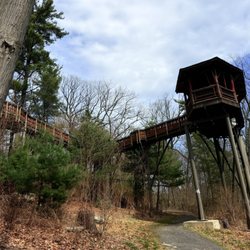
    We originally came to Nay Aug Park because we wanted to visit the Everhart Museum, and we did, but…read morewe had no idea that this park had so much to explore! We ended up walking our dog over to the tree house overlook and the views of the gorge and the water below were genuinely breathtaking. Along the way, we made time to check out Brooks Coal Mine which is an interesting piece of history. It's a small, shallow mind that was built more than 100 years ago and I love that there is a memorial there to all the coal miners who have lost their lives working in the mine. We walked through shaded paths and green spaces taking in the scenery and just really enjoying the vibes here. There were lots of trees and greenspace with quiet benches and so many things to look at. We actually got really excited when we spotted a bug that we had never seen before. I added a photo below and maybe I sound like a crazy person but I'm not from this area. I learned afterwards that it was a spotted lantern fly. Apparently that's not a great thing for the ecosystem and they're kind of a n invasive pest, but you learn something new everyday right? I honestly wish we had planned for more time at the park itself, but we did stay for about an hour and really enjoyed our walk and the fact that our dog was having such a lovely time here. I still feel like there was more for us to see. Parking was easy and entry was free. If you are in the area and just want to stretch your legs or take in the beautiful nature, this is definitely a place to check out.

    I grew up in the Scranton area, but somehow never went hiking at Nay Aug until last year when my…read morewife and I were back in the area visiting family. The trails are quite nice and it's always nice to walk to some waterfalls, particularly when it's hot out. There's a good amount of trails and there's plenty of parking all around the park. It's definitely one of the nicest things to do in Scranton and I'd definitely recommend it if you're in the area!

    Photos
    Found a squatch!
    Found a squatch!
    Nay Aug Park
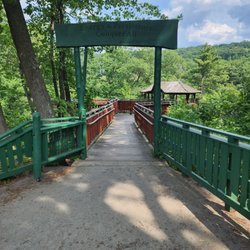
    Walkway to the tree house.

    See all

    Walkway to the tree house.
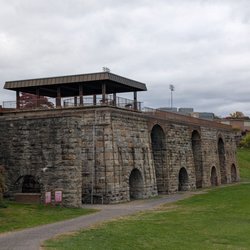
    Scranton Iron Furnaces.

    Scranton Iron Furnaces.

    4.0
    (2 reviews)
    9.0 mi

    We found the Scranton Iron Furnaces by chance as we were driving by to go to another location and…read moredecided to pull in. I'm so glad we did because the stop was educational and unique, even if it was really really cold on the particular day we chose to visit. The original reviewer, actually the only other reviewer at the time of me posting this, gave so much information and history about this location that I will try and keep it quick. There definitely is a lot to read and a lot to learn here. The furnaces are huge, not like anything I expected, and reading the plaques makes you think about how intense it must have been here back when this place was active. Is really interesting. It's also a large open space so it was dog friendly and our dog liked walking around and sniffing the paths. There was a nice grassy area down at the bottom for her to run around in as well. It was also helpful that we were the only people there, with the exception of a city cop who seemed to be sleeping in his car or hiding from the general public. It was definitely a unique place to visit and these furnaces are worth checking out if you're in Scranton, especially if you're a history buff, but between the open space and the stairs, it's also just a good place to wander and get some steps in.

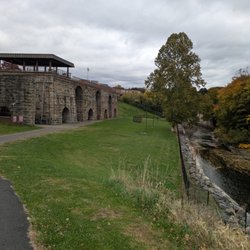
    The Scranton Iron Furnaces, aka the The Lackawanna Iron and Coal Company Furnaces, represent the…read more19th century iron industry in the United States at it's finest. The four massive stone blast furnaces are the remnants of a once extensive plant operated by the Lackawanna Iron & Steel Company. Started in 1840 as Scranton, Grant & Company, the firm began as a partnership between William Henry (he had already been experimenting in New Jersey will the concept of using a "hot-blast technique" to make steel), his son-in-law Seldon Scranton, George Scranton and Sanford Grant. Henry with help from the Scrantons and other investors bought 500+ acres of land in what was then called Slocum Hollow along the Roaring Brook and set up shop building their first blast furnace in 1841. Initially the operation hemorrhaged money and had numerous production issues that plagued the company for its first few years almost driving it to bankruptcy on several occasions. Eventually by 1844 more investors were brought in so that capital could be raised for upgrades and to take care of any lingering flaws in their production model. By the summer of 1844 the furnace averaged five to seven tons of pig iron a day, but the company soon went into the more profitable business of producing T-rails for the railroad industry as there were no facilities in America where rails were capable of being produced. Everything at that point had to be ordered and shipped from Europe. In 1851, the town of Slocum's Hollow changed its name to Scranton in honor of the majority owners of the iron works for their success. (Scranton had other names in between like Harrison in honor of Presidential candidate William Henry Harrison and Scrantonia but I'm just focusing on what stuck.) By 1865 the company had the largest iron production capacity in the United States and were the second largest independent steel making operation in America.. After a long and successful run the fortunes of the company began to change due to higher labor costs, multiple strikes, higher shipping costs, changing markets and more efficient steel making processes in Europe all of which caused the company to move the operation to the Buffalo area in at the beginning of the 20th century. (The operation in the Buffalo area lasted all the way thru several mergers until Bethlehem Steel shut it down in the 1980's.) In 1903 the Scranton property was sold to the Wyoming Valley Railroad, which contracted with a Philadelphia company that scrapped all of the equipment, and tore down all the structures except the stone blast furnaces that you still see today. From the Internet: "In the late 1960s the furnaces were acquired by the Commonwealth of Pennsylvania, and were administered under the State park system. The furnaces were transferred to the Pennsylvania Historical and Museum Commission in 1971. Today the four connected stone blast furnace stacks are surrounded by 3.84 acres. The furnaces are set into the south side of a hillside with a 10 foot wide bridge, supported by masonry arches connecting them to the rock cliff. The two easternmost furnaces, dated 1848-1849, are built of smooth dressed stone blocks and stand 40 feet high and are 40 feet wide at the base. No. 3 and No. 4 furnaces were constructed c.1852 and c.1857 respectively, and are constructed of rough dressed stone blocks and also stand 40 feet high. Furnace No. 3 is 46 feet wide at the base, and furnace No. 4 is 48 feet wide at the base. All of the furnace stacks still contain vestiges of their firebrick linings. The first, third and fourth stacks contain ruins of their 19th-century hearths." If you go today what you see quite honestly isn't a whole heck of a lot. The entrance to the furnace site has two small brown NPS style signs that lead you up a narrow driveway to the parking area which has space for maybe 15-20 cars. You've got what's left of the four blast furnace stacks, an example of a T-rail along the walkway the leads from the parking lot to the upper viewing platform and an acre or two of grassy park land that sits along Roaring Brook. Worth mentioning is that there are plenty of displays at the site explaining what you're looking at but if you need more your best bet would be to head over to the Anthracite Heritage Museum which is about four miles away over in McDade Park on the other side of town. If you go: The site itself is free and open to the public daily from sunrise until sunset. There are no amenities on site although you are very close to all the fun (LOL!) that downtown Scranton has to offer including the foamtastic fun over at Steamtown. There are a few special events that occur on the grounds annually. Most notably would be the Scranton Bonfire Festival which happens every year in October.

    Photos
    Scranton Iron Furnaces.
    Scranton Iron Furnaces.
    Scranton Iron Furnaces.

    See all

    Archbald Pothole State Park - parks - Updated July 2026

    Loading...
    Loading...
    Loading...