Cancel

    Open app

    Search

    St Michael

    5.0 (1 review)

    St Michael Photos

    Recommended Reviews - St Michael

    Your trust is our priority, so businesses can't pay to alter or remove their reviews. Learn more about reviews.
    Yelp app icon
    Browse more easily on the app
    Review Feed Illustration
    Photo of David J.
    96
    2344
    11912

    17 years ago

    Helpful 0
    Thanks 0
    Love this 0
    Oh no 0

    Verify this business for free

    Get access to customer & competitor insights.

    Verify this business

    Parish Church

    Parish Church

    5.0(1 review)
    0.8 mi

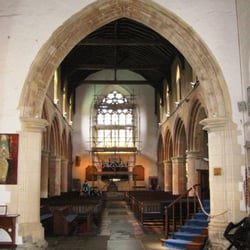
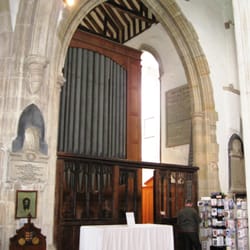
    St Mary's stands at the very heart of Rye, atop the hill in the centre of the town and surrounded…read moreby the quaint streets and ancient houses for which this Cinque Port is known. History Although a church was almost certainly present before the Norman conquest in 1066, the present building dates from the early 12th century, where the transepts survive from a cruciform church probably similar in size to the present structure. The nave arcades were replaced early in the 13th century, and the aisles are from around the same period or slightly later. The 13th century provided the chapels either side of the chancel, the north (Clare Chapel) being slightly earlier from around 1220. The 14th century provided porches to both aisles, as well as additional buttressing. A new south porch was added in the 15th century, the south and part of the north chancel arcades were renewed, and the present crossing and tower inserted. The main 16th century addition was the tower clock - inserted in 1561-2, it is one of the oldest still functioning in situ. The town's turbulent history in the front line of the mediaeval wars with France is reflected in the church: during a raid in 1377, both town and church were burned (the nave walls still bear the scorch marks), the church roof collapsed and the French carried off the bells. These were later recovered from France by a reprisal raid, by the townsmen of Rye and nearby Winchelsea in 1378. Less happily, the authorities felt that the town had put up insufficient resistance to the French raiders and some of the leading townspeople who survived the attack were hanged and quartered as traitors. The church The church's location is almost perfect: accessed by narrow cobbled streets, its tree-filled churchyard is lined with old houses, many timber-framed. However, the intimate setting means it is hard to appreciated the scale of the church until you enter. Before doing so, it is worth a walk around the outside to see the impressive buttressing added over the years, particularly around the chancel. Inside, the north walls of the transepts are the best place to look for the earliest elements, with Norman blank arcades on corbels of grotesque heads, and others with crenellation and chevron decoration. The original 12th century Norman arches lead into the nave arcades. The nave itself is impressive, with five bays of barely pointed arches on round and octagonal piers, but most of the windows are Victorian replacements. The chancel's 15th century rebuilding also makes it an impressive space, leading to the original 15th century east window. To the north, the Clare Chapel has classic Early English Gothic lancets, although the east window is Victorian. On the south side, the chapel is now the choir vestry: it has paired lancets, shafted inside and each topped with an oculus window. The church has generous fixtures and fittings. The screens into the Chancel Chapels are late 14th century and Perpendicular in style. In the Clare Chapel is a late mediaeval brass, and the pulpit has 16th century panels. The clock has a pendulum, replaced in 1810, which swings down into the crossing. There are many memorials from the 18th and 19th centuries. Notable stained glass includes aisle windows by both Kempe and Morris, and windows donated by the novelist and former Mayor, E F Benson, in the south transept and the western wall of the nave. Finally, if you want really excellent views over the town and its surroundings, for a few pounds you can climb the church tower. Practicalities The church is a busy place - the most visited, apparently, in Chichester Diocese after the Cathedral itself. There is a small shop in the south transept selling cards, books and gift items. Car parking around the church is severely limited (as it is in the old town generally) but it is only a short distance - albeit steeply uphill - from the various car parks dotted around the centre.

    Photos
    Parish Church
    Parish Church
    Parish Church

    See all

    St Augustine's Church

    St Augustine's Church

    5.0(1 review)
    5.1 mi

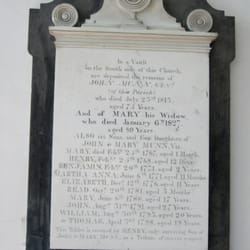
    Photos added 24-07-2007…read more *************************** Set in the flat and bleak landscape of Romney Marsh, Brookland church looks weirdly out of place. The distinctive belfry, with its three conical tiers of wooden shingles, might look more at home in the Balkans than in the Garden of England. According to legend, the belfry was originally located on the roof, but leapt from the church in surprise when an aged batchelor married an equally elderly spinster. The adjacent church is a little more orthodox, although still interesting. The porch, with its wooden half-gates is charmingly rustic, and adjacent is a narrow, low tower with a clock. Dating from around 1250, the gothic nave is wide and spacious, and it has equally generous aisles. The scarily odd angles of the walls and arcade arches betray serious signs of subsidence, all adding to the charm (and betraying the real reason for not building the belfry on the church roof). It still retains its original box pews, some pretty 14th-century stained-glass windows, and a well preserved pre-reformation wall painting of the murder of Thomas a Becket. The most notable furnishing is a Norman font, made of lead: reputedly stolen by a local raiding party from a church in France, it features the signs of the zodiac and pictures of rural life. Close by are other artifacts of rural life, including a set of weights and measures, an unusual portable porch (supposedly intended to keep the priest dry at funerals), and the clock mechanism, set at ground level for all to see. But most poignant for me is the memorial erected to John and Mary Munn and ten of their children, all of whom predeceased them. It was erected by the only survivor, Henry. You can almost feel his plight.

    Photos
    St Augustine's Church
    St Augustine's Church
    St Augustine's Church

    See all

    Fazal Mosque - Fazal mosque also know as the London Mosque

    Fazal Mosque

    5.0(2 reviews)
    52.9 miWimbledon

    The first purpose built mosque in the UK. It is also considered as a must see for tourists in…read morelondon due to its historical significance. It was from this mosque that Muhammad Ali Jinnah (Qaid-e Azam) gave his speech stating that he would return to politics and to India (from where he retired due to on going difficulties) in order to continue his campaign for an independent state. He was successful in this campaign and Pakistan was formed in 1947. There are many other famous people who have visited this mosque. Upon requst all the old photos of the above events can be seen as well as a photo of what the mosque and surrounding area was like around the 1920s. A famous prophecy is also linked to this mosque; During the time of the world war God revealed to some of the worshippers of the mosque that anybody within the confines of this mosque would be safe from danger. This prophecy was put to the test when a bomb landed at the site failing to detonate and without causing any damage. Visitors who intend to visit the mosque should be aware that due to the significance and history of the mosque there is tight security and checks are carried out on every visitor without fail. Please take proof of ID and carry minimal things as bags need to be left at security. It is also recommend that once in the mosque it is a good idea to make a prayer as it is common that the majority of the prayers are accepted here. The mosque is open to all and you will find many of the worshippers are extremely friendly and do not mind being stopped to answer any question or have a general chit-chat. Do not be suprised if somebody offers to take you home for a cup of tea or snacks! May God bless you all!
    This is my favourite mosque in London. This is the blessed mosque and has really historic life.read more

    The oldest synagogue in England

    The oldest synagogue in England

    5.0(2 reviews)
    52.0 miAldgate

    There's not much to add to Templar's comprehensive review: still regarded by many as one of the…read moremost important centres in the Anglo-Jewish community, the Bevis Marks Synagogue is beautifully maintained. It is strongly reminiscent of the Wren and Hawksmoor churches of the City in its classical architecture and furnishings, which include impressive brass candelabra and 17th century wooden benches. The Synagogue's tradition is Orthodox, so men and women are separated: men on the ground floor, women in the galleries. Their opening hours (for visits) are slightly longer than advertised on their website, so it's worth contacting them ahead of a trip to London if you want to pay a call. Tourists (as opposed to those attending services) are asked to pay £3 for entry, and men are asked to wear a skull cap - one will be provided if you don't have one. Your bags may also be searched. They sell a small range of postcards and books at the entrance.
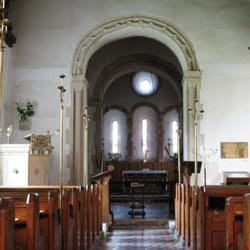
    Situated in a secluded courtyard, the Bevis Marks Synagogue was opened in 1701 to serve the Spanish…read more& Portuguese Jewish Congregation. Today it is one of the best-preserved houses of worship of its period still in regular use. The Inquisition, revived by Ferdinand and Isabella, turned its attention to these crypto-Jews, and from the last years of the fifteenth century, they: were systematically persecuted, arrested, tortured, tried, and burnt at the stake. From about this time there was a constant exodus of 'Marranos' who succeeded in escaping from Spain and Portugal or its dependencies to avoid persecution and a small number of them reached Protestant England. Outwardly, they were obliged to behave as Christians, for at that time Jews were not allowed officially, to enter the country, but at any rate they could live there, provided that they behaved with circumspection, and could meet in secret in each others' houses for prayer. The first Jewish house of worship of the resettlement of the Jews in England was as opened in 1656 in the upper floor of a house in Creechurch Lane, which is but a stone's throw from the present Synagogue in Bevis Marks The site of this house is today marked by a plaque, on the rear corner of Cunard House in Creechurch Lane. Jews were permitted to return to Britain in 1657 under Oliver Cromwell. They felt that the time was opportune to present a petition in the form of a humble address to Oliver Cromwell asking for the official re?admittance of the Jews to England Their decision was no doubt a wise one, as Cromwell, reared in a Puritanical atmosphere with its emphasis on the Old Testament was likely to hear favourably any petition presented by the 'people of the Old Testament'. Some of the most eminent figures of Anglo-Jewry sat at prayer in the Synagogue such as Sir Moses Montefiore. Disraeli was born into the Congregation and there are links to the Rothschilds. Today it is regarded as the most distinguished British Synagogue. The magnificent wooden Ark or cupboard) resembling a reredos, at the east end, is built in classical architecture in the manner of Sir Christopher Wren's time. It contains (as is the custom in Jewish synagogues') the sacred scrolls of' the Pentateuch, or five books of Moses, written in Hebrew on parchment, which are read in consecutive instalment over the period of a year as the central feature of the Sabbath Service. Several splendid seventeenth century vestments and silver ornaments belonging to the scrolls survive. The entablature of the Ark has as its central feature the Ten Commandments written in Hebrew (abbreviated), above which are inscribed in Hebrew the words 'Know before Whom thou standest'. The silver hanging Sanctuary Lamp, burning perpetually before the Ark, was presented by Edward Foligno in 1876 and evidently replaces an earlier example, now lost. Except for the addition of the doors to the Banca or Wardens' pews and to the Haham's or Chief Rabbi's seat in 1787, and of the choirstalls in about 1830, the ancient synagogue has remained virtually unchanged. Electric light was installed in 1929 Even though recently restored, the interior has barely changed since it was built. It is in the style of many Nonconformist chapels of the period. The influence of Sir Christopher wren is also evident. The Synagogue has one of the finest collections of Cromwellian and Queen Anne furniture in the country and the magnificent brass candelabra with glowing candlelight. On 19th December 1951 the Congregation held a Service to celebrate the 250th anniversary, of the opening of the Synagogue which was attended by the Duke of Edinburgh. On 22nd March 1956 British Jewry held a Service of dedication and thanksgiving at the Synagogue on the tercentenary of the resettlement of the Jews in the British Isles. Twelve pillars, symbolising the tribes of Israel, support the ladies' gallery, the reading desk and Echal are flanked by 10 candlesticks representing the Ten Commandments; and the interior is dominated by seven magnificent candelabra, corresponding to the days of the week. One of the great oak beams supporting the roof is said to have been presented by Princess (later Queen) Anne. In 1992 and 1993 the synagogue suffered great damage from terrorist bomb attacks on the City of London. Nearly £200,000, raised by donation, has since been spent in repairing and renovating the structure

    Photos
    The oldest synagogue in England

    See all

    Church of St Mary the Virgin, Kemptown - St Mary Brighton - nave from baptistery

    Church of St Mary the Virgin, Kemptown

    5.0(1 review)
    38.8 mi

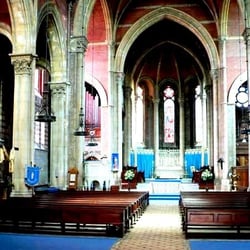
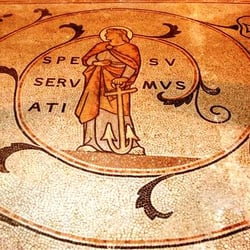
    Never can such an unprepossessing exterior have hidden such a gem. From the outside, St Mary's…read morelooks like you average, run-of-the-mill neo-gothic Victorian church. It doesn't even look that large, and has the added humiliation of a public lavatory attached on one side. But once inside, you turn and find yourself in a cathedral-like space: a huge nave, an even larger crossing and a spectacular chancel and sanctuary. This is architecture as drama, writ large. St Mary's has had an interesting history: opened in 1827 to cater for the burgeoning suburbs of east Brighton, the original church was a rather handsome neo-classical building, modelled on the temple of Nemesis in Athens. Alas, like many Regency buildings, it was badly built, and partially collapsed during building work in 1876. The architect commissioned to design its replacement was William Emerson, known mostly for his work in India. St Mary's is his only church in the UK, and he chose the decorated gothic style for his new creation, albeit one with other elements: the aisle arches are round-headed and groups of Early-English lancets proliferate - all in red brick, with Bath stone detailing. The arcades rise to Corinthian capitals, both in the nave and in the apse of the sanctuary. Cleverly, Emerson made full use of the changes in levels, first down from the entrance and baptistery into the nave, and then back up again into the sanctuary, to emphasise the height. (The nave is 40ft across and 60ft high.) The only element not completed was the tower, which was abandoned for lack of funds, although early drawings show what was intended. The church has a wide array of Victorian stained glass, including an example by Kempe, although other workshops predominate. (The web-site has excellent pictures of all the glass). The furnishings are also of high quality, including a carved pulpit of Caen stone, and a marble font, which stands on a plinth of granite from the Schreckhorn mountain in the Bernese Oberland in Switzerland. This commemorates the second Vicar, Julius Elliott: an accomplished rock climber, he was the second to ascend the North Face of the Matterhorn, but died in 1869 after an apparently successful ascent of the Schreckhorn, at the age of 28. The other notable feature is its organ, which is known for its tonal quality, enhanced by the excellent acoustics of the church. The only downside to all this grandeur is that to-day's rather smaller congregation struggles to resource the scale of maintenance required of such a huge building. It needs generous visitors.

    Photos
    Church of St Mary the Virgin, Kemptown - St Mary Brighton - original design with the tower (never built)

    St Mary Brighton - original design with the tower (never built)

    Church of St Mary the Virgin, Kemptown - St Mary Brighton High Altar Reredos (1893)

    St Mary Brighton High Altar Reredos (1893)

    Church of St Mary the Virgin, Kemptown - St Mary Brighton Mosaic 01

    See all

    St Mary Brighton Mosaic 01

    St Nicholas' Church

    St Nicholas' Church

    5.0(1 review)
    33.2 mi

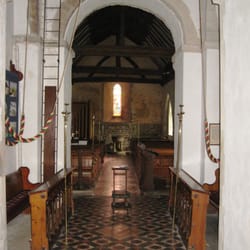
    Iford is a small village in the Ouse Valley near Lewes, consisting of a single lane which loops off…read morethe Lewes to Newhaven road. Half way around is the surprisingly large and complex church of St Nicholas, dominated by an imposing central pyramidal tower. Built just after the Norman Conquest, the nave and central tower date from around 1090, with the current chancel built slightly later, perhaps around 1100. In the late 12th century, a north aisle was added but subsequently removed, and the remains of the three-arched arcade can be seen inside and out. Around the same time, the pyramidal tower cap was added and, in the 13th century, a little north chapel off the chancel, which now serves as a vestry. The interior is dark and atmospheric. It is dominated by the tall, Norman chancel arch, decorated with a roll and chevron motif, although the capitals are part of a Victorian restoration. The arches under the tower are all plain. The tower above contains three bells dated 1426, dedicated to Saints Margaret, Katherine and Botolph. A low, wide arch in the chancel leads to the former north chapel, and has a corbel in the form of a head at the east end: the chancel itself has an unusual arrangement of three, round-headed arches under a single oculus window at the East end. At the west end is the font, from around 1200, lit by a single lancet above the original (and now blocked) west door of the first church.

    Photos
    St Nicholas' Church
    St Nicholas' Church
    St Nicholas' Church

    See all

    St Michael - religiousorgs - Updated May 2026

    Loading...
    Loading...
    Loading...