Cancel

Open app

Search

Parish Church

5.0 (1 review)

Parish Church Photos
Recommended Reviews - Parish Church

Your trust is our priority, so businesses can't pay to alter or remove their reviews. Learn more about reviews.
Yelp app icon
Browse more easily on the app
Review Feed Illustration
Photo of David J.
96
2344
11912

16 years ago

Helpful 0
Thanks 0
Love this 0
Oh no 0

Verify this business for free

Get access to customer & competitor insights.

Verify this business

Parish Church of St Nicolas

Parish Church of St Nicolas

5.0(1 review)
19.5 mi

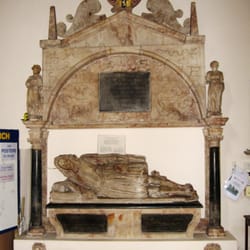
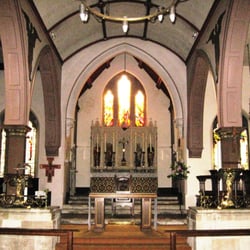
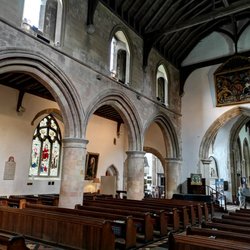
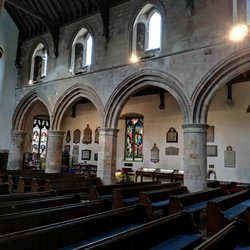
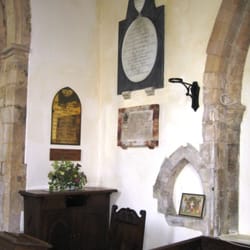
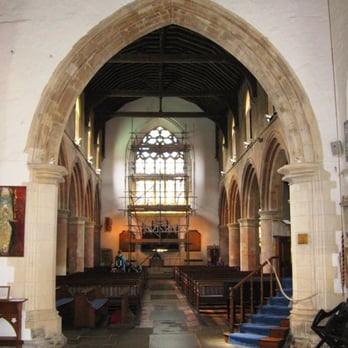
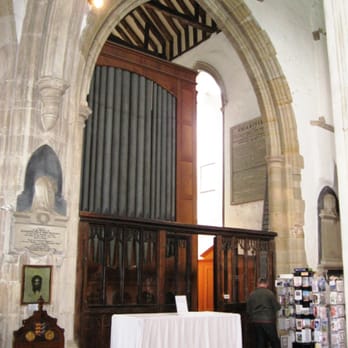
Most people visiting Pevensey get no further than the castle, but its mediaeval church is also very…read moreattractive and well worth a visit. History Although there is some architectural evidence of late 12th century work, the present chancel dates from the reign of King John 1200-1216, at the time the castle was being expanded, with the nave built a little later. As Pevensey declined as a port, the church fell into disrepair, and the chancel was walled off from the nave in the 17th century, to be used for sheltering cattle, storing coals and hiding contraband brandy for smugglers! Restored tastefully in 1875-1900 under George Gilbert Scott Jnr, it remains an excellent and complete example of the Early English Gothic style. The church From the outside, the church is built largely of flint, the most notable feature being the attractive tower, of three stages: Scott rebuilt the second stage and added the third, but kept the broach spire design of the original. The north chapel (built on the site of an early chapel) is also Scott's work. On entering into the nave, the most striking feature are the wonderful arcades of double-chamfered arches, which rest on piers which alternate between octagonal and a clustered quatrefoil designs. There are five bays to the south, and three to the north, leading to a heavily buttressed tower arch. With the exception of the west window, all are lancets, including those of the tall clerestory. All is roofed off by a fine king-post roof. The chancel is entered through a fine, tall Gothic arch of the purest form, with elaborately carved stiff-leaf capitals, which date it to around 1230. The chancel is almost as long as the nave, and has three elegant lancets at the East End, with another two lancets paired on the south wall, with attractive shafts and mouldings on the inside. Fittings of interest include a 13th century stone coffin lid with a cross design in the south aisle, the crude Norman font, but most impressive is the alabaster monument to John Wheatley (d. 1616), which includes an effigy lying on his side. he contributed to £40 to the fitting out of a ship from Pevensey to fight the Spanish Armada. Two piers also have niches for statues, doubtless disposed of during the Reformation.

Photos
Parish Church of St Nicolas

See all

St. Michaels

St. Michaels

5.0(5 reviews)
32.1 mi

Located right on the High Street in Lewes, yet strangely hidden, St Michael's is a fascinating…read moreamalgam from different periods, with a distinctive and rare round tower, with a tall shingled spire. History The church dates from the late 12th or early 13th century, the actual date a puzzle as the pointed arches indicate a 13th century, but the round tower is more typical of the 11th or 12th centuries. There are two others of similar design in Sussex. The list of rectors goes back to 1283. The church was rebuilt in the 14th century with the addition of a south aisle, the arcade of which survives. However, the church suffered badly after the Reformation (Lewes being a fiercely Protestant town) and was semi-derelict by the 18th century. This necessitated a significant rebuilding in 1748, in which a north arcade was added, and the south arcade extended - unusually in wood - but in a vaguely matching style. A further rebuilding in 1884 extended the chancel, remodelled the interior and replaced three Georgian windows in the south wall with Gothic versions. The church The most distinctive external feature is the tower, now rendered, with a single pointed lancet window, and a later trefoil window above. The tower is adorned with a prominent sculpture of St Michael by Harry Phillips, erected in 1976. The 18th century frontage to High Street is an attractive example of square and knapped flintwork, with two doors, each surmounted by rounded windows, and the three Gothic windows inserted in 1884. Inside, despite the dark and atmospheric interior, one can clearly identify the distinction between the original 14th century arcade of slender Gothic arches, and the 18th century wooden versions - painted a slightly odd chocolate colour. At the west end of the south aisle is an original lancet window, an equivalent on the north side now blocked and infilled with a Victorian wall painting of St Pancras. The fittings are of extensive interest. Behind the attractive Victorian font are two brasses, relocated from the floor. The older brass, dated around 1430, is of a knight in full armour, now sadly headless, a lion at his feet. One heraldic shield survives. He may be a member of the extended de Warenne family (who built Lewes castle), possibly John Waryne, a member of the household of Henry IV. Adjacent is a half brass to John Braydforde, (d. 1457) a former rector of St Michael's. His brass has a wonderfully touching expression. On the north wall, a 16th century classical style memorial to Sir Nicholas Pelham shows him and wife facing in prayer, their ten children as mourners below. He is famous for his defence of Seaford against a French force which had previously sacked Brighthelmstone (modern Brighton). A wonderful inscription on the monument has a play on his name: His valr's proofe, his manlie virtues prayse; Cannot be marshall'd in this narrow roome; His brave exploit in great King Henry's dayes, Among the worthye hath a worthier tombe. What time the French sought to have sack't Seafoord, This Pelham did repel them back aboord. Opposite are the remains of the monument to George Goring, MP for Lewes, (d. 1601) and on the north wall a brass memorial records the life of Dr Gideon Mantell, (1790-1852), a local doctor, geologist and paleontologist. He discovered first the teeth and then a skeleton of an Iguanadon, now on show in the Natural History Museum, and is credited with helping inaugurate the scientific study of dinosaurs. There are two paintings, one large 17th century canvas of the Descent from the Cross, possibly by Balucchi, and one of the Madonna and child, thought to be Spanish of 17th century. Finally, the reredos is by celebrated Victorian Gothic architect J L Pearson. Through a door in the north wall, steep steps (formed from tomb slabs) lead up to the small but tranquil graveyard. A surprising space for the town centre, from the rear there are fine views of Lewes Castle's keep. Practicalities The church is normally open during weekdays until 5pm. The graveyard may be closed if the steps are wet. The church is part of the united benefice that includes St Anne's and St Thomas a Beckett in Cliffe. There is a Sunday Mass at St Michael's at 10.30am.

Walking along the treachorously Icy High Street of Lewes on a bitingly cold, snowy day, I came…read moreacross St Michael-In-Lewes, a 12th century church, welcome to all for prayer and contemplation. With the pure white snow clinging to the nearly sheer face of the church spire, and the surrounding areas all blotted out by the whiteness, the place looked like something out of a German fairy tale, set in a quaint little village somewhere in the Alps. Needless to say it was pretty darned beautiful, and I would recommend coming here, because architecturally the building is very interesting and quite rare. The clock that hangs of the side, gives the whole place that slightly disney-esque fairy tale, village feeling, which I guess in many ways Lewes is!

Photos
St. Michaels
St. Michaels
St. Michaels

See all

St Augustine's Church

St Augustine's Church

5.0(1 review)
5.5 mi

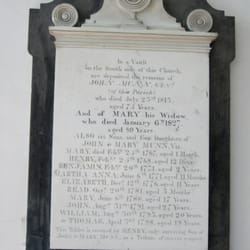
Photos added 24-07-2007…read more *************************** Set in the flat and bleak landscape of Romney Marsh, Brookland church looks weirdly out of place. The distinctive belfry, with its three conical tiers of wooden shingles, might look more at home in the Balkans than in the Garden of England. According to legend, the belfry was originally located on the roof, but leapt from the church in surprise when an aged batchelor married an equally elderly spinster. The adjacent church is a little more orthodox, although still interesting. The porch, with its wooden half-gates is charmingly rustic, and adjacent is a narrow, low tower with a clock. Dating from around 1250, the gothic nave is wide and spacious, and it has equally generous aisles. The scarily odd angles of the walls and arcade arches betray serious signs of subsidence, all adding to the charm (and betraying the real reason for not building the belfry on the church roof). It still retains its original box pews, some pretty 14th-century stained-glass windows, and a well preserved pre-reformation wall painting of the murder of Thomas a Becket. The most notable furnishing is a Norman font, made of lead: reputedly stolen by a local raiding party from a church in France, it features the signs of the zodiac and pictures of rural life. Close by are other artifacts of rural life, including a set of weights and measures, an unusual portable porch (supposedly intended to keep the priest dry at funerals), and the clock mechanism, set at ground level for all to see. But most poignant for me is the memorial erected to John and Mary Munn and ten of their children, all of whom predeceased them. It was erected by the only survivor, Henry. You can almost feel his plight.

Photos
St Augustine's Church

See all

Church of St Mary

Church of St Mary

4.5(2 reviews)
3.7 mi

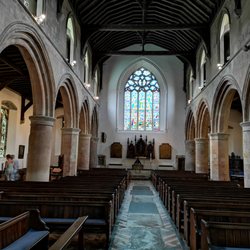
Udimore is one of those small English villages strung out along a road, with no real centre, which…read moreis so easy to drive through. But just off the busy B2089 is the lovely church of St Mary, situated in an idyllic spot next to a farm and to a duck pond (which actually had a family of ducks on it when I visited). Udimore is recorded in the Domesday Book, and there was an important lodge here in mediaeval times, in which both Edward I and Edward III stayed - Edwards III's Queen, Eleanor, is said to have watched the English fleet from Udimore before the Battle of Winchelsea (against a Castilian fleet) on 29 August 1350. Historically, the church nave was originally 12th century Norman, to which a south aisle was added around 1200, with the chancel added slightly later and the tower slightly later still, around 1230. The aisle was lost at some later period and the whole church was heavily restored in 1896. From the outside, the church looks impressively large: the tower is robust and squat, and barely higher than the tall nave and chancel roofs. The walls on both north and south sides of the nave betray a series of alterations, with blocked arches abounding. On entering the church, it is clear that it once had a south aisle of three bays, in the Early English Gothic style, on round columns with stiff-leaf capitals, dating from the very beginning of the 13th century: these are best preserved in the central bay, which now forms the south 'porch', although there is no internal door or wall. It is not clear when the aisle was demolished, but may have been around the time of the Black Death. The porch was added during the 19th century, using a 15th century door, and the north wall nave lancets are also 19th century. The south nave windows are 15th century, although heavily restored, and probably came from the original south aisle wall. The chancel is entered through a beautifully proportioned (and very pointed) arch, and now we find ourselves firmly in the 13th century. The chancel is indeed textbook Early English Gothic: there are lancets in the north and south walls, and a triple lancet composition at the east end. The westernmost lancet on the south wall was originally lower, to allow people outside the church to watch the mass: the sill was raised in line with the others in Victorian times - the alteration is clearly visible on the outside. The church has some interesting fittings: in the chancel is an interesting wooden font, covered in plaster to make it look like stone: an edict at the Reformation forbade the use of wooden vessels, and this is an unusually late example (early 18th century) of a stone 'forgery'. The Jacobean period is represented by a fine bench seat in the porch, and there is a particularly grand coat of arms of George III, erected by two churchwardens in 1772. Back outside, the churchyard contains some interesting graves, including a number of anthropomorphic 'bodystones'.

St. Mary's Parish Church goes back to the 1200s and has had a turbulent history, with parts…read moredestroyed and added through the centuries. As it now stands, it is a charming building with a pleasant dark wood interior and still very much the picturesque town's religious centre. When you're in Rye, it is certainly worth a visit, especially in tandem with St. Thomas the Martyr in nearby Winchelsea. Both were important harbours (Rye was one of the Cinque Ports) until the sea just disappeared over time. The church is generally open throughout the day until the late afternoon (5.15 pm on most days), entry is free, and photography allowed.

Photos
Church of St Mary
Church of St Mary
Church of St Mary

See all

Parish Church - churches - Updated May 2026

Loading...
Loading...
Loading...