Cancel

    Open app

    Search

    St Leonards Church

    5.0 (2 reviews)

    St Leonards Church Photos

    Recommended Reviews - St Leonards Church

    Your trust is our priority, so businesses can't pay to alter or remove their reviews. Learn more about reviews.
    Yelp app icon
    Browse more easily on the app
    Review Feed Illustration
    Photo of Emma M.
    2720
    437
    329

    14 years ago

    Helpful 1
    Thanks 0
    Love this 0
    Oh no 0

    13 years ago

    Helpful 0
    Thanks 0
    Love this 0
    Oh no 0

    Verify this business for free

    Get access to customer & competitor insights.

    Verify this business

    Parish Church

    Parish Church

    5.0(1 review)
    17.4 mi

    St Mary's stands at the very heart of Rye, atop the hill in the centre of the town and surrounded…read moreby the quaint streets and ancient houses for which this Cinque Port is known. History Although a church was almost certainly present before the Norman conquest in 1066, the present building dates from the early 12th century, where the transepts survive from a cruciform church probably similar in size to the present structure. The nave arcades were replaced early in the 13th century, and the aisles are from around the same period or slightly later. The 13th century provided the chapels either side of the chancel, the north (Clare Chapel) being slightly earlier from around 1220. The 14th century provided porches to both aisles, as well as additional buttressing. A new south porch was added in the 15th century, the south and part of the north chancel arcades were renewed, and the present crossing and tower inserted. The main 16th century addition was the tower clock - inserted in 1561-2, it is one of the oldest still functioning in situ. The town's turbulent history in the front line of the mediaeval wars with France is reflected in the church: during a raid in 1377, both town and church were burned (the nave walls still bear the scorch marks), the church roof collapsed and the French carried off the bells. These were later recovered from France by a reprisal raid, by the townsmen of Rye and nearby Winchelsea in 1378. Less happily, the authorities felt that the town had put up insufficient resistance to the French raiders and some of the leading townspeople who survived the attack were hanged and quartered as traitors. The church The church's location is almost perfect: accessed by narrow cobbled streets, its tree-filled churchyard is lined with old houses, many timber-framed. However, the intimate setting means it is hard to appreciated the scale of the church until you enter. Before doing so, it is worth a walk around the outside to see the impressive buttressing added over the years, particularly around the chancel. Inside, the north walls of the transepts are the best place to look for the earliest elements, with Norman blank arcades on corbels of grotesque heads, and others with crenellation and chevron decoration. The original 12th century Norman arches lead into the nave arcades. The nave itself is impressive, with five bays of barely pointed arches on round and octagonal piers, but most of the windows are Victorian replacements. The chancel's 15th century rebuilding also makes it an impressive space, leading to the original 15th century east window. To the north, the Clare Chapel has classic Early English Gothic lancets, although the east window is Victorian. On the south side, the chapel is now the choir vestry: it has paired lancets, shafted inside and each topped with an oculus window. The church has generous fixtures and fittings. The screens into the Chancel Chapels are late 14th century and Perpendicular in style. In the Clare Chapel is a late mediaeval brass, and the pulpit has 16th century panels. The clock has a pendulum, replaced in 1810, which swings down into the crossing. There are many memorials from the 18th and 19th centuries. Notable stained glass includes aisle windows by both Kempe and Morris, and windows donated by the novelist and former Mayor, E F Benson, in the south transept and the western wall of the nave. Finally, if you want really excellent views over the town and its surroundings, for a few pounds you can climb the church tower. Practicalities The church is a busy place - the most visited, apparently, in Chichester Diocese after the Cathedral itself. There is a small shop in the south transept selling cards, books and gift items. Car parking around the church is severely limited (as it is in the old town generally) but it is only a short distance - albeit steeply uphill - from the various car parks dotted around the centre.

    Photos
    Parish Church
    Parish Church
    Parish Church

    See all

    St Augustine's Church

    St Augustine's Church

    5.0(1 review)
    12.0 mi

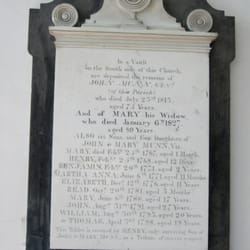
    Photos added 24-07-2007…read more *************************** Set in the flat and bleak landscape of Romney Marsh, Brookland church looks weirdly out of place. The distinctive belfry, with its three conical tiers of wooden shingles, might look more at home in the Balkans than in the Garden of England. According to legend, the belfry was originally located on the roof, but leapt from the church in surprise when an aged batchelor married an equally elderly spinster. The adjacent church is a little more orthodox, although still interesting. The porch, with its wooden half-gates is charmingly rustic, and adjacent is a narrow, low tower with a clock. Dating from around 1250, the gothic nave is wide and spacious, and it has equally generous aisles. The scarily odd angles of the walls and arcade arches betray serious signs of subsidence, all adding to the charm (and betraying the real reason for not building the belfry on the church roof). It still retains its original box pews, some pretty 14th-century stained-glass windows, and a well preserved pre-reformation wall painting of the murder of Thomas a Becket. The most notable furnishing is a Norman font, made of lead: reputedly stolen by a local raiding party from a church in France, it features the signs of the zodiac and pictures of rural life. Close by are other artifacts of rural life, including a set of weights and measures, an unusual portable porch (supposedly intended to keep the priest dry at funerals), and the clock mechanism, set at ground level for all to see. But most poignant for me is the memorial erected to John and Mary Munn and ten of their children, all of whom predeceased them. It was erected by the only survivor, Henry. You can almost feel his plight.

    Photos
    St Augustine's Church
    St Augustine's Church
    St Augustine's Church

    See all

    Parish Church of St Nicolas

    Parish Church of St Nicolas

    5.0(1 review)
    36.9 mi

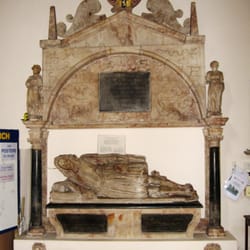
    Most people visiting Pevensey get no further than the castle, but its mediaeval church is also very…read moreattractive and well worth a visit. History Although there is some architectural evidence of late 12th century work, the present chancel dates from the reign of King John 1200-1216, at the time the castle was being expanded, with the nave built a little later. As Pevensey declined as a port, the church fell into disrepair, and the chancel was walled off from the nave in the 17th century, to be used for sheltering cattle, storing coals and hiding contraband brandy for smugglers! Restored tastefully in 1875-1900 under George Gilbert Scott Jnr, it remains an excellent and complete example of the Early English Gothic style. The church From the outside, the church is built largely of flint, the most notable feature being the attractive tower, of three stages: Scott rebuilt the second stage and added the third, but kept the broach spire design of the original. The north chapel (built on the site of an early chapel) is also Scott's work. On entering into the nave, the most striking feature are the wonderful arcades of double-chamfered arches, which rest on piers which alternate between octagonal and a clustered quatrefoil designs. There are five bays to the south, and three to the north, leading to a heavily buttressed tower arch. With the exception of the west window, all are lancets, including those of the tall clerestory. All is roofed off by a fine king-post roof. The chancel is entered through a fine, tall Gothic arch of the purest form, with elaborately carved stiff-leaf capitals, which date it to around 1230. The chancel is almost as long as the nave, and has three elegant lancets at the East End, with another two lancets paired on the south wall, with attractive shafts and mouldings on the inside. Fittings of interest include a 13th century stone coffin lid with a cross design in the south aisle, the crude Norman font, but most impressive is the alabaster monument to John Wheatley (d. 1616), which includes an effigy lying on his side. he contributed to £40 to the fitting out of a ship from Pevensey to fight the Spanish Armada. Two piers also have niches for statues, doubtless disposed of during the Reformation.

    Photos
    Parish Church of St Nicolas
    Parish Church of St Nicolas
    Parish Church of St Nicolas

    See all

    St Leonards Church - churches - Updated May 2026

    Loading...
    Loading...
    Loading...