Cancel

Open app

Search

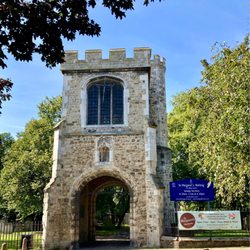
St Dunstan's Church

5.0 (1 review)

St Dunstan's Church Photos

Recommended Reviews - St Dunstan's Church

Your trust is our priority, so businesses can't pay to alter or remove their reviews. Learn more about reviews.
Yelp app icon
Browse more easily on the app
Review Feed Illustration
Photo of David J.
96
2344
11912

17 years ago

Helpful 0
Thanks 0
Love this 0
Oh no 0

Verify this business for free

Get access to customer & competitor insights.

Verify this business

St Augustine's Church

St Augustine's Church

5.0(1 review)
1.7 km

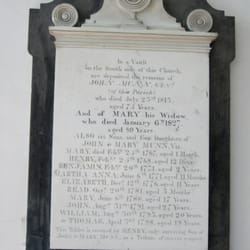
Photos added 24-07-2007…read more *************************** Set in the flat and bleak landscape of Romney Marsh, Brookland church looks weirdly out of place. The distinctive belfry, with its three conical tiers of wooden shingles, might look more at home in the Balkans than in the Garden of England. According to legend, the belfry was originally located on the roof, but leapt from the church in surprise when an aged batchelor married an equally elderly spinster. The adjacent church is a little more orthodox, although still interesting. The porch, with its wooden half-gates is charmingly rustic, and adjacent is a narrow, low tower with a clock. Dating from around 1250, the gothic nave is wide and spacious, and it has equally generous aisles. The scarily odd angles of the walls and arcade arches betray serious signs of subsidence, all adding to the charm (and betraying the real reason for not building the belfry on the church roof). It still retains its original box pews, some pretty 14th-century stained-glass windows, and a well preserved pre-reformation wall painting of the murder of Thomas a Becket. The most notable furnishing is a Norman font, made of lead: reputedly stolen by a local raiding party from a church in France, it features the signs of the zodiac and pictures of rural life. Close by are other artifacts of rural life, including a set of weights and measures, an unusual portable porch (supposedly intended to keep the priest dry at funerals), and the clock mechanism, set at ground level for all to see. But most poignant for me is the memorial erected to John and Mary Munn and ten of their children, all of whom predeceased them. It was erected by the only survivor, Henry. You can almost feel his plight.

Photos
St Augustine's Church

See all

The oldest synagogue in England

The oldest synagogue in England

5.0(2 reviews)
84.2 km•Aldgate

There's not much to add to Templar's comprehensive review: still regarded by many as one of the…read moremost important centres in the Anglo-Jewish community, the Bevis Marks Synagogue is beautifully maintained. It is strongly reminiscent of the Wren and Hawksmoor churches of the City in its classical architecture and furnishings, which include impressive brass candelabra and 17th century wooden benches. The Synagogue's tradition is Orthodox, so men and women are separated: men on the ground floor, women in the galleries. Their opening hours (for visits) are slightly longer than advertised on their website, so it's worth contacting them ahead of a trip to London if you want to pay a call. Tourists (as opposed to those attending services) are asked to pay £3 for entry, and men are asked to wear a skull cap - one will be provided if you don't have one. Your bags may also be searched. They sell a small range of postcards and books at the entrance.

Situated in a secluded courtyard, the Bevis Marks Synagogue was opened in 1701 to serve the Spanish…read more& Portuguese Jewish Congregation. Today it is one of the best-preserved houses of worship of its period still in regular use. The Inquisition, revived by Ferdinand and Isabella, turned its attention to these crypto-Jews, and from the last years of the fifteenth century, they: were systematically persecuted, arrested, tortured, tried, and burnt at the stake. From about this time there was a constant exodus of 'Marranos' who succeeded in escaping from Spain and Portugal or its dependencies to avoid persecution and a small number of them reached Protestant England. Outwardly, they were obliged to behave as Christians, for at that time Jews were not allowed officially, to enter the country, but at any rate they could live there, provided that they behaved with circumspection, and could meet in secret in each others' houses for prayer. The first Jewish house of worship of the resettlement of the Jews in England was as opened in 1656 in the upper floor of a house in Creechurch Lane, which is but a stone's throw from the present Synagogue in Bevis Marks The site of this house is today marked by a plaque, on the rear corner of Cunard House in Creechurch Lane. Jews were permitted to return to Britain in 1657 under Oliver Cromwell. They felt that the time was opportune to present a petition in the form of a humble address to Oliver Cromwell asking for the official re?admittance of the Jews to England Their decision was no doubt a wise one, as Cromwell, reared in a Puritanical atmosphere with its emphasis on the Old Testament was likely to hear favourably any petition presented by the 'people of the Old Testament'. Some of the most eminent figures of Anglo-Jewry sat at prayer in the Synagogue such as Sir Moses Montefiore. Disraeli was born into the Congregation and there are links to the Rothschilds. Today it is regarded as the most distinguished British Synagogue. The magnificent wooden Ark or cupboard) resembling a reredos, at the east end, is built in classical architecture in the manner of Sir Christopher Wren's time. It contains (as is the custom in Jewish synagogues') the sacred scrolls of' the Pentateuch, or five books of Moses, written in Hebrew on parchment, which are read in consecutive instalment over the period of a year as the central feature of the Sabbath Service. Several splendid seventeenth century vestments and silver ornaments belonging to the scrolls survive. The entablature of the Ark has as its central feature the Ten Commandments written in Hebrew (abbreviated), above which are inscribed in Hebrew the words 'Know before Whom thou standest'. The silver hanging Sanctuary Lamp, burning perpetually before the Ark, was presented by Edward Foligno in 1876 and evidently replaces an earlier example, now lost. Except for the addition of the doors to the Banca or Wardens' pews and to the Haham's or Chief Rabbi's seat in 1787, and of the choirstalls in about 1830, the ancient synagogue has remained virtually unchanged. Electric light was installed in 1929 Even though recently restored, the interior has barely changed since it was built. It is in the style of many Nonconformist chapels of the period. The influence of Sir Christopher wren is also evident. The Synagogue has one of the finest collections of Cromwellian and Queen Anne furniture in the country and the magnificent brass candelabra with glowing candlelight. On 19th December 1951 the Congregation held a Service to celebrate the 250th anniversary, of the opening of the Synagogue which was attended by the Duke of Edinburgh. On 22nd March 1956 British Jewry held a Service of dedication and thanksgiving at the Synagogue on the tercentenary of the resettlement of the Jews in the British Isles. Twelve pillars, symbolising the tribes of Israel, support the ladies' gallery, the reading desk and Echal are flanked by 10 candlesticks representing the Ten Commandments; and the interior is dominated by seven magnificent candelabra, corresponding to the days of the week. One of the great oak beams supporting the roof is said to have been presented by Princess (later Queen) Anne. In 1992 and 1993 the synagogue suffered great damage from terrorist bomb attacks on the City of London. Nearly £200,000, raised by donation, has since been spent in repairing and renovating the structure

Photos
The oldest synagogue in England

See all

St Margaret's Church Barking - Nave

St Margaret's Church Barking

5.0(1 review)
78.1 km•Barking, Dagenham

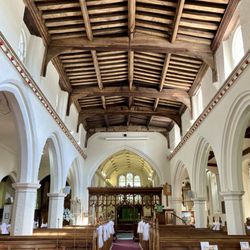
At the edge of the bustling town centre is a delightful (and substantial) mediaeval church, which…read moreis well worth a visit. St Margaret of Antioch was built as a chapel within Barking Abbey, and in 1300 it became the town's parish church. It sits east of the centre in a wide expanse of green - once the Abbey grounds, of which only the Curfew Tower remains. The church has been expanded over the years, so it now contains a happy mix of all periods from the 13th to the 16th centuries. Inside, the oldest part is the chancel and part of the nave, which date from c. 1215, although most of the fabric is 15th Century: the outer north aisle and chapel were added in the 16th Century using materials from the dissolved abbey. In 1772, the church was heavily remodelled under the direction of a local landowner, Bamber Gascoyne, who had much of the original fabric encased in decorative plasterwork. Of this, the lovely chancel ceiling remains, complementing the fine mediaeval roofs in the nave and north aisles. Traces of mediaeval painting remain in the chancel arch. However, the true joy of the church is its furnishings, testament to the wealth of Barking from the 17th Century onwards, when it was a sizeable fishing port. In the chancel, the memorial to Sir Charles Montagu (d. 1625) shows him in his tent on campaign, dozing while armed musketeers stand guard. Nearby is the fine engraved tombstone of Martinus, the first recorded Vicar of Barking, dating from 1315. Of special note is that to Captain John Bennett (d. 1715) and his mother and father, his figure surrounded by the fore and aft of a fully-rigged sailing ship, navigational instruments and globes. He also has a fine tomb in the churchyard in the same style. The nave has poppyhead pews incorporating 18th century woodwork, and the classical-style font (c.1635) is topped by a jolly cover, decorated by Jessie Jack, daughter of the Arts & Crafts craftsman George Jack. There is some good stained glass, and the Fisherman's Chapel includes statues of local notables associated with the parish, including Captain Cook (who married Elizabeth Batts here in 1762), the Quaker and prison reformer Elizabeth Fry, and St Ethelburga, the first Abbess of Barking. The church is the centre of a busy parish life, and includes an excellent tea room in the adjoining church centre, where I enjoyed a lovely lunch and a very friendly welcome.

Photos
St Margaret's Church Barking - The Curfew Tower, the only remaining part of Barking Abbey to survive.

The Curfew Tower, the only remaining part of Barking Abbey to survive.

St Margaret's Church Barking - Nave, looking west

Nave, looking west

St Margaret's Church Barking - Stained-glass window depicting the last supper

See all

Stained-glass window depicting the last supper

St Dunstan's Church - religiousorgs - Updated May 2026

Loading...
Loading...
Loading...