Having headed up the effort to protect this important Great Blue Heron colony for many decades, I…read morewant everyone visiting Renton's Black River Riparian Forest have a safe experience. This is a magnificent, world-class sanctuary, but it requires local knowledge to navigate safely.
4/30/2026 The cottonwoods have leafed out, making visibility of the full 80-nest colony difficult. However, there is a clear gap in the center where binoculars offer a great view of 11 nests.
These herons are a unique, non-migratory subspecies called the Pacific Heron (Ardea herodias fannini). Their population is small and at risk due to habitat loss, bald eagle predation, and human disturbance.
What to Expect: Nestlings are currently small and quiet, but they grow quickly, reaching full size with 6-foot wingspan by July or August.
The nestlings usually fledge in July (ideally) and sometimes August if they have suffered setbacks from predation (especially Bald Eagles). After fledging, they remain at Black River for about two weeks to hone their hunting and flying skills (landing is especially tricky with those massive new wings). While most disperse to other nearby shorelines, a few may overwinter here, especially if they fledge late in the season. Our Pacific herons do not migrate, instead, dispersing to nearby habitat. Their diets change from fish, frogs, and snakes in the summer, to small mammals such as voles in the winter, so where they disperse to will depend on the food sources.
How to Find the Nests: Coordinates: 47°28'31.4"N 122°14'24.0"W
From the Kidney Center, cross the short bridge over Springbrook Creek. STAY IN SINGLE FILE and hug the railing -- vehicles pass very close to the narrow sidewalk here. Immediately after the bridge, turn right onto the paved path. At the bottom of the short hill, the paved path veers right, but YOU WANT TO TURN LEFT ONTO THE UNPAVED TRAIL.
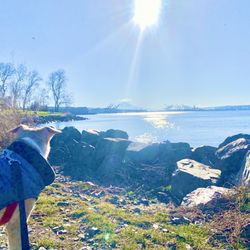
The Arrival: Walk the equivalent of about one city block. The nests are directly across the pond. Listen for the nestlings' prehistoric-sounding "guk-guk-guk" calls.
Safe Parking: Park at Northwest Kidney Center, 602 Oakesdale Ave. SW, Renton, WA 98057. This is the safest access point. This is a private lot but we have not had any issues parking here for a couple of hours.
Areas to Avoid: Do NOT park in the small lot at the foot of Monster Road or walk through the upper meadow due to explicit adult meetups.
Personal Safety: This is an isolated sanctuary. Women should NOT visit alone. It is strongly advised to stay in groups of 2 or 3. Maintain high situational awareness. Men from the meadow area often watch visitors, especially as the weather improves. If you are being watched and there are only a few of you, it's best to leave (we always do unless there are quite a few of us, and men are in our group). Trust your gut. There are no shortcuts. Stay on the main path to get back to Oakesdale.
Bridge Safety: When crossing the bridge over Springbrook Creek, walk in single file and hug the railing. Vehicles pass very close to the narrow sidewalk.
Accessibility: The final trail to the viewing area is NOT wheelchair accessible (uneven, unpaved dirt path).
Gear: Heavy-duty mosquito repellent during warm weather and binoculars to see the herons are essential.