As the former hourly instructor for the technical orientation of the multifaceted pathway mentioned by Esmeralda below, I am providing a factual record of the EV charging class curriculum and program structure. The 9 hour orientation training covered many topics across electric vehicle and clean energy economics, technology, and careers including examples such as:
Data-driven deep dive into the entire Electric Vehicle (EV) and Clean Energy economy, mapping the industry from global macro-data to micro-level engineering:
Global Climate Science: Mechanisms of the greenhouse effect, average global temperatures, and thermodynamics of the climate crisis using data from NASA and the University of Alabama.
Macro-Economics & Local Trends: Analysis of the global transition to clean energy, including EV ownership data specific to Bakersfield and Kern County compared to California and the U.S.
Advanced Vehicle Technologies: In-depth study of BEV (Battery Electric), PHEV (Plug-in Hybrid), HEV (Hybrid), and FCEV (Hydrogen Fuel Cell) systems, including motor schematics, battery chemistries, and Zero Tailpipe Emissions science.
Infrastructure & Hardware Standards: Technical requirements for microgrids, grid load requirements (e.g., 7.2 kVA per space), and the circuitry for Level 1, 2, and 3 chargers (including wattage and voltage).
Global Plug Standards: Detailed training on the Japanese CHAdeMO standard, the CCS (Combined Charging System), and the NACS type.
Career Development: Comprehensive analysis of the career landscape within the electric vehicle charging infrastructure installation industry, including current job demand, employer requirements and qualifications, and the specific professional conduct and technical proficiencies required for success.
In general, the orientation covered subjects pertaining to the green economy and careers, ecosystems and climate science, electric vehicles, electric vehicle charging station technology and clean energy systems.
The part I taught was just the beginning of a Four-Component Specialized Pathway: The first of four training pathways that also included:
Specialized Electrical Safety: Comprehensive training on NFPA 70E standards, delivered by a dedicated District Specialist.
Industrial Safety & Compliance: Specialized industrial safety principles necessary for high-voltage infrastructure installation, delivered by a second District Specialist.
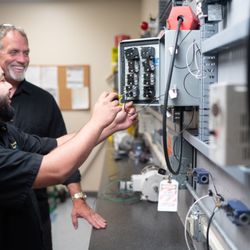
The IBEW Partnership: This program is a direct bridge to the IBEW (International Brotherhood of Electrical Workers)--the Gold Standard for the electric vehicle charging infrastructure installation industry. This included two weeks of hands-on training at the Union Center and a formal graduation.
Exclusive Access: This is a specialized institutional partnership not available to the general public to 'walk in off the street.' While the program provides the technical foundation and this direct union immersion, final entry into a pre-apprenticeship is a competitive process decided independently by the union's board.
Institutional Role & Oversight: My role was strictly limited to delivering the orientation curriculum. I was not the program manager, administrator, or advertiser. All program funding is managed directly by the District's financial office and is subject to rigorous state and federal audits, where every penny is accounted for to the government. Instructors have no access to grant funds. Instructors are paid a standard hourly wage for time spent conducting the training and must submit audited time cards through a standard payroll process.
Instructional Style: PowerPoint is the industry standard for delivering this volume of high-density technical, scientific and economic data accurately. I appreciate all feedback and will consider incorporating more interactive handouts in the future.
Finally, thank you for noticing the professional attire! I take pride in representing the program well. I wish all former students success in finding a career path that fits their goals. read more