Cancel

    Open app

    Search

    Viking Coastal Trail Photos

    Viking Coastal Trail Reviews in Other Languages

    Verify this business for free

    Get access to customer & competitor insights.

    Verify this business

    Titchfield Abbey

    Titchfield Abbey

    4.0(3 reviews)
    60.4 km

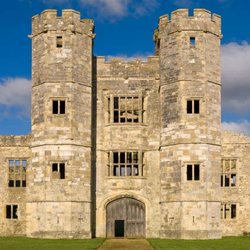
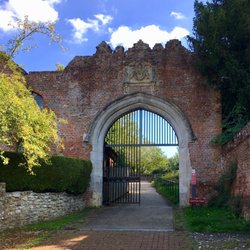
    On our Road Trip through England, Wales and Scotland we focused on Castles, Abbeys and walks…read more The Titchfield Abbey we've visited on our first full day here in England. It was a hot summer day. A monday. And only really a handful people on site. Which is surprising, because these are beautiful remains of a former abbey and mansion. It's almost still fully complete even. There's no entrance fee. And even parking is free if you're a member of the EH. If not it's 2£ only. The building is very impressive. Built in the 13th Century it was first in the hand of monks. Then it changed hands under Henry VIII. And was turned into a Tudor mansion. It's quite a sight to behold. And you can walk around the whole site. But as usual: Be respectful, don't climb around and pick up your litter and after your dog (which are allowed here on the site). A very good start for this year's Road Trip. A great place to visit. And there are even one or two lunch options around, if you feel hungry after your visit.

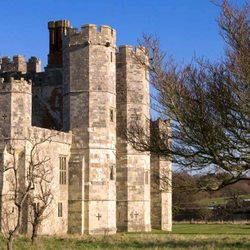
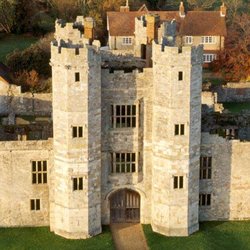
    Titchfield Abbey is a ruined former country home, which was itself adapted from an Abbey during the…read moreDissolution. The Abbey was founded in 1222 by the Premonstratensian Order of canons. It was founded as a daughter house of Halesowen Abbey, and endowed both by its founder Bishop Peter of Winchester and Henry III. Never especially wealthy, the Abbey was nevertheless noted for its scholarship and held a substantial library. The Abbey buildings followed a standard plan, albeit on a relatively modest scale. The Abbey seems to have had a quiet and ordered existence, although it's location near the south coast on one of the main routes to France meant it hosted both Richard II and Henry V, and was the location of Henry VI to Margaret of Anjou in 1445. The Abbey was dissolved in 1537, at the behest of Thomas Wriothesely, Chancellor to Henry VIII. Unlike many dissolutions, the Abbott John Salisbury secured a peaceful handover, with pensions provided for the canons and the position of Dean of Norwich for himself in 1539. Wriothesely adapted the buildings to form a n impressive country home for himself, called Place House. The Abbey church itself was converted to a grand gatehouse and accommodation wing, with a long gallery and hall formed around the former cloister. This involved taking down the church tower and chancel. The house hosted Elizabeth I, Edward VI, Charles I and Charles II. It continued in use as a home until the 1780s, when the decision was taken to abandon and deliberately demolish much of the complex to form a romantic ruin. Today it is in the care of English Heritage. The impressive turreted gatehouse forms the larger part of what is visible today, the bare structure enabling much of the former church to be traced. There are also remains of the cloister walls, with the foundations of the demolished buildings traced out on the ground. The site is also known for its collection of decorative mediaeval floor tiles. The adjacent fish ponds have survived but are no longer part of the site. Practicalities: the gravel drive is quite narrow and leads to a gravel car park. Although there is level access the rough surfaces make for challenging wheelchair access. There are no toilets on site.

    Photos
    Titchfield Abbey
    Titchfield Abbey
    Titchfield Abbey

    See all

    Bibury

    Bibury

    5.0(2 reviews)
    52.3 km

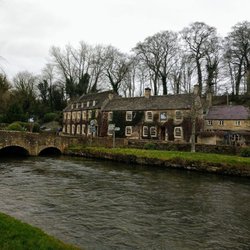
    Bibury is a charming, typically Cotswold. It's easy to see why William Morris called Bibury 'The…read moremost beautiful village in England' - wonderful stone buildings strung out along the banks of the River Coln. Arlington Row, owned by the National Trust, is one of England's most iconic and photographed sites - it even appears on the inside cover of UK passports! Originally built in the 14th century as a monastic wool store, it was converted in the 17th century into a row of weavers' cottages. The River Coln flows through Bibury sandwiched between the main village street and an expanse of boggy water meadow known as Rack Isle, so called because wool was once hung out to dry there on racks after it had been washed in Arlington Row. You can even see some trout in the river, which the trout farm owners told us they are the escape artists! With Arlington Row as a backdrop, it makes one of the most picturesque scenes you will find in the Cotswolds. Other attractions in Bibury include: Bibury Trout Farm, (see my other review) one of the oldest and most attractive trout farms in the country covering almost 15 acres, where you can learn about trout or event catch your own dinner. This village is stunning, perfect photographers dream. Do come you will not be disappointed.

    If traveling past Oxford don't miss out on this picturesque little town, offering a prime example…read moreof the Cotswold way of living. Houses are maintained in much the old fashion, offering not just wonderful photo opportunities but also a glimpse into housing of the past . You will find several small tea houses and shops here, as well as a trout farm and hotel. Well worth a visit or even a relaxing weekend.

    Photos
    Bibury
    Bibury - Biburys river and hotel and pub

    Biburys river and hotel and pub

    Bibury

    See all

    Silchester Roman City Walls & Amphitheatre - Silchester Roman City Walls and Amphitheatre

    Silchester Roman City Walls & Amphitheatre

    4.5(2 reviews)
    21.0 km

    This idyllic rural spot was, for over four hundred years, a bustling Roman town at a crossroads on…read morethe road from London to the West Country. The location was the earlier tribal capital of the Atrebates, a Celtic tribe whose territory covered much of present day Berkshire, and parts of Hampshire and Wiltshire. Soon after the Roman conquest in 43AD, a Roman town was established on the same site, called Calleva Atrebates. The town was established within the current walls. These were originally made just of earth with a wooden palisade, but were faced with stone around 280 AD, enclosing around 100 acres. The town had a forum, baths, an inn, several temples and latterly a Christian Church. Evidence is that the town declined gradually after the withdrawal of the Roman Legions in 410AD, but unlike many other locations, it was eventually abandoned. Excavations have identified the street plan and the details described above, but most of the remains have since been covered over. The principal sight is therefore the impressive walls, which form an almost complete circuit. You can walk along the top of the bank above the walls around the site, a distance of around three miles. Close to the modern hamlet near the medieval Church but outside the walls, is the amphitheatre, which is well preserved. This has earthen banks on which wooden seating would have been erected. There is a car park on the north western corner. The walls are not suitable for wheelchairs (the access paths have stiles) , although a section is clearly visible from the road on its eastern side. The path to the amphitheatre is relatively level but the surface is uneven.

    Originally a tribal centre of the Iron Age Atrebates, Silchester became the large and important…read moreRoman town of Calleva Atrebatum. Unfortunately there is not a great deal left of the original Roman Silchester as it was never re-occupied or built over after its abandonment in the 5th century. As a result of this it is apparently an archaeoligical haven as it gives an unusually complete picture of its development. It is however a very nice day out (in better weather), as there is a lovely 8 mile walk around the old city walls which remain in some form or another. There is also the remains of an impressive amphitheatre which is a must to view during the walk. The amphitheatre is just outside the old city walls, but its location is made apparrent when viewing the information boards. There is parking available by the city walls. Sign posts are not great, but if you keep driving around the wall you will come accross it eventually. Plenty of areas for pickniking in nice weather and plenty of lovely pubs to stop in and get a drink and bite to eat in the local area.

    Photos
    Silchester Roman City Walls & Amphitheatre
    Silchester Roman City Walls & Amphitheatre
    Silchester Roman City Walls & Amphitheatre - Silchester - amphitheatre

    See all

    Silchester - amphitheatre

    Basing House Ruins - Basing House - main entrance

    Basing House Ruins

    4.0(1 review)
    26.4 km

    Once a rival to Hampton Court, in the 16th Century Basing House was one of the grandest houses in…read moreEngland, and hosted all of the Tudor monarchs from Henry VIII to Elizabeth I. Besieged three times in the Civil War, it was stormed by Cromwell and destroyed. The ruins are extensive but fragmentary, and a good imagination is needed to understand the site. Basing started life as a Norman motte-and-bailey castle in the 11th Century, when it was chief of the 55 manors granted to Hugh de Port by William the Conquerer. Unusually the motte was low but over 300ft wide. The estate was passed through inheritance to the Paulet family, and it was Sir William Paulet (1483-1572), 1st Marquess of Winchester, who developed the famous great house. He held a range of high offices during his long career, and amassed a considerable fortune, which he spent on the remodelling and extending the house. He first developed the original castle into a more comfortable residence in the classic Tudor style, using locally made bricks. He built a great gatehouse as the main accommodation, leading to a separate great hall, with other buildings arranged around the inside of the walls. However, this was insufficient to host the monarchs and their large retinues on their Royal progresses, so he built an enormous new palace of some 360 rooms, adjacent to the original castle, to provide additional accommodation. This took the form of a large square stately house, with a central range and two oblong courtyards, again in red brick with classical decoration. The two houses were linked by a short bridge and gateway through the original defences. The Royal visits, however, exhausted the family fortunes. Elizabeth I visited several times; most notably, on one visit she hosted the new French ambassador. She brought a retinue of 1,500 people in her court - and he brought 400. They stayed for two weeks, enjoying banquets, hunts and spectacles. In modern terms, the visit cost millions of pounds. As a result, the 5th Marquess mothballed the new house when he inherited the estate in 1629. His plan was to save enough funds to restore part of the house, but the intervention of the Civil War saw him refortify both houses. A Royalist supporter, the house - on the main road to the south west - was a key strategic location, and it was besieged three times. The final siege began in August 1645; the defenders withstood the Parliamentary forced until October, but the arrival of Cromwell with substantial reinforcements made defeat inevitable: first the new house was overcome, and then the defences of the Old were breached. As well as substantial damage from canon fire, fires were set which destroyed much of both buildings. Cromwell asked parliament to agree that locals be given the right to remove building materials - which led to the dismantling of most of the ruins. The red bricks now form many of the lovely 17th Century cottages in the village. The site today comprises Grange Farm (now the Visitor Centre), where the magnificent Great Barn is the most substantial reminder of Paulet's achievements. A short walk away along a lane, you enter through one of the original gates to the estate, over a bridge over the disused Basingstoke canal, and up towards the motte and bailey. Here you can walk around the scant remains of the old house - primarily basements and cellars, with elements of the main walls. Virtually nothing survives of the new house, but there are interpretation boards at key points, and a viewing platform provides s good perspective over the site. Of interest are the partially restored walled garden, and the 17th Century earthwork defences thrown up during the Civil War: these are rare survivors. There's a small but disappointing museum on the site and an entrance building containing, bizarrely, a model of both houses - in lego. Tickets are bought at the visitor centre at Grange Farm, but car parking is a further five minute walk along the River Loddon near the Barton Mills pub. Walking around the site, and to and from the car park, is around a two miles. Access for those of limited mobility is a challenge. The main site is fairly hilly, mostly grass, and the viewing platform is reached by an outdoor staircase. There are toilets at the Visitor Centre and at the entrance to the main site.

    Photos
    Basing House Ruins - The partially restored formal walled garden.

    The partially restored formal walled garden.

    Basing House Ruins - The Great Barn, completed in 1534.

    The Great Barn, completed in 1534.

    Basing House Ruins - Cannon on the Civil War emplacement

    See all

    Cannon on the Civil War emplacement

    Greys Court - In the ice house

    Greys Court

    4.8(4 reviews)
    34.2 km

    Greys Court is a Tudor country house and gardens in the southern Chiltern Hills at Rotherfield…read moreGreys, near Henley-on-Thames in the county of Oxfordshire, England. Now owned by the National Trust, and is open to the public. The mainly Tudor-style house has a courtyard and gardens. The walled gardens contain old-fashioned roses and wisteria, an ornamental vegetable garden, maze (laid to grass with brick paths, dedicated by Archbishop Robert Runcie on 12 October 1981) and ice house. Some of this property is undergoing restoration at the moment. The wisteria garden is over 100 years old and amazing to walk through. Take time to explore this beautiful property and the grounds. It is today a working farm and there are beautiful patches of wild flowers and blue bells to walk through during spring. There is a tea house here that serves food and drinks. This is spectacular English countryside well worth exploring.

    Gorgeously kept and overflowing with charm - Grey's Court is well worth a visit on a beautiful…read moresummery English day. Parking is easy and on certain days you may find yourself surrounded by grazing sheep - further adding to the Elizabethan style of the manor. Strolling through a well lit house packed with old memorabilia and antique furniture, it's easy to lose yourself. The gardens are stunning, and throughout the grounds there are lovely surprises and beautiful reminders of a time that once was. Trust.

    Photos
    Greys Court
    Greys Court
    Greys Court

    See all

    Cowdray Ruins

    Cowdray Ruins

    4.3(3 reviews)
    63.8 km

    This is a pleasant place to be!!! Midhurst is one of our favourite spots in Sussex, especially for…read moreeating out. There is so much going on..polo, golf and just plain soaking up the atmosphere here. Plenty of free parking. Don't forget to have a look at Cowdray Hall!!!

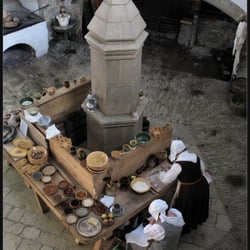
    Went on Heritage Day so was free to enter. Access is about 0.5k from the main car park & bus stand…read morealong a straight path (The Causeway) across marshy grassland. This early Tudor courtier's estate & house is or more accurately, was palatial or lets just settle on huge! A very large inner gatehouse with an enormous courtyard then main house beyond. There was an exhibition of the 2nd World War from a Naval perspective in the main cellar which had a rather fine vaulted roof, the Buck Hall & chapel were open to the elements but the hexagonal Kitchen Tower had been partially restored with an open hearth fire with Tudor cooking being demonstrated. The kitchen could also be viewed from half way up the spiral stairs that lead to the roof. You get a great view of the ruins & the adjacent Polo park. The tops of the walls were protected by red tiles which made them look a bit odd but will probably keep frost damage to a minimum - just an unsympathetic colour when seen from above. There is a visitor Centre with toilets & a formal garden beyond. I think tea & cakes were also available. The house was built in 1520-29 & was partially destroyed by fire in 1793.

    Photos
    Cowdray Ruins
    Cowdray Ruins
    Cowdray Ruins

    See all

    Viking Coastal Trail - landmarks - Updated May 2026

    Loading...
    Loading...
    Loading...