Stratfield Saye is best known as the home of the Duke of Wellington, which he purchased with funds…read morevoted to him by the British Parliament after the Battle of Waterloo. It contains a large number of items connected with the Duke, and is well worth a visit by those interested in this period of history.
His descendants still live there today, and the house can be viewed on tours limited each year to days in April and August (NB these must be booked in advance).
The origins of the house itself dates back to the mediaeval period, and by the 12th century the manor (the forerunner of today's estate) was owned by the Stoteville family. By the early in the 13th century it had passed by marriage to the Saye family (hence the modern name) and it passed again by marriage in the 14th century to the Dabridgecourts.
In 1629 the Dabridgecourts sold the property to the Pitt family, cousins of the great father-and-son Prime Ministers, and it is they who were largely responsible for giving the house the form we see today. The house was enlarged some time after 1630 by Sir William Pitt, Comptroller of the Household to King James I, and the two handsome stable blocks were built. Further changes were made, including the landscaping of the estate and raising some of the ceilings, in the 18th century by George Pitt, the first Baron Rivers. (Those familiar with the Pitt Rivers museum in Cambridge will recognise the name.)
In 1817, the UK Parliament voted a sum of £600,000 to the Duke of Wellington for him to purchase and estate and build a palace, along the same lines as had been done by the Duke of Marlborough over a century before. After looking at a number of different estates, Wellington chose Stratfield Saye. An important consideration for him was that the estate should have sufficient land to be self supporting, as he was not independently wealthy. Initially, he intended to build a larger palace nearby, but his desire to purchase a house in London (Apsley House) and rising costs, meant the palace was never constructed, although detailed plans were drawn up. (The plans can be viewed on the tour.) Instead, the Duke had more modest changes made, adding additional wings to the existing house, and modern conveniences such as central heating and some of the first ensuite toilet facilities seen in England.
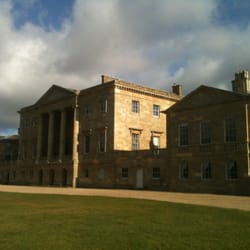
The house as we see it now is essentially two stories high with two sets of flanking wings, each with Dutch gables. Originally in brick, the house was rendered in the 18th century and is now a pleasant mustard yellow colour. The interior includes a grand entrance hall, a fine long gallery and other impressive rooms, with elaborate panelling and stuccoed ceilings. The drawing room in particular has wonderfully gilded plasterwork as well as a number of paintings from the Spanish Royal Collection. These were looted by a retreating Joseph Bonaparte, but captured by Wellington at the Battle of Vitoria at the end of the Peninsular War. (The Spanish King later decreed that Wellington could keep the paintings).
The house contains many other paintings, sculpture and furniture connected with the previous families, as well as the Duke of Wellington (who was a keen collector) and his descendants. These include some Roman mosaics from nearby Silchester. The library was his favourite room, which is left largely in the condition when he was a resident.
In the nearby stables, is the impressive funeral carriage made especially for Wellington's funeral parade in London, constructed partly from melted-down cannon from Waterloo in 1815. Also in the grounds is the grave of his horse, Copenhagen, which he rode during the Battle of Waterloo. The grounds also include some lovely gardens, which can be visited at the same time is it as the house.
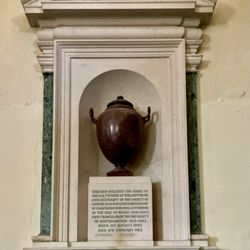
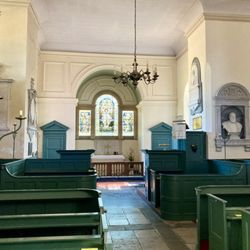
Tours to visit the house can be booked on the estate's website. These are strictly limited in availability to a couple of months a year, and last for about an hour. Visitors may visit the grounds and gardens, and also the nearby parish church, where all but the 1st and 6th Dukes are buried.
Our guide was extremely knowledgeable and provided insight into the life of Wellington and his family, as well the house and its contents. Note the house contains steps inside, and it is a 400m walk from the car park, via the cafe, past the stables, to the house itself. Photographs are not permitted inside the house.
[Note: I have lodged a correction for the map marker - Stratfield Saye is in fact 12 miles (18km) south west of Reading.]