Cancel

Open app

Search

Basildon Park Photos

Recommended Reviews - Basildon Park

Your trust is our priority, so businesses can't pay to alter or remove their reviews. Learn more about reviews.
Yelp app icon
Browse more easily on the app
Review Feed Illustration
Helpful 0
Thanks 0
Love this 0
Oh no 0

Verify this business for free

Get access to customer & competitor insights.

Verify this business

Silchester Roman City Walls & Amphitheatre - Silchester Roman City Walls and Amphitheatre

Silchester Roman City Walls & Amphitheatre

(2 reviews)

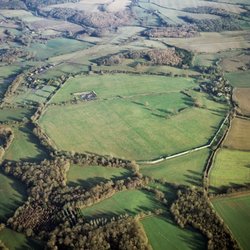
This idyllic rural spot was, for over four hundred years, a bustling Roman town at a crossroads on…read morethe road from London to the West Country. The location was the earlier tribal capital of the Atrebates, a Celtic tribe whose territory covered much of present day Berkshire, and parts of Hampshire and Wiltshire. Soon after the Roman conquest in 43AD, a Roman town was established on the same site, called Calleva Atrebates. The town was established within the current walls. These were originally made just of earth with a wooden palisade, but were faced with stone around 280 AD, enclosing around 100 acres. The town had a forum, baths, an inn, several temples and latterly a Christian Church. Evidence is that the town declined gradually after the withdrawal of the Roman Legions in 410AD, but unlike many other locations, it was eventually abandoned. Excavations have identified the street plan and the details described above, but most of the remains have since been covered over. The principal sight is therefore the impressive walls, which form an almost complete circuit. You can walk along the top of the bank above the walls around the site, a distance of around three miles. Close to the modern hamlet near the medieval Church but outside the walls, is the amphitheatre, which is well preserved. This has earthen banks on which wooden seating would have been erected. There is a car park on the north western corner. The walls are not suitable for wheelchairs (the access paths have stiles) , although a section is clearly visible from the road on its eastern side. The path to the amphitheatre is relatively level but the surface is uneven.

Originally a tribal centre of the Iron Age Atrebates, Silchester became the large and important…read moreRoman town of Calleva Atrebatum. Unfortunately there is not a great deal left of the original Roman Silchester as it was never re-occupied or built over after its abandonment in the 5th century. As a result of this it is apparently an archaeoligical haven as it gives an unusually complete picture of its development. It is however a very nice day out (in better weather), as there is a lovely 8 mile walk around the old city walls which remain in some form or another. There is also the remains of an impressive amphitheatre which is a must to view during the walk. The amphitheatre is just outside the old city walls, but its location is made apparrent when viewing the information boards. There is parking available by the city walls. Sign posts are not great, but if you keep driving around the wall you will come accross it eventually. Plenty of areas for pickniking in nice weather and plenty of lovely pubs to stop in and get a drink and bite to eat in the local area.

The Mathematical Bridge - GORGEOUS LOCATION

The Mathematical Bridge

(1 review)

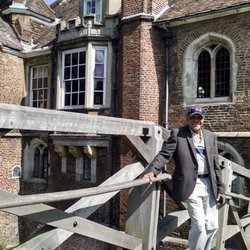
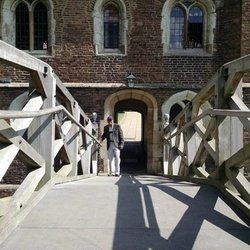
This bridge is located at the Queens university in Oxford. It is called the mathematical bridge…read morebecause of its structure - The arrangement of timbers is a series of tangents that describe the arc of the bridge, with radial members to tie the tangents together and triangulate the structure, making it rigid and self-supporting. This type of structure, technically tangent and radial trussing, is an efficient structural use of timber, and was also used for the timber supporting arches (centring) used for building stone bridges. Analysis of the design shows that the tangent members are almost entirely under compression, while the radial timbers are almost entirely subject to tension with very little bending stress, or to put it another way, the tangent and radial elements elegantly express the forces involved in arched construction. myths - A popular fable is that the bridge was designed and built by Sir Isaac Newton without the use of nuts or bolts. Various stories relate how at some point in the past either students or fellows of the University attempted to take the bridge apart and put it back together, but were unable to work out how to hold the structure together, and were obliged to resort to adding nuts and bolts. In reality, bolts or the equivalent are an inherent part of the design. When it was first built, iron spikes were driven into the joints from the outer side, where they could not be seen from the inside of the parapets, explaining why bolts were thought to be an addition to the original. Newton could not have been directly involved since he died in 1727, twenty-two years before the bridge was constructed.[6] However, more than two centuries earlier a strikingly similar design of a self-supporting bridge, with no nuts or bolts, was drawn by Leonardo di ser Piero da Vinci, probably in the late 1490s. The bridge was intended to be easily and quickly constructed and dismantled during military engagements. Here is some more info about it - https://www.queens.cam.ac.uk/visiting-the-college/history/college-facts/mathematical-bridge

Stratfield Saye Estate - Stratfield Saye view from house

Stratfield Saye Estate

(1 review)

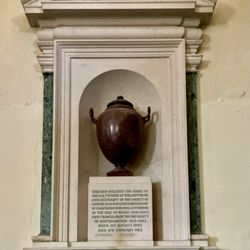
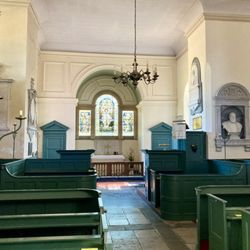
Stratfield Saye is best known as the home of the Duke of Wellington, which he purchased with funds…read morevoted to him by the British Parliament after the Battle of Waterloo. It contains a large number of items connected with the Duke, and is well worth a visit by those interested in this period of history. His descendants still live there today, and the house can be viewed on tours limited each year to days in April and August (NB these must be booked in advance). The origins of the house itself dates back to the mediaeval period, and by the 12th century the manor (the forerunner of today's estate) was owned by the Stoteville family. By the early in the 13th century it had passed by marriage to the Saye family (hence the modern name) and it passed again by marriage in the 14th century to the Dabridgecourts. In 1629 the Dabridgecourts sold the property to the Pitt family, cousins of the great father-and-son Prime Ministers, and it is they who were largely responsible for giving the house the form we see today. The house was enlarged some time after 1630 by Sir William Pitt, Comptroller of the Household to King James I, and the two handsome stable blocks were built. Further changes were made, including the landscaping of the estate and raising some of the ceilings, in the 18th century by George Pitt, the first Baron Rivers. (Those familiar with the Pitt Rivers museum in Cambridge will recognise the name.) In 1817, the UK Parliament voted a sum of £600,000 to the Duke of Wellington for him to purchase and estate and build a palace, along the same lines as had been done by the Duke of Marlborough over a century before. After looking at a number of different estates, Wellington chose Stratfield Saye. An important consideration for him was that the estate should have sufficient land to be self supporting, as he was not independently wealthy. Initially, he intended to build a larger palace nearby, but his desire to purchase a house in London (Apsley House) and rising costs, meant the palace was never constructed, although detailed plans were drawn up. (The plans can be viewed on the tour.) Instead, the Duke had more modest changes made, adding additional wings to the existing house, and modern conveniences such as central heating and some of the first ensuite toilet facilities seen in England. The house as we see it now is essentially two stories high with two sets of flanking wings, each with Dutch gables. Originally in brick, the house was rendered in the 18th century and is now a pleasant mustard yellow colour. The interior includes a grand entrance hall, a fine long gallery and other impressive rooms, with elaborate panelling and stuccoed ceilings. The drawing room in particular has wonderfully gilded plasterwork as well as a number of paintings from the Spanish Royal Collection. These were looted by a retreating Joseph Bonaparte, but captured by Wellington at the Battle of Vitoria at the end of the Peninsular War. (The Spanish King later decreed that Wellington could keep the paintings). The house contains many other paintings, sculpture and furniture connected with the previous families, as well as the Duke of Wellington (who was a keen collector) and his descendants. These include some Roman mosaics from nearby Silchester. The library was his favourite room, which is left largely in the condition when he was a resident. In the nearby stables, is the impressive funeral carriage made especially for Wellington's funeral parade in London, constructed partly from melted-down cannon from Waterloo in 1815. Also in the grounds is the grave of his horse, Copenhagen, which he rode during the Battle of Waterloo. The grounds also include some lovely gardens, which can be visited at the same time is it as the house. Tours to visit the house can be booked on the estate's website. These are strictly limited in availability to a couple of months a year, and last for about an hour. Visitors may visit the grounds and gardens, and also the nearby parish church, where all but the 1st and 6th Dukes are buried. Our guide was extremely knowledgeable and provided insight into the life of Wellington and his family, as well the house and its contents. Note the house contains steps inside, and it is a 400m walk from the car park, via the cafe, past the stables, to the house itself. Photographs are not permitted inside the house. [Note: I have lodged a correction for the map marker - Stratfield Saye is in fact 12 miles (18km) south west of Reading.]
Basildon Park - landmarks - Updated May 2026

Loading...
Loading...
Loading...