
The Mathematical Bridge Photos


Recommended Reviews - The Mathematical Bridge
Start your review...



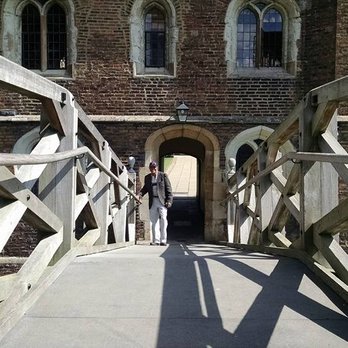
This bridge is located at the Queens university in Oxford. It is called the mathematical bridge because of its structure - The arrangement of timbers is a series of tangents that describe the arc of the bridge, with radial members to tie the tangents together and triangulate the structure, making it rigid and self-supporting. This type of structure, technically tangent and radial trussing, is an efficient structural use of timber, and was also used for the timber supporting arches (centring) used for building stone bridges. Analysis of the design shows that the tangent members are almost entirely under compression, while the radial timbers are almost entirely subject to tension with very little bending stress, or to put it another way, the tangent and radial elements elegantly express the forces involved in arched construction. myths - A popular fable is that the bridge was designed and built by Sir Isaac Newton without the use of nuts or bolts. Various stories relate how at some point in the past either students or fellows of the University attempted to take the bridge apart and put it back together, but were unable to work out how to hold the structure together, and were obliged to resort to adding nuts and bolts. In reality, bolts or the equivalent are an inherent part of the design. When it was first built, iron spikes were driven into the joints from the outer side, where they could not be seen from the inside of the parapets, explaining why bolts were thought to be an addition to the original. Newton could not have been directly involved since he died in 1727, twenty-two years before the bridge was constructed.[6] However, more than two centuries earlier a strikingly similar design of a self-supporting bridge, with no nuts or bolts, was drawn by Leonardo di ser Piero da Vinci, probably in the late 1490s. The bridge was intended to be easily and quickly constructed and dismantled during military engagements. Here is some more info about it - https://www.queens.cam.ac.uk/visiting-the-college/history/college-facts/mathematical-bridge read more
More info about The Mathematical Bridge

















Why does Yelp recommend reviews?
1 review that is not currently recommended
The reviews below are not factored into the business's overall star rating.

3 years ago


