Nothing to see except where it was…read more

The parish of St George-the-Martyr, Southwark, had a workhouse on the north side of Mint Street in Southwark.
It lies just to the south of the river between Blackfriars and Southwark bridges.
A workhouse with all the appalling and Dickensian connotations of deprivation, human misery and cruelty had stood on this block since 1782. One of the few remains of London workhouses
A new Brick House was built in Mint-street, and at Christmas opened for receiving and employing all the Poor of the Parish ; There are now in it 68 Men, Women, and Children, of which all that are able, spin Mop-Yarn, and Yarn for Stockings, which are knit by the Women; and beside this Work, 25 Children are taught to read, and say their Catechism.
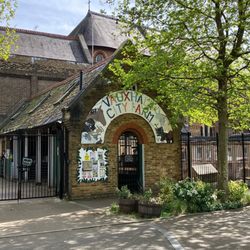
The story goes that this workhouse was Dickens' model for the workhouse in Oliver Twist. The workhouse is generally described as having been completely demolished but this is not true. The workhouse was subsequently used as, amongst other things, a furniture warehouse and a coffee essence factory. It was demolished, except for a wall, in 1935.
An important aspect of its resonance is the association with Charles Dickens, who had resided on nearby Lant Street of which he wrote in Pickwick Papers, and the contributions that this area made to his writing.
In 1865, the Mint Street Workhouse was the subject of a scathing report in The Lancet, describing the dreadful conditions:
This house is situated in Mint Street, Southwark, a densely crowded district on the south east of the Thames, with a population of 55,510 and is surrounded with every possible nuisance, physical and moral. Bone-boilers, grease and cat-gut manufactories represent some of them, and there is a nest of thieves, which has existed ever since the days of Edward the third. The house was built for 624 inmates, but when we visited it there were only 420 in residence, and yet it appeared very full. Classification there is none, excepting the common division of male and female wards, and the separation of the 'foul cases.' In a house so conditioned there can be neither order nor methodWe cannot doubt that, with such a history and so many surroundings, it is our duty to condemn this workhouse, which ought to be removed, and one built better adapted to fulfil its duties to the poor and sick of the neighbourhood.
This description provoked outrage, and was instrumental in leading to the passing of the Metropolitan Poor Law Act of 1867 which went some way to alleviating conditions in these institutions.