Cancel

    Open app

    Search

    Stanley Town Hall

    1.0 (1 review)

    Stanley Town Hall Photos

    Recommended Reviews - Stanley Town Hall

    Your trust is our priority, so businesses can't pay to alter or remove their reviews. Learn more about reviews.
    Yelp app icon
    Browse more easily on the app
    Review Feed Illustration

    3 years ago

    Helpful 0
    Thanks 0
    Love this 0
    Oh no 0

    Verify this business for free

    Get access to customer & competitor insights.

    Verify this business

    Salem Town Hall - Salem Town Hall, Winston-Salem

    Salem Town Hall

    4.0(1 review)
    69.7 mi

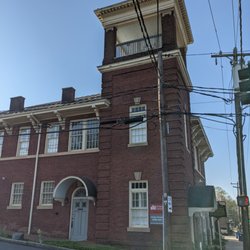
    Before there was Winston-Salem, there was Winston and there was Salem. This marker is in front of…read morethe former Salem Town Hall. It reads, "The Salem Town Hall was Salem's last municipal building before the Town's consolidation with Winston in 1913. The last of Salem's town halls to remain standing, the building was designed by the prominent local architect Willard C. Northup and features the Italianate style as well as local Moravian architectural influences. The 1912 Salem Town Hall expresses the local pride and development of Salem in the year before its consolidation with the city of Winston. After the two towns merged, the building continued in use for over fifty years as one of Winston-Salem's most important fire stations. Listed on the National Register of Historical Places in 1983." The origin of the town of Salem dates to January 1753, when Bishop August Gottlieb Spangenberg, on behalf of the Moravian Church, selected a settlement site in the three forks of Muddy Creek. He called this area "die Wachau" (Wachovia) named after the ancestral estate of Count Nicolaus Ludwig von Zinzendorf. The land, just short of 99,000 acres, was subsequently purchased from John Carteret, 2nd Earl Granville. On November 17, 1753, the first settlers arrived at what would later become the town of Bethabara. This town, despite its rapid growth, was not designed to be the primary settlement on the tract. Some residents expanded to a nearby settlement called Bethania in 1759. Finally, lots were drawn to select among suitable sites for the location of a new town. The town established on the chosen site was given the name of Salem (from "Shalom" meaning "Peace", after the Canaanite city mentioned in the Book of Genesis) chosen for it by the Moravians' late patron, Count Zinzendorf. On January 6, 1766, the first tree was felled for the building of Salem. Salem was a typical Moravian settlement congregation with the public buildings of the congregation grouped around a central square, today Salem Square. These included the church, a Brethren's House and a Sisters' House for the unmarried members of the Congregation, which owned all the property in town. For many years only members of the Moravian Church were permitted to live in the settlement. This practice had ended by the American Civil War. Many of the original buildings in the settlement have been restored or rebuilt and are now part of Old Salem Museums & Gardens. Salem was incorporated as a town in December 1856. Salem Square and "God's Acre", the Moravian Graveyard, since 1772 are the site each Easter morning of the world-famous Moravian sunrise service. This service, sponsored by all the Moravian church parishes in the city, attracts thousands of worshipers each year. [Review 14988 overall, 490 of 2021, number 2854 in North Carolina.]

    Photos
    Salem Town Hall - Salem Town Hall, Winston-Salem

    Salem Town Hall, Winston-Salem

    Salem Town Hall - Salem Town Hall, Winston-Salem

    Salem Town Hall, Winston-Salem

    Salem Town Hall - Salem Town Hall, Winston-Salem

    See all

    Salem Town Hall, Winston-Salem

    Stanley Town Hall - townhall - Updated May 2026

    Loading...
    Loading...
    Loading...