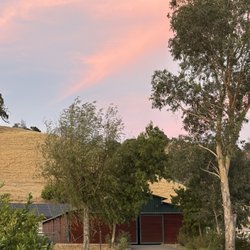
Skye Valley has a lot to recommend it. The barns are clean and well-maintained. The horses are treated like royalty and have round-the-clock care designed to accommodate all kinds of feeding challenges. The farrier, veterinarian, and even the chiropractor make regular appearances. The basic items are all checked off the list--turnout, exercise, water. The barns are safe places to leave your kids or your wallets unattended. Jaimi genuinely loves horses, and that shows in how the horses under her care are treated.
At the time that I rode from her, I was young and idealistic, perhaps too sycophantic. I wasn't concerned that the horses in training with Jaimi were exercised for perhaps 15 minutes each riding day, though the owners thought they were paying for much more. I didn't recognize that the barn suffered from the same syndrome that afflicts so many dressage-centered barns, where the students are taught to ride front to back instead of back to front. I learned to toss around phrases like "in a frame" or "collected" like a champ, without the most basic idea of what these words meant or how to achieve them without limiting the horses' natural movement. I thought I knew what I was doing, because I thought that my trainers knew what they were doing.
There were moments when these problems became starker. Every thoroughbred lesson horse in the barn, like clockwork, developed behavioral issues (bucking, rearing) that eventually made them dangerous to ride. I went in to feed one of these thoroughbreds one night, with a minimal kind of "be careful" warning from Jaimi; once I was in his stall, the horse reared up at my head, pinning me to the stall door. This horse who had been a complete gentleman the last time I'd ridden him, only a year before that night, was now entirely unmanageable.
Accidents can happen and these situations are not always the fault of poor training methods. Yet every barn I've been to since Skye Valley has shocked me with its utter lack of drama. Turns out that in much of the civilized world, "training" does not send horses into bucking and rearing fits. Elsewhere, fireworks" are not typical, because the goal is to work with the horse rather than to overwhelm the horse until he panics and violently resists his rider. Yes, a young and untried student might make a mistake with a horse that causes this kind of reaction, but the trainers of a barn of 20-head do not use methods that invoke this reaction because they have learned how to train a horse correctly. This kind of ill-conceived training can turn a decent horse into a resistant, frothy and slow starter; this kind of training can, and did, turn very sensitive, often also very talented, horses into inconsistent and sometimes dangerous basket cases.
In addition to the impact on horses of this insensitive, impatient, demanding and often cruel attitude, was the impact on humans. The assistant trainer at the time had me trot a horse at a fence with no warm-up; when both the horse and I landed jarringly, this trainer screeched at me that I'd ridden it terribly and the horse had every right to dump me. It is one of my life's regrets that I did not screech back: jumping a horse with no warm-up is dangerous for horse and rider, and if an accident had occurred it would have been due to her poor methods.
I assumed then, and I suppose I assume now, that these training methods got results with some horses. Many students at this barn have been very successful, if inconsistent. I on the other hand, well...when I came to Skye Valley, I was jumping 2'9" consistently and smoothly. When I left, I was jumping 2'3" consistently and smoothly. By the end, I assumed that I was simply not talented, not built for it, not good enough. Indeed, some of the aspects of riding that came most naturally to me, like having light and gentle hands and an intuitive sense for the horse's rhythm, had been basically stampeded out of me; instead, I'd learned to ride in that way dressage students learn, all hand and very little seat, resisting the horse' natural way of motion. The horses I rode, too, had started to have "episodes" in which they resisted the work in the ring by bolting or bucking.
There are elements I will feel guilty about for a long time, and have. I should never have tried to take a Paint mare built for Western Pleasure and make her into a hunter/jumper horse. She hated every second of it, and she was never a safe or happy jumper. There is a photo of me kicking her over a fence cowboy-style and I was applauded for that moment in the barn later on, but I never wanted to be the kind of rider who demands a horse do something she is fundamentally unsuited for and then punishes her when she tells me no. That might be good riding, in some people's minds, but it is terrible horsemanship. That is what I learned here: I learned to assume that the horse is always wrong, and my will is divine and dominant. Now I am unlearning that cruelty. read more