I love Scarborough Castle for its position and the general ambiance. Kids seem to love it too…read more Wonderful views of both bays from here.
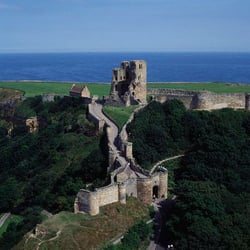
The ruins of the castle are situated at the Eastern extremity of the town, on a lofty promontory, elevated more than 300 feet on the southern, and 330 feet on the northern side, above the level of the sea, and presenting to the north, the east, and the south, a vast range of perpendicular rocks, completely inaccessible. Its western aspect is also bold and majestic, being a high, steep, rocky, slope, commanding the town, harbour and the bay. The whole area, at the top of the hill, is upwards of nineteen acres of excellent soil, gently sloping near 20 feet from the north to the south lines.
During the civil wars, in the reign of Charles I. this castle was twice besieged, and taken by the parliamentary army.
Scarborough Castle, is supposedly haunted by the ghost of Piers Gaveston, Earl of Cornwall, favourite and companion since childhood of Edward II. Gaveston was captured at the castle in 1312. He surrendered on condition that his life would be spared and that he would have a fair trial. However, on the journey to London he was beheaded at Warwick. He is said to have ever since enjoyed a vendetta against living people by lurking in the deep shadows of the castle walls and luring them to their deaths over the cliff edge to the sea, 300 feet below.
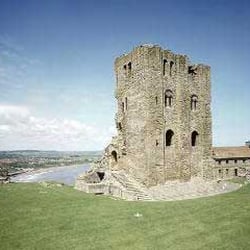
Although the top of the keep has disappeared, some remaining walls provide a good indication of how splendid this structure was. Fireplaces at the first and second levels can still be seen in the walls. Nothing exists of the once mighty forebuilding except the foundations, which show clearly its size and estimated height of some 40ft (12m). From this date, Scaborough Castle became practically impregnable, although the outer defences were continually improved and reinforced over the years. Scarborough Castle was the strategically important Northern base of Kings and Queens for almost five centuries, and with each new reign came further additions and improvements to the original building.
Perched high on a headland above the North Sea, Scarborough Castle occupies one of the most dramatic castle sites in the country and boasts over 2,500 years of turbulent history. Before the castle was built, this natural fortress was favoured by prehistoric settlers before serving as a Roman signal station and Viking haven. It has endured sieges from medieval kings and Civil War armies, and German naval bombardment during WWII. Now you can climb to the battlement viewing platforms for dramatic coastline views, and take tea in the 18th-century Master Gunner's House.
Built in the reign of King Stephen, by William le Gros; Earl of Albemarle and Holderness. Here Piers de Gaveston, the favourite of Edward II. sought refuge against the exasperated barons, but after a short siege, he was obliged to surrender for want of supplies, and lost his head, as already related, (the ghost) in the castle of Dedington.
Robert Aske, the leader of the Pilgrims of Grace, made an unsuccessful attempt upon Scarborough Castle, in 1536. In the time of Wyat's rebellion, in 1553, it was surprised and taken by the stratagem of introducing a number of soldiers, disguised as peasants. This achievement was performed by Thomas, second son of Lord Stafford, but his success was of short duration, three days afterwards the place was retaken by the Earl of Westmoreland, and Stafford; and three other of the leaders were conveyed to London, and executed for high treason. A nasty end.
Really must be visited when in Scarborough.