Many books have been Written using Whitby as the setting. Most notably of course Dracula and the…read moreteen books of the Witby Witches series by Robin Jarvis which mentions the whole town but particularly the 199 steps, the hand of glory, in the museum, and the Aufwaders..a mysterious clan of gnome like fisherfolk who live in the cliffs. But the most famous as I say is Dracula. The author Bram Stoker, set three quarters of his story around Whitby and it is still possible to retrace those steps of the undead, taking the Dracula Trail Tour.
Overall I was very impressed with the Whitby Dracula Trail
For 50p I bought the Whitby Dracula Trail guide from the local Tourist Information Centre. The guide was developed with the help of the London based Dracula Society and takes in the landmarks of old and new Whitby.
The tour starts at the Bram Stoker Memorial Seat which was built on the 20th April 1980 to commemorate the 68th anniversary of Bram Stoker's death. It was said that on this spot directly opposite the Royal Hotel, the inspiration for the novel, Dracula, was born.
This bench on the west cliff, overlooking Whitby Harbor, is one that all travelers should visit at least once. Bring a breakfast thermos of (blood?) bloody Marys and your tattered copy of Dracula. Read chapters six through eight while sitting on the bench, and watch the novel come to life before you begin the trail.
Below are the cold sand beaches that welcomed the Russian schooner Demeter, the ship that brought Dracula to England from Transylvania. In the book, the ship's captain is dead and lashed to the wheel. The crew is missing. The only sign of life on board is a huge, black, dog-like creature that dives from the ship and disappears into the narrow alleys of Whitby's east side.
A real Russian schooner called Demitrius washed ashore on those sands in 1885, about a decade before Stoker visited Whitby for a holiday weekend.
Gaze across the harbor to the east cliff where the red-roofed houses seem to pile up on top of each other against the hillside, just like Stoker's character Mina Harker described. At the top of the cliff are St. Mary's Church and its graveyard of limestone markers, worn blank by the North Sea wind. (some say brass plaques were removed to make musket balls in the Civil War).
This is the graveyard where Stoker's ill-fated character Lucy is first seduced by the count.
Dracula didn't die in Whitby, but he took refuge in the grave of George Cannon, who had commited suicide. According to the booklet there is no trace of George Cannon grave today.
A Commemorative Plaque is at 6 Royal Crescent, on the West Cliff, where Bram Stoker stayed. There are still hotels in Royal Crescent today.
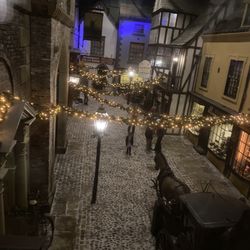
As the self-guided tour winds its way around the old streets of Whitby documenting different points of interest it is easy to imagine yourself back in the 1870s when Stocker wrote his classic novel. As you make your way along the narrow streets and steep slopes, numerous old fashioned restaurants and quaint shops reminiscent of times past can be seen. Whitby has gone out of its way to mark and memorialize every possible sight in the town that had a place in the novel.
The final destination on this tour is perhaps the most famous landmark mentioned in Dracula the 199 steps leading up to St. Mary's Church. It was here that Mina made a frantic dash as she ran up the steps to save Lucy only to find her friend being protected and asleep beside the Black Dog
(Dracula). Of course the legend is that the black dog exists and can still be seen or heard howling.
Even better do the tour at night on a Whitby Goth weekend when the place is full of vampires.
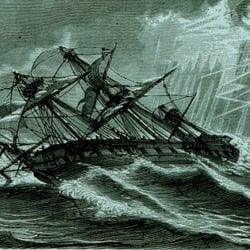
Then without warning the tempest broke. With a rapidity which, at the time, seemed incredible, and even afterwards is impossible to realize, the whole aspect of nature at once became convulsed. The waves rose in growing fury, each over-topping its fellow, till in a very few minutes the lately glassy sea was like a roaring and devouring monster. White-crested waves beat madly on the level sands and rushed up the shelving cliffs. Others broke over the piers, and with their spume swept the lanthorns of the lighthouses which rise from the end of either pier of Whitby Harbour.
To add to the difficulties and dangers of the time, masses of sea-fog came drifting inland. White, wet clouds, which swept by in ghostly fashion, so dank and damp and cold that it needed but little effort of imagination to think that the spirits of those lost at sea were touching their living brethren with the clammy hands of death, and many a one shuddered as the wreaths of sea-mist swept by.
Bram Stoker, Dracula