Observatory at Mauna Kea Photos


You might also consider

More like Observatory at Mauna Kea
Recommended Reviews - Observatory at Mauna Kea
Start your review...


Reviews With Photos
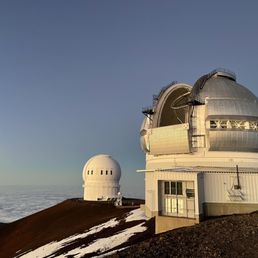

Highly recommend making your way to the top...if you have 4 wheel drive. The 9k visitor center views were obstructed and due to covid didn't have any telescopes. If you plan to go either have the 4wheel (road was graded well and we drove in 4L without any issues) or go with a group tour.


As much as I wanted to see the stars and moon, sadly it was not as expected. It was pretty fair from our hotel, so by the time we got there we only had an hour left to go up on the drive to the observatory. Bring coat and wear long warm pants!!!! Definitely was not prepared for this. Our car wasn't four wheel drive to even attempt going up the high steep road. I didn't bring a coat or anything. I didn't expect it to be freezing cold. All I packed with me were summer clothes. Who knew I needed winters coat in Hawaii. So I had to buy a sweater at the shop. Since we were unable to drive up, we decided to hike up and wait till the hours are near to see the stars at night where the shop were located. That hike nearly killed me. I was out of breathe, freezing my behind, out of water, and got dehydrated. The view was amazing. I felt accomplished and king of the world. Even thou it wasn't a far hike. Afterwards we climb back down and met with everyone at the shop. They were showing us the planets, stars,and moon. We only got a good visual of the moon. It was very cloudy that night so we were able to see much. I would love to come back here and really see what they have to offer.


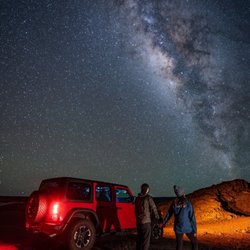
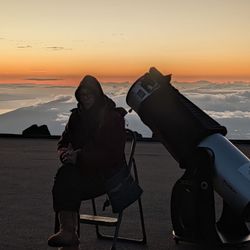
If I was going to die tomorrow this would be the thing I would do right before I take the long last walk. You can take a tour bus but I say... rent a car! The rental place will also tell you that you will loose your car insurance if you go to the top but I say you only live once. The roads are not all that bad and they are in the process of repaving them as of today's date. Now, think of being able to see every single star in the universe. They surround you like a blanket. This is the highest point in America (that is what I was told) so it is almost like you can touch the sky. Also, you are above the clouds. The moon didn't come up until we were up at the top for about 20 minutes. After the moon arose, the pitch black area lit up. The clouds underneath us looked like the ocean running right up to the mountain. Also, they have several scopes set up and very knowledgeable people available to answer any questions you might have. Please note that if you do take the risk like us with the rental car, there is less oxygen getting to your gas up on top of the mountian. Just take your time getting up there but this place was 100% worth it!


Long drive to the top where the telescopes are. On a dry week, you could probably take a non 4WD up there, but at your own risk. There is a paved road after a windy bumpy loose gravel trail (hence the 4WD requirement) views going to the top is just as perfect as the view from the top. We went during June, weather was dry, temperature was in the high 50, once u get half way....ur above the clouds. Great experience!


4 years ago
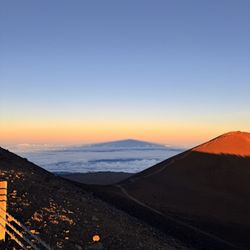
It's worth every bump you hit! In our last visit we were unaware we needed four wheel drive and didn't attempt with 2 wheel. This time we made sure to take 4 wheel drive up to the observatory. Please bring warm clothes including earmuffs and mitts. You will be thankful to yourself for getting it. It may be cloudy when you drive up with ring of clouds around both Mauna Kea and Mauna Loa but many a times sky above at 13k is clear. You would also see Haleakala in west in distance if its clear. - BONUS! At 9k visitor center there is a restroom and then there are porta potties where observatories are. The road is 25% grade so be kind to your breaks and use 4L with m2 to drive up and 4L +drive while coming down. The rangers checked tank plus if the car is 4wheel and have instructions. Mind you! They also checked break after we reached down. That's good for you and your car! Now up at the summit you might be lucky to see the observatories rotating and opening for their nightly duties. They used to allow admissions in the past and sky gazing program at visitor center but not anymore. So you might have to check with them. No drones allowed - fyi! The rangers will also be everywhere and make everyone leave 10 minutes after sunset. Key point- bring enough water for all the members with you. Water has oxygen which helps you breathe and keeps you hydrated. Coming back to experience... The views are ethereal. This was one of the topmost points in my list ( pun intended) in big island. Sunset hues are out of the world. If you go on moonless nights and clear days you might get to see more stars and planets. read more




5 years ago
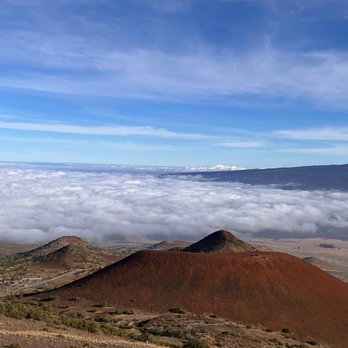
Great views, cold and clear! Bring water, camera and warm clothes! Went near sunset and if you have good 4wd, worth the drive!! read more


5 years ago
Highly recommend making your way to the top...if you have 4 wheel drive. The 9k visitor center views were obstructed and due to covid didn't have any telescopes. If you plan to go either have the 4wheel (road was graded well and we drove in 4L without any issues) or go with a group tour. read more


As much as I wanted to see the stars and moon, sadly it was not as expected. It was pretty fair from our hotel, so by the time we got there we only had an hour left to go up on the drive to the observatory. Bring coat and wear long warm pants!!!! Definitely was not prepared for this. Our car wasn't four wheel drive to even attempt going up the high steep road. I didn't bring a coat or anything. I didn't expect it to be freezing cold. All I packed with me were summer clothes. Who knew I needed winters coat in Hawaii. So I had to buy a sweater at the shop. Since we were unable to drive up, we decided to hike up and wait till the hours are near to see the stars at night where the shop were located. That hike nearly killed me. I was out of breathe, freezing my behind, out of water, and got dehydrated. The view was amazing. I felt accomplished and king of the world. Even thou it wasn't a far hike. Afterwards we climb back down and met with everyone at the shop. They were showing us the planets, stars,and moon. We only got a good visual of the moon. It was very cloudy that night so we were able to see much. I would love to come back here and really see what they have to offer. read more



19 years ago
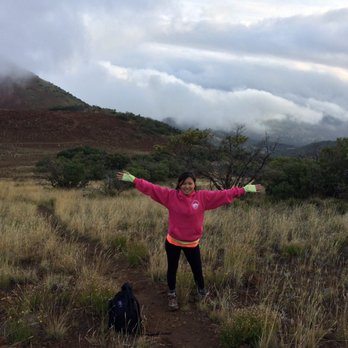
If I was going to die tomorrow this would be the thing I would do right before I take the long last walk. You can take a tour bus but I say... rent a car! The rental place will also tell you that you will loose your car insurance if you go to the top but I say you only live once. The roads are not all that bad and they are in the process of repaving them as of today's date. Now, think of being able to see every single star in the universe. They surround you like a blanket. This is the highest point in America (that is what I was told) so it is almost like you can touch the sky. Also, you are above the clouds. The moon didn't come up until we were up at the top for about 20 minutes. After the moon arose, the pitch black area lit up. The clouds underneath us looked like the ocean running right up to the mountain. Also, they have several scopes set up and very knowledgeable people available to answer any questions you might have. Please note that if you do take the risk like us with the rental car, there is less oxygen getting to your gas up on top of the mountian. Just take your time getting up there but this place was 100% worth it! read more


10 years ago
Long drive to the top where the telescopes are. On a dry week, you could probably take a non 4WD up there, but at your own risk. There is a paved road after a windy bumpy loose gravel trail (hence the 4WD requirement) views going to the top is just as perfect as the view from the top. We went during June, weather was dry, temperature was in the high 50, once u get half way....ur above the clouds. Great experience! read more


10 years ago
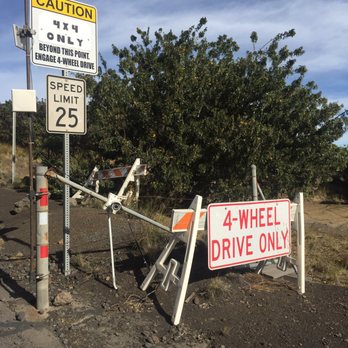
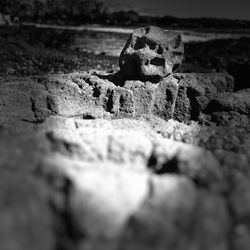
Not many may know: Hawaii is the longest and most isolated archipelago in the world. This isolation of the Hawaiian Islands, located in the middle of the Pacific Ocean makes Mauna Kea one of the best locations on earth for ground-based astronomy. Today while visiting, we learned that it is an ideal location for submillimeter, infrared and optical observations. The other factor in selecting the home of this observatory is the altitude. Other little known facts that you will learn while visiting, this observatory lies at an elevation almost twice that of any other major observatory and above 40 percent of the Earth's atmosphere; there is thus less intervening atmosphere to obscure the light from distant stellar objects. A high proportion of nights at Mauna Kea are clear, calm, and cloudless owing to local weather peculiarities and the fact that the mountaintop lies above cloud cover most of the time. The high elevation and extremely dry, clear air make the site ideal for observing astronomical objects that emit radiation at far-infrared wavelengths, which are easily blocked by atmospheric water vapour. As air pollution from industrialization and light pollution from artificial lighting increased during the Industrial Revolution, astronomers sought observatory sites in remote locations with clear and dark skies, naturally drawing them towards the mountains. The highest mountains of the Hawaiian Islands, are located on the Big Island. Mauna Kea rises 13,796 feet and Mauna Loa 13,679 feet above sea level. Mauna Kea is a dormant volcano. The summit of Mauna Kea is so high that visitors are advised to stop at the visitor station for at least 30 minutes to acclimate to atmospheric conditions before continuing to the summit. At 14,000 feet, there is 40% less oxygen than at sea level. This was our second visit, the first time, several years back was during the month of December, with temperatures dipping into the low 40's, it was much too cold, paired with high winds. This clear, no wind day in late November was ideal for a second attempt to reach the summit. Mauna Kea houses the world's largest observatory. It has became the site of the world's most important collection of telescopes designed for observation. Once you reach the top of the summit, you will see some of the largest reflectors, owned by the United Kingdom, Canada-France-Hawaii, the NASA, The Keck telescope, operated jointly by Caltech and the University of California. the Japanese Subaru and the Gemini. There are other smaller ones, which I could not recall. You must have a four wheel drive vehicle to drive to the top of the summit, why risk your safety and ruin a perfectly good rent a car? Other cool things to take notice of while visiting... Lake Waiau is located here, if you are able to handle the cold, (dress appropriately in winter clothing) and altitude, you may hike to see it. We did not do this but we're told by the park ranger that it would take approximately an hour and half. An hour if you are a sherpa. There is a trail, so we put it on our list, for a future visit. The lake is one of the highest in the world, an anomaly in the peak region of Mauna Kea as everywhere else the ground is unable to retain water. The exact nature of the impermeable ground layer of the lake is unknown. It is one of very few lakes at all in the state of Hawaii. Mauna Kea Adz Quarry, a large complex of archeological sites, is located on the south slope of Mauna Kea in the Mauna Kea Ice Age Natural Area Reserve. The Adz Quarry is the largest primitive rock quarry in the world and was used by the ancient Hawaiians to both obtain basalt and make various stone tools. An adze (adz) is an ancient type of edge tool dating back to the stone age. Similar to an axe in shape, it was used for cutting, smoothing, and carving wood and other materials. In the Hawaiian Islands, an adze blade was generally made out of basalt, a common volcanic rock formed by the rapid cooling of lava. Basalt was favored for tool making because of its hardness and ability to hold an edge. An adze was made by quarrying a suitable piece of rectangular basalt and then chipping at it with a piece of hard stone until it took on the rough shape of an axe head. The upper and lower sides of the adze blade were then tapered using a grinding stone sprinkled with sand and water. Once the sides had been ground down and the edge was sharpened, the blade was secured to a wooden handle with a fiber cord. The finished adze was then ready to be used or traded for other goods or services. A perfect and solid tool. Basalt is a fine-grained, hard rock that forms when bits of lava shoot out of volcanoes, so it's one kind of igneous rock. When the lava cools quickly, it turns into basalt. read more




11 years ago
More info about Observatory at Mauna Kea
Mauna Kea Access Rd
kamuela, HI 96743
Directions
Hours
Other Amenities
Ask the Community - Observatory at Mauna Kea















Observatory at Mauna Kea - observatories - Updated October 2026
Browse Nearby
BEST of kamuela, Hawaii Restaurants near Observatory at Mauna Kea
BEST of kamuela, Hawaii Coffee near Observatory at Mauna Kea
BEST of kamuela, Hawaii Breakfast near Observatory at Mauna Kea
BEST of kamuela, Hawaii Shopping near Observatory at Mauna Kea
BEST of kamuela, Hawaii Hotels near Observatory at Mauna Kea


