North Haven Historical Marker Photos
More like North Haven Historical Marker
Recommended Reviews - North Haven Historical Marker
Start your review...



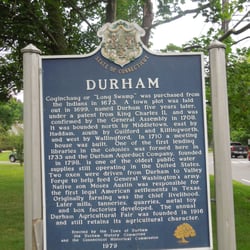
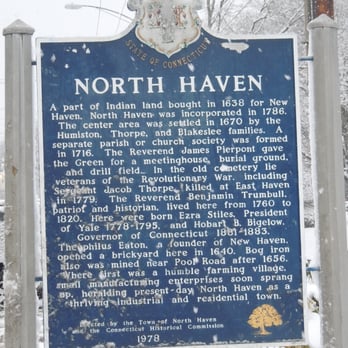
On the Town Green across from North Haven's Memorial Town Hall you'll find this marker with an interesting narrative of the town's settlement and history. It's Indian origins, settlement by three pioneering families, early patriarchs and benefactors, and development of agriculture and manufacturing are all described nicely. This is a two-sided marker from the CT Historical Commission, with the familiar white lettering on a blue background. It has the same inscription on both sides.. The marker dates to 1978 and is in pretty good shape except for some chipping, and peeling on the blue paint at the top of the sign. I took these photos on a snowy day. The shot of the sign against the background of Town Hall and all that snow came out very nicely. The full inscription reads: A part of Indian land bought in 1638 for New Haven, North Haven was incorporated in 1786. The center area was settled in 1670 by the Humiston, Thorpe, and Blakeslee families. A separate parish or church society was formed in 1716. The Reverend James Pierpont gave the Green for a meetinghouse, burial ground, and drill field. In the old cemetery lie veterans of the Revolutionary War, including Sergeant Jacob Thorpe, killed at East Haven in 1779. The Reverend Benjamin Trumbull, patriot and historian, lived here from 1760 to 1820. Here were born Ezra Stiles, President of Yale 1778 - 1795, and Hobart B. Bigelow, Governor of Connecticut 1881 - 1883. Theophilus Eaton, a founder of New Haven, opened a brickyard here in 1640. Bog iron also was mined near Pool Road after 1656.Where first was a humble farming village, small manufacturing enterprises soon sprang up, heralding present-day North Haven as a thriving industrial and residential town. Erected by the Town of North Haven and the Connecticut Historical Commission 1978 read more