Cancel

Open app

Search

Mariä Himmelfahrt Photos

Mariä Himmelfahrt Reviews in Other Languages

St. Georgskirche - Epitaph

St. Georgskirche

4.5(6 reviews)
12.6 km

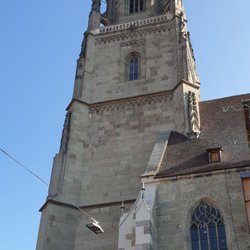
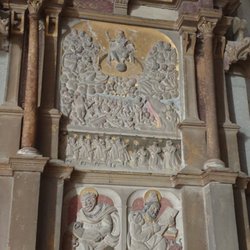
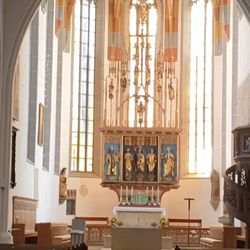
St. Gorgeskirche is a late Gothic hall church built between 1427 and 1505 with its 89.9-meter tower…read moreabove the west portal, popularly known as "Daniel," can be seen from some distance, is the town's landmark. The council of the imperial city of Nördlingen decided to build the Georgskirche on October 17, 1427. The choir of the hall church was completed in 1451, and in 1454 construction of the tower began. The high altar by Friedrich Herlin was completed in 1462, and the tower in 1490. With the completion of the vault in 1505, the construction, which consists largely of suevite, was completed. Because Nördlingen joined the Reformation under Kaspar Kantz, St. Georg became the Protestant town church in 1523/1525. The 93-meter long and over 20 meter high nave makes St. Georg one of the largest hall churches in southern Germany. The building consists of a three-aisled choir and a three-aisled, twelve-bay hall with twelve central columns. The baroque high altar is decorated with late Gothic wooden sculptures. It is a crucifixion group with Mary and John and two mourning angels, flanked by St. George with the defeated dragon at his feet and Mary Magdalene with the anointing vessel in her hand. These figures, which can be seen today in the Nördlingen City Museum, were originally in a wooden shrine with movable wings that was built around the same time and painted by Friedrich Herlin. The altar was given its baroque appearance in 1683. The housing of the late Gothic wooden shrine was only discovered under the baroque casing during the restoration in 1971-1973. Today it stands on the north wall with the painted rear front (eight Passion scenes of Christ and the Last Judgment ) to the front. The late Gothic stone pulpit has a plinth with lush, intertwined ribs and a staircase with an openwork tracery parapet. The four evangelists with their symbols are depicted as reliefs on the pulpit. In between, the Man of Sorrows, Mary, Mary Magdalene, John the Evangelist and St. George can be seen under canopies. The baroque sound cover, on which Christ is enthroned with the globe, was made by Johann Michael Ehinger in 1681. The wooden sound cover is decorated with putti and angel heads. First restoration happened in the years 1877 - 1887. On March 30, 1945 at 9:25 p.m., an aerial bomb destroyed the "Steinmeyer Organ" set up in 1889. On February 2,1974 a fire destroyed the old baroque organ from 1610.
Photos
St. Georgskirche - St. Georg

St. Georg

St. Georgskirche - Epitaph

Epitaph

St. Georgskirche - Orgel und Kanzel

See all

Orgel und Kanzel

St. Salvatorkirche - Altar

St. Salvatorkirche

3.3(3 reviews)
13.0 km

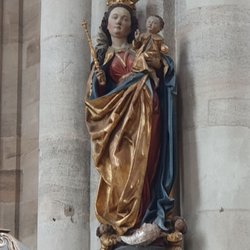
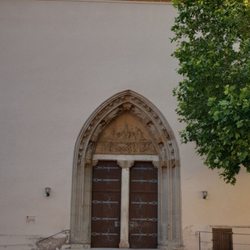
The church was built on the southwestern edge of the city center. The reason for the construction…read morewas the "Host Miracle" in 1381, when a piece of a consecrated host could not be found after a ceiling collapse in the house of a terminally ill patient. The ruins were burned and the missing host is said to have been found intact from the ashes. The Gothic winged altar in the choir was made between 1505 and 1507 for the Church of St. Michael in Fürth. In 1815 it was sold to an art dealer and acquired in 1827 for the St. Salvator Church, as a replacement for the high altar by Sebastian Taigfrom 1518, which was largely destroyed in the course of the Napoleonic Wars. The altar was restored and partially redesigned and enlarged, with figures from the previous altar also being built in. The altar shrine has four movable wings, each painted on both sides, and two fixed wings. If the inner wings are closed, a representation of the Most Holy Trinity appears in the middle, enthroned on clouds and surrounded (in the background) by flocks of praising angels. The paintings were probably created at the end of the 15th century and probably come from the environment of the Nürnberg painter family Traut. The two side altars, the Marien Altar and the Joseph Altar, were created in 1955 by Joseph Steinacker from Wemding to replace the two neo-Gothic side altars, which were removed in the course of a comprehensive redesign of the church in 1879 and 1884. The statue of the Virgin Mary on the Altarpiece was acquired in the art trade in 1954. When the figure was created is unclear. Some sources point to the year 1650, others to the year 1520. The church has been completely renovated since 2001. The work was completed in 2012; the total costs were estimated at 2.43 million €. The costs were raised through a fundraising campaign.

Photos
St. Salvatorkirche - Skulptur

Skulptur

St. Salvatorkirche - St. Salvator

St. Salvator

St. Salvatorkirche - Skulptur

See all

Skulptur

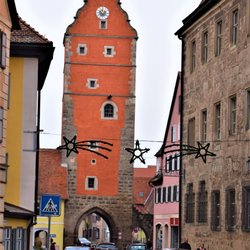
Stadtmauer - Wörnitztor Getting ready for Christmas

Stadtmauer

5.0(1 review)
17.6 km

The city wall of Dinkelsbühl is one of three well-preserved medieval city fortification walls in…read morethe area that encircle the entire old towns; incidentally, other two towns are Nördlingen and Rothenburg o. d. Tauber. It's always so much fun to walk around these medieval towns imagining how the life might have been lived within these walls. A circular hiking trail (about 2.6 km) leads around the entire medieval city wall of Dinkelsbühl, mostly right along the wall. The western part of the fortification is particularly impressive. Due to the hillside location, the double wall built on the deep moat has a staggered height. We have King Ludwig I of Bavaria to thank for our pleasures of walking on the entire city wall around this fantastic medieval town since he placed the wall under his protection and prohibited for demolition in 1826. It's a must stop when you are visiting this area. There is a free parking lot available outside the city wall at every town gate for your convenience. To this day, all road traffic in and out of the city only goes through the four medieval city gates. Of course, you always have to watch out for oncoming traffic. This is probably one of the reasons why large parking lots were built for visitors and tourists in front of each gate. This is very practical, especially since you can park right in front of the first attractions you see as you enter the old town. The Segringertor already existed in 1384. During renovations in the 17th century, the gate tower was given its current baroque dome. There is a small, at first glance somewhat inconspicuous, Chapel of the Three Kings built in 1378 near the gate tower. Today the church houses a memorial for the victims of the Nazi regime. The Rothenburgertor was built around 1390 and has its original appearance to this day, which is why this gate can only be passed in one direction by car. The Wörnitztor with humpback blocks from the Staufer period is the oldest of the four city gates. The tower was raised at the end of the 14th century. The renaissance gable with bell tower dates from the 16th century. On the outside, as on all four city gates, there is the coat of arms of the imperial city of Dinkelsbühl - three golden ears of dinkel (wheat) on three hills. In addition, the imperial eagle is shown as a symbol of imperial involvement. The Nördlingertor (around 1400) is adorned with a stepped gable with half-shells (16th century). This town appears to be a lot less commercialized (it almost seems the town keeps it that way to discourage herd of tourists pouring in to this town) especially compared to Rothenburg. You will enjoy quietness of this town as you wander in and out of the city wall. If you had one to one and half hour of your time, you can enjoy a very leisurely stroll around this town.

Photos
Stadtmauer - Münster St. Georg from the City Defensive Wall

Münster St. Georg from the City Defensive Wall

Stadtmauer - Free clean restrooms under Segringertor (outside of the wall)

Free clean restrooms under Segringertor (outside of the wall)

Stadtmauer - Noerdlingertor, can you see the stork nest on top?

See all

Noerdlingertor, can you see the stork nest on top?

Mariä Himmelfahrt - landmarks - Updated May 2026

Loading...
Loading...
Loading...