Cancel

    Open app

    Search

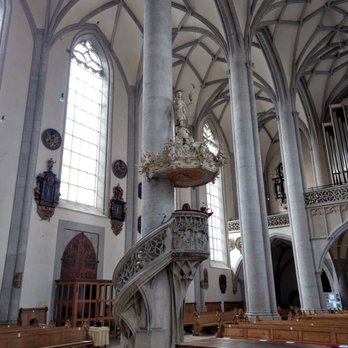
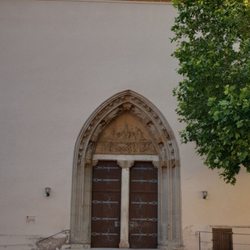
    St. Georgskirche

    4.5 (6 reviews)

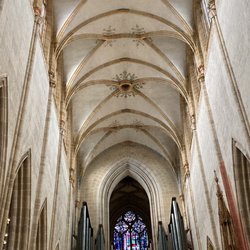
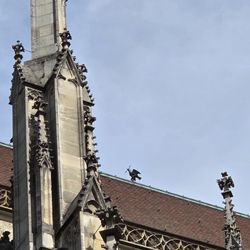
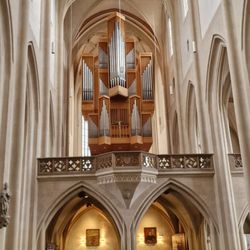
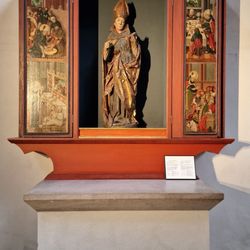
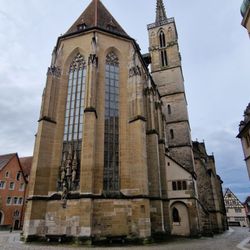
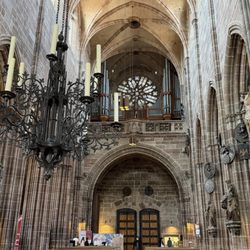
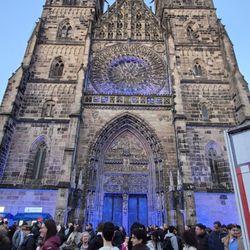
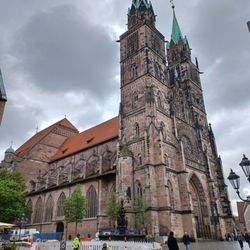
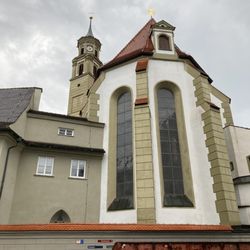
    St. Georgskirche Photos

    Recommended Reviews - St. Georgskirche

    Your trust is our priority, so businesses can't pay to alter or remove their reviews. Learn more about reviews.
    Yelp app icon
    Browse more easily on the app
    Review Feed Illustration
    Photo of Mike N.
    349
    927
    3946

    5 years ago

    Helpful 15
    Thanks 0
    Love this 17
    Oh no 0

    St. Georgskirche Reviews in Other Languages

    Verify this business for free

    Get access to customer & competitor insights.

    Verify this business

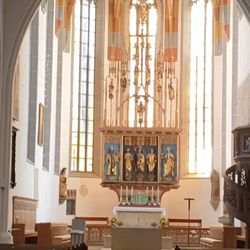
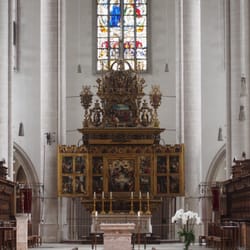
    St. Salvatorkirche - Altar

    St. Salvatorkirche

    3.3(3 reviews)
    0.3 km

    The church was built on the southwestern edge of the city center. The reason for the construction…read morewas the "Host Miracle" in 1381, when a piece of a consecrated host could not be found after a ceiling collapse in the house of a terminally ill patient. The ruins were burned and the missing host is said to have been found intact from the ashes. The Gothic winged altar in the choir was made between 1505 and 1507 for the Church of St. Michael in Fürth. In 1815 it was sold to an art dealer and acquired in 1827 for the St. Salvator Church, as a replacement for the high altar by Sebastian Taigfrom 1518, which was largely destroyed in the course of the Napoleonic Wars. The altar was restored and partially redesigned and enlarged, with figures from the previous altar also being built in. The altar shrine has four movable wings, each painted on both sides, and two fixed wings. If the inner wings are closed, a representation of the Most Holy Trinity appears in the middle, enthroned on clouds and surrounded (in the background) by flocks of praising angels. The paintings were probably created at the end of the 15th century and probably come from the environment of the Nürnberg painter family Traut. The two side altars, the Marien Altar and the Joseph Altar, were created in 1955 by Joseph Steinacker from Wemding to replace the two neo-Gothic side altars, which were removed in the course of a comprehensive redesign of the church in 1879 and 1884. The statue of the Virgin Mary on the Altarpiece was acquired in the art trade in 1954. When the figure was created is unclear. Some sources point to the year 1650, others to the year 1520. The church has been completely renovated since 2001. The work was completed in 2012; the total costs were estimated at 2.43 million €. The costs were raised through a fundraising campaign.

    Photos
    St. Salvatorkirche - Skulptur

    Skulptur

    St. Salvatorkirche - St. Salvator

    St. Salvator

    St. Salvatorkirche - Skulptur

    See all

    Skulptur

    Ulmer Münster

    Ulmer Münster

    4.8(73 reviews)
    62.1 km

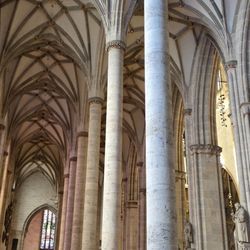
    Ulmer Münster (Ulm Minster) is a Evangelisch-Lutherische (Lutheran) church located in Ulm, State of…read moreBaden-Württemberg. It is currently the tallest church in the world and will likely remain so until Sagrada Familia in Barcelona is finally completed. The church is the fifth-tallest structure built before the 20th century, with a steeple measuring 161.5 meters (530 ft.). Ulmer Münster was begun in the Gothic architecture of the Late Middle Ages (1377) but the building was not completed until the late 19th century (1890) after a hiatus of centuries. When work ceased in 1543, all of the church except the towers and some outer decorations were complete, unlike at Kölner Dom (Cologne Cathedral) where less than half of the work had been done before construction halted in 1473 (started in 1248). Visitors can climb the 768 steps that lead to the top of the minster's spire. At 143 m (469 ft.) it gives a panoramic view of Ulm in Baden-Württemberg and Neu-Ulm in Bavaria, and, in clear weather, a vista of the Alps from Säntis to the Zugspitze (highest point in Germany). Though it is sometimes referred to as Ulm Cathedral because of its great size, the church is not a cathedral as it has never been the episcopal see of a bishop. Though the towers and all decorative elements are of stone masonry, attracting the attention of visitors, most of the walls, including the façades of the nave and choir, actually consist of visible brick. Therefore, the building is sometimes referred to as a brick church. As such, it lays claim to the rank of second- to fourth-largest, after San Petronio Basilica in Bologna and together with Frauenkirche in München and St. Mary's Church in Gdańsk. The tower, however, was mainly built from sandstone. The tale/legend of the Ulmer Spatz (sparrow) is an interesting story. I received a pamphlet at the Tourist Information: the inhabitants of Ulm needed a particularly large beam for the construction of Ulm Minster, but could not get it through the city gate. As they were about to tear the gate down, they noticed a sparrow carrying a straw for its nest; which turned it from crosswise to lengthwise in its beak. A realization descended on the people of Ulm. Since that epiphany, they have placed long loads along rather than across their carts and were able to enter the city without rebuilding their gate. It's a must visit when you are in Ulm. Gothic architecture is magnificent, and you'll earn bragging rights of having been to the tallest church in the world!!
    What a beautiful and amazing church. The inside of the church is absolutely worth walking around…read moreand looking at. Gorgeous. Make sure you are prepared to climb 700+ stairs. Pay the €5 and climb it. The view is amazing. It is very difficult, but worth it in the end. If you find yourself in Ulm, you must visit the cathedral. You won't regret it.

    Photos
    Ulmer Münster
    Ulmer Münster
    Ulmer Münster

    See all

    St. Lorenz Kirche

    St. Lorenz Kirche

    4.4(18 reviews)
    79.3 kmInnenstadt

    One of my favorite churches in Nuernberg. I believe it is also the largest. I'm not going to state…read moreall the history and facts about this church, others have already done so. Just one little anecdote that always amuses me is that the builders could not agree on the style of the towers and this is why each tower is different. A feud that is permanently displayed on the towers of a church no less... Anyway, take a close look at this church both inside and out. There are so many details to see, that even after years coming here, I still seem to discover new details. A must see for sure.

    This is the largest church in Nuremberg. To my surprise, I thought I was entering in a Catholic…read moreGothic style church (built circa 1250) to find out it was a Lutheran one. In any case, amazing church with so much art to see in just an hour I spent there (I was with a colleague and did not want to spend the usual amount of time I would do in this type of sacred buildings with so many details and art in every corner). I can't believe it was bombarded during WWII, then rebuilt with great effort. The stained glass art is amazing and I was happy to see that during our visit it was an exhibit about the artist who created all of them originally. It was a very well paid 2 euros visit (I dont like to pay to enter in a church, I am more pro-donations, but still it was worth it). One suggestion is that I would prefer not to have a gift shop inside the church. That devalue both the religious experience and the artistic value, converting the whole thing in a theme park. That is the only part I disliked during my visit as well as the attitude of the young girl that was collecting the money...I got confused of door of our way out and she started yelling at me: no, not there, stop stop...which made me feel weird. Anecdotes apart, a must visit.

    Photos
    St. Lorenz Kirche
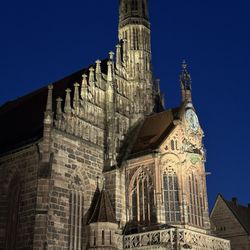
    St. Lorenz Kirche - ... Abendstimmung ...

    ... Abendstimmung ...

    St. Lorenz Kirche

    See all

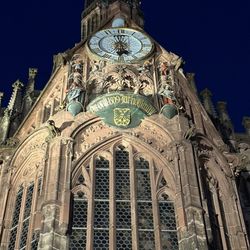
    Frauenkirche - ... Impressionen ...

    Frauenkirche

    4.1(19 reviews)
    79.6 kmInnenstadt

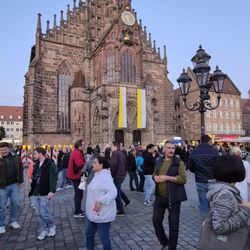
    I am not going to go through the history and facts of the church. Clearly another example of…read moreNuernberg's rich history as a medieval city. What makes this church stand out is the fact that it overlooks the main market place with it's many fruit and veggie stands, most with locally grown produce. Of course there are also food trucks and household wares to be had. The market place turns into a giant Christkindl Market and at its opening the Christkindl (which by the way is a Christmas angel - child of Christ) stands atop the church balcony and officially opens the Christkindl Market with a speech and blessings. Definitely worth attending, if you can squeeze in somehow, because be aware that it will be super crowded. Just before 12 noon you will see crowds gather looking up towards the top of the church. They are all waiting for the "Maennleinlaufen" were the figures start moving and the electors turn and face the Roman emperor. There are also musician figures that move as if playing their instruments.

    Frauenkirche or " The Church of Our Lady" is an example of brick Gothic architecture, and it was…read morebuilt on the initiative of Charles IV, Holy Roman Emperor (reign 1346-1378) between 1352 and 1362. The church contains many sculptures, some of them heavily restored. Numerous works of art from the Middle Ages are kept in the church, such as the so-called Tucher Altar (c. 1440, originally the high altar of the Augustinian church of St. Vitus also in Nürnberg). The church was built in the grand market, in place of the former Jewish synagogue, which was destroyed during the Nürnberg pogrom (Jewish persecutions of 1349) which followed an outbreak of Black Death. Charles IV wanted to use the Frauenkirche for imperial ceremonies, which is reflected in the porch with the balcony, and in the fact that the church is relatively unadorned except for the coats of arms of the Holy Roman Empire, the seven Electors, the town of Nuremberg, and the city of Rome, where the Holy Roman Emperors were crowned. Construction of the church continued until the 1360s. Charles IV's son Wenceslas was baptized in the church in 1361, on which occasion the Imperial Regalia, including the imperial reliquaries, were displayed to the people. References to Wenceslaus can be found throughout the sculptural program of the church. Beginning in 1423, the Imperial Regalia was kept permanently in Nürnberg and displayed to the people once a year on a special wooden platform constructed for that purpose. The current west gable of the church dates from 1506-8. Historic images show that this gable was once richly decorated with sculptures which were presumably destroyed in the Reformation. In 1525 the church became Lutheran and galleries were added in the aisles. In 1810, the church was acquired by a Catholic parish which removed the galleries and restored the church in 1816. This restoration involved replacing and repairing surviving sculptures and gathering Medieval art to adorn the church. One of the most notable features of the church is the Männleinlaufen, a mechanical clock that commemorates the Golden Bull of 1356. The clock was installed in the church between 1506 and 1509. The Holy Roman Emperor is shown seated with the prince-electors surrounding him. The clock mechanism is activated at noon when a bell is rung to start the sequence and is followed by the trumpeters and drummer. Then there is a procession of the electors around the figure of the Holy Roman Emperor.

    Photos
    Frauenkirche - ... Impressionen ...

    ... Impressionen ...

    Frauenkirche
    Frauenkirche

    See all

    St. Georgskirche - churches - Updated May 2026

    Loading...
    Loading...
    Loading...