St. Salvatorkirche Photos



Recommended Reviews - St. Salvatorkirche
Start your review...



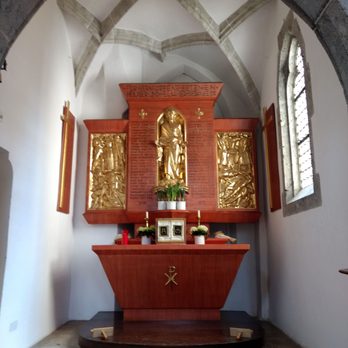
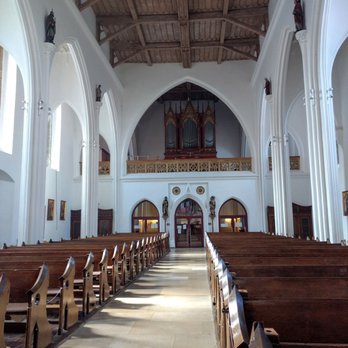
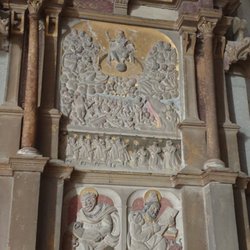
The church was built on the southwestern edge of the city center. The reason for the construction was the "Host Miracle" in 1381, when a piece of a consecrated host could not be found after a ceiling collapse in the house of a terminally ill patient. The ruins were burned and the missing host is said to have been found intact from the ashes. The Gothic winged altar in the choir was made between 1505 and 1507 for the Church of St. Michael in Fürth. In 1815 it was sold to an art dealer and acquired in 1827 for the St. Salvator Church, as a replacement for the high altar by Sebastian Taigfrom 1518, which was largely destroyed in the course of the Napoleonic Wars. The altar was restored and partially redesigned and enlarged, with figures from the previous altar also being built in. The altar shrine has four movable wings, each painted on both sides, and two fixed wings. If the inner wings are closed, a representation of the Most Holy Trinity appears in the middle, enthroned on clouds and surrounded (in the background) by flocks of praising angels. The paintings were probably created at the end of the 15th century and probably come from the environment of the Nürnberg painter family Traut. The two side altars, the Marien Altar and the Joseph Altar, were created in 1955 by Joseph Steinacker from Wemding to replace the two neo-Gothic side altars, which were removed in the course of a comprehensive redesign of the church in 1879 and 1884. The statue of the Virgin Mary on the Altarpiece was acquired in the art trade in 1954. When the figure was created is unclear. Some sources point to the year 1650, others to the year 1520. The church has been completely renovated since 2001. The work was completed in 2012; the total costs were estimated at 2.43 million €. The costs were raised through a fundraising campaign. read more