Lemon City Cemetery Photos


More like Lemon City Cemetery
Recommended Reviews - Lemon City Cemetery
Start your review...



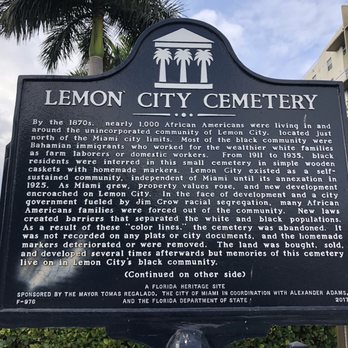
This made me sad. Apart from a sign to state its history, there was nothing else to see. This made me sad, really? all that history, all these pour should and bodies that were originally buried here, and that's the best you can do? Very sad. Nothing to see apart from an area, taken over, possibly avoiding the truth the history just be forgotten in the name of what? progress? life? life carrying on? According to records there were 525 people buried in the land, many of whom were Black and Bahamian labourers that helped develop Miami in the early 1900's. Discovered in 2008, the Lemon City Cemetery is believed to be one of the oldest burial sites of people of color in Miami and was designated a historical site in November 2009. In April 2009, Carlisle Development Group and Biscayne Housing Group were in the beginning stages of developing a series of low-income housing buildings, when human remains were found while digging the land. At the time, the city had no records of the cemetery's existence. An examination of the remains and the land concluded that the construction site was indeed a cemetery, believed to date back to the early 1900s. (This is so freaken sad - how can this be so????) Further examination of the human remains concluded 525 souls were interred in the cemetery, the majority of whom were of Black American and Bahamian descent. Many of them were laborers who helped with the construction and development of Miami. see this for more information - https://www.miamitimesonline.com/faith_family/to-be-laid-to-rest-historical-markers/article_93f90568-bc1d-11e8-a548-fbaebc0ed876.html read more


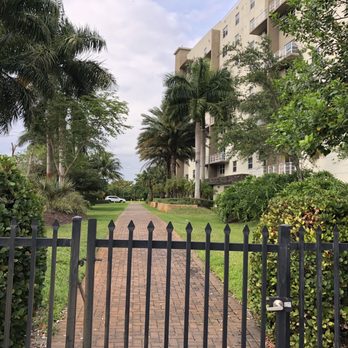
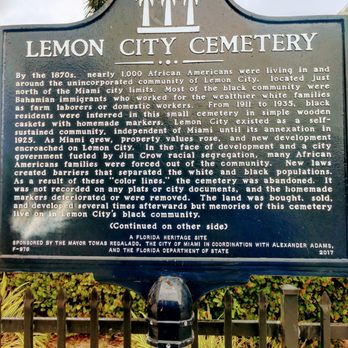
Lemon City is an unincorporated area that predates Miami. It was a farming community that sprang up in the 1850's, 26 years before the founding of Miami. The community took their name from the unusually sweet lemon trees that grew in the area. By the time Miami was incorporated, Lemon City already had a population of 300. Lemon City had the areas oldest school, the Lemon City School, and the first library, the Lemon City Library. Lemon City was segregated with Black families living in three neighborhoods, Nazarine, Boles Town, and Knightsville. The exact boundaries of Lemon City have been lost to time since it was never incorporated. During the 1980's many Haitian immigrants made what was once Lemon City their home. The area has now been designated as Little Haiti which upset some of the descendants of the pioneers of Lemon City who thought the name change was insulting to their history. To be more inclusive of all of the history of the area, 10 historical signs marking the history of Lemon City were erected by the Mayor's office. Markers were placed at the Lemon City Train Station, Lemon City Pharmacy, Lemon City Library, the Lemon City Port, and here at the Lemon City Cemetery. In April 2009 while doing construction on the Village Carver Apartments, an affordable housing development off Northwest 71st Street near Fourth Avenue, workers who were digging discovered bones. According to the city, they were not aware that the 2.4 million dollars worth of land held a cemetery. It turned out that a total of 525 lemon City residents were buried there, most of whom were black Americans of Bahamian descent. Burials in the Lemon City Cemetery are documented from 1911 until 1935 when African-Americans were buried here during segregation. Eventually the city lost track of the location of the cemetery. Concerned citizens united to prevent building from taking place on the cemetery. Led by local historian Enid Pinkney, they formed the Lemon City Cemetery Community Corporation. In November 2009, the City of Miami designated the cemetery a historical site. The developers offered to move the remains buried here but ultimately gave in to the demand to leave them. Instead a memorial was constructed in 2011 and the cemetery was left as a garden. The memorial is on private property and contains 500 names but where everyone is exactly buried is lost to time. In 2018 a historical marker was placed her to explain the history of the cemetery. It is one of the sadder chapters of Lemon City but thanks to the City of Miami and community leaders this cemetery was rescued from being a housing development. It now provides 2 acres of green space to an area that is otherwise paved over. read more