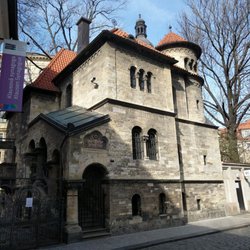
1. Klausová synagoga

0

Prague, PR

Cancel

Open app

Search

Klausová synagoga Photos

Klausová synagoga Reviews in Other Languages

Verify this business for free

Get access to customer & competitor insights.

Verify this business

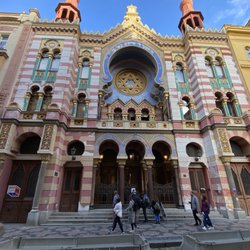
Jerusalem Synagogue - Front facade

Jerusalem Synagogue

4.8(5 reviews)
1.2 km•Nové Město, Praha 1

I had bookmarked this landmark and it did not disappoint. First, it is just beautiful on the…read moreoutside, the tile work and the combination of Moorish and Jewish touches make this a really striking building. Then on the inside the main area is expansive and it is full of historical information on the Jewish people in Czechia. Going upstairs, there's more information to read. The synagogue was built between 1905-1906. Initially it bore the name of the Jubilee Temple of Emperor Franz Joseph to commemorate the 50th anniversary of his reign, in 1898. After WWI, the present name, the Jerusalem Synagogue, based on the street name where it stands, slowly gained ground.

It's not often you come upon synagogues with both Moorish and Art Nouveau styles incorporated, what…read morea beautifully unexpected combination! The Jerusalem Synagogue (aka Jubilee Synagogue) was constructed in 1906 and in honor of the golden jubilee (50th anniversary) of Emperor Franz Joseph's reign, and is the largest synagogue in Prague though not the largest in the Czech Republic. Designed by Wilhelm Stiassny originally this was used as a synagogue by the Reform Judaism community though now used by a Modern Orthodox congregation. Both inside and outside are decorated with moorish horseshoe arches, bright red, gold and blue patterns--the ones on the interior painted with Art Nouveau patterns. One of the more elaborate synagogues I've visited and probably the most colorful! The second floor has some displays of Prague's Jewish community and the history of this synagogue. The building opened in 2008 to the public on days when it wasn't actively used as a place of worship, and current ticket prices are: Adults: 150 CZK (eTicket 135 CZK) Children under 6: free Children under 15 and students: 100 CZK (eTicket 90 CZK) Reduced entrance fee for visitors with valid ticket to the Jewish Town sites: Adults: 100 CZK Children under 6: free Children under 15 and students: 80 CZK More info here: synagogue.cz

Photos
Jerusalem Synagogue - Beautiful facade

Beautiful facade

Jerusalem Synagogue - Jerusalem Synagogue

Jerusalem Synagogue

Jerusalem Synagogue

See all

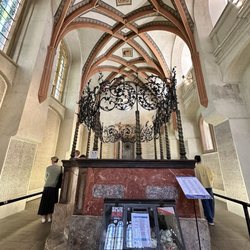
Pinkasova synagoga - Prices for Jewish Synagogue tour Oct 2024

Pinkasova synagoga

4.5(12 reviews)
0.1 km•Josefov, Staré Město, Praha 1

An emotional tribute to the children of Terezin and 78,000 victims of the Holocaust…read more The second oldest serving synagogue in Prague is another emotional stop on the Jewish Museum Tour. Built starting in 1535, it is a mix of Gothic, Renaissance, Baroque and Rococo styles. After the Holocaust, the walls were covered with the names of the 78,000 Czech and Moravian Jews that perished. It was closed during the Soviet occupation. It also has a collection of the artwork of the children of Terezin. Frederika Dicker-Brandeis and her husband were deported to Terezin in December 1942. She helped to organize secret art classes for the children in this concentration ghetto as a way for them to express their emotions. Before she was transported to Auschwitz in 1944, she managed to smuggle two suitcases filled with 4500 of the children's drawings to the chief tutor of Girls'Home L410. After the war, the director returned the suitcases with the children's drawings to the Jewish community in Prague where they are currently displayed in the Pinkas Synagogue. These pictures give an insight into their grim experiences, hopes and daily lives.

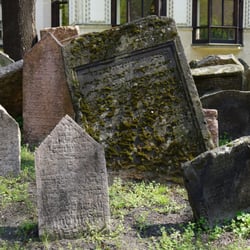
We visited while in Prague and it was a sad but memorable experience about the Holocaust. On the…read moreway out we passed through this cemetery which was very sad after seeing the kids' drawings and names of their victims on the walls. We all thought it was worthwhile to see and gain more insight and knowledge...we visited to learn and see more about the history. The kids' drawings/ paintings were also sad to see and they were preserved very well. It was also sad to see the pics of the trains - a journey with no return I think it was called. A must-see when in the Jewish quarter and we highly recommend it.

Photos
Pinkasova synagoga
Pinkasova synagoga - Jewish Synagogue and cemetery

Jewish Synagogue and cemetery

Pinkasova synagoga - Cemetery

See all

Cemetery

Staronová synagoga

Staronová synagoga

3.9(8 reviews)
0.1 km•Josefov, Staré Město, Praha 1

Not open on a Saturday afternoon (duh, Sabbath), which was really the only free time I had to…read morevisit. But the outside? Stunning. And the history? Amazing! It is the oldest synagogue in all of Europe. The "Old New" Synagogue is neither old nor new, the name originates from a Hebre word "Al tnay" which means "on condition" and has to do with the stones that were imported from Jerusalem to build the temple in around 1270. The stones were to be used "on condition" that they were returned to Jerusalem when the Messiah comes so that the Temple in Jerusalem is rebuilt and the stones are needed. Interesting tidbit. It is said that the body of Golem (no, not Gollum) lies in the attic storage area. A Nazi officer attempted to access the attic but instead died. And so this synagogue was spared much of the destruction that was brought on others. This "golem" concept also brought the word "robot" into language. Robot is drawn fro the Czech/Slavic word "robota" for servitude or drudgery. The Karel Čapek story "R.U.R." tells the story of a company using the latest technology to build workers who "lack nothing but a soul." [Review 12244 overall, 2028 of 2019.]

Oldest Active Synagogue in Europe…read more Built around 1270 in the Gothic style, this is one of three active synagogue in Prague's Josefov Quarter. It is a miracle that it has survived pogroms, fires, floods and the Holocaust. Legend states that the synagogue is protected by angels who brought the stones from the ruins of King Solomon's Temple. These stones are being "saved" until the temple in Jerusalem can be rebuilt. Originally called the New Synagogue, when a newer synagogue was constructed, this became the Old-New Synagogue.

Photos
Staronová synagoga - On a clear afternoon

On a clear afternoon

Staronová synagoga - Map of everything included in the tour

Map of everything included in the tour

Staronová synagoga

See all

Orloj

Orloj

4.4(102 reviews)
0.4 km•Staré Město, Praha 1

Oldest working astronomical clock in the world faithfully performed at top of the hour.read more

This magnificent clock is not just a timekeeper but also an impressive work of art that tells a…read morestory about the history of Prague and its people..Many call this one of the most over-hyped attractions in Europe, but I did find some interesting points after listening to our tour guide. The Astronomical Clock was built in the 15th century and is the oldest working clock of its kind in the world. It consists of three main components: the astronomical dial, the calendar dial, and the figurines. The astronomical dial displays the position of the sun, the moon, and the stars, as well as the time of day. The calendar dial shows the current date, zodiac signs, and saints' days. Finally, the figurines perform every hour, with the twelve apostles appearing in a procession. The clock face displays four different times, some recognizable and others ancient. Beginning on the outer edge of the dial, in deep blue, is Bohemian (or Old Czech) time shown in the Gothic numbers. The day consists of 24 hours and starts from the sunset (rather than midnight, as we'd use today). Bohemian time was utilized by Holy Roman Emperor Charles IV, and is pointed by the golden hand. Next is Central European Time (CET) Zone, two sets of 12 hours shown in Roman numerals inside the Bohemian time numbers. CET is also indicated by the golden Sun hand. Third is Babylonian (or Arabian) time, the oldest time displayed on the astronomical dial. Babylonian time, displayed in black Arabic numerals, separates the time between sunrise and sunset; that's why there are only 12 hours. Finally, there's star time, or sidereal time. Sidereal uses the time it takes Earth to rotate once on its axis and return facing a distant star. Its time is 23 hours and 56 minutes, four minutes shorter than a solar day. A solar day is defined by when the Sun is overhead at noon, which must account for the Earth tracking one degree, or day, along its orbit around the Sun and hence is longer. Follow the little golden star among the Roman numerals for sidereal time. Now you are prepared to tell time via the stars or even back in the Middle Ages. Fun piece of workmanship.

Photos
Orloj - People around every turn

People around every turn

Orloj - Dining area inside

Dining area inside

Orloj - The famous astronomical clock in Prague, it was constructed in 1410

See all

The famous astronomical clock in Prague, it was constructed in 1410

Klausová synagoga - landmarks - Updated November 2026

Loading...
Loading...
Loading...