1. Jeff Davis State Historic Site

0

Irwinville, GA

Cancel

Open app

Search

Jeff Davis State Historic Site

4.7 (3 reviews)

Jeff Davis State Historic Site Photos

More like Jeff Davis State Historic Site

Recommended Reviews - Jeff Davis State Historic Site

Your trust is our priority, so businesses can't pay to alter or remove their reviews. Learn more about reviews.
Yelp app icon
Browse more easily on the app
Review Feed Illustration
Photo of Bruce K.
2442
26519
79277

2 years ago

Helpful 5
Thanks 1
Love this 4
Oh no 0

7 years ago

Helpful 3
Thanks 1
Love this 3
Oh no 0
Photo of Jim D.
0
50
0

2 years ago

A lot of history can be learned here. The orator is very knowledgeable and enjoys his job.

Helpful 0
Thanks 0
Love this 0
Oh no 0

Verify this business for free

Get access to customer & competitor insights.

Verify this business

Mary Turner Lynching Site - Current memorial sign that simply reads Mary Turner 1918

Mary Turner Lynching Site

3.0(1 review)
46.1 mi

Last review of my 2022 February Black History Series & I honestly don't know how to rate it. This…read moreis by far the most difficult piece of history to digest and the most uncomfortable to write & read. It is so difficult in fact, that I don't think I'm capable of presenting it without myself becoming upset. Here are the words from the historic marker that was removed and place in the National Center for Civil & Human Rights because was constantly being defaced and pierced with high caliber BULLETS. It reads: [ historic marker ] MARY TURNER AND THE LYNCHING RAMPAGE OF 1918 Near this site on May 19, 1918, twenty-one year-old Mary Turner, eight months pregnant, was burned, mutilated, and shot to death by a local mob after publicly denouncing her husband's lynching the previous day. In the days immediately following the murder of a white planter by a Black employee on May 16, 1918, at least eleven local African Americans including the Turners died at the hands of a lynch mob in one of the deadliest waves of vigilantism in Georgia's history. No charges were ever brought against known or suspected participants in these crimes. From 1880-1930, as many as 550 people were killed in Georgia in these illegal acts of mob violence. Erected by the Georgia Historical Society, the People's Temple, Valdosta State University - Woman and Gender Studies Program, and The Mary Turner Project. *** [ missing details of the sign ] What the sign does not describe is the circumstances of the death of the white planter by his black "employee". While the emancipation proclamation freed enslaved blacks in the United States, the 13th amendment allowed for one loophole. Penal labor in the United States is explicitly allowed: "Neither slavery nor involuntary servitude, except as a punishment for crime whereof the party shall have been duly convicted, shall exist within the United States, or any place subject to their jurisdiction." That amendment gave rise to CONVICT LEASING, a system of forced penal labor that provided prisoner labor to private parties, such as plantation owners and corporations (e.g. Tennessee Coal and Iron Company, Chattahoochee Brick Company). The lessee was responsible for feeding, clothing, and housing the prisoners AND could punish or discipline them as they saw fit. Considering slavery had barely been outlawed, the treatment of these mostly black inmates was often bitterly WORSE that of their previous slave status. These convicts were actually profitable for state revenue. In 1898, 73% of Alabama's entire annual state revenue came from convict leasing. Corruption, lack of accountability, and racial violence resulted in "one of the harshest and most exploitative labor systems known in American history." TheConversation.com writes this in a February 2017 article: "They lived in squalid conditions, chained, starved, beaten, flogged and sexually violated. They died by the thousands from injury, disease and torture. For both the state and private corporations, the opportunities for profit were enormous. For the state, convict lease generated revenue and provided a powerful tool to subjugate African-Americans and intimidate them into behaving in accordance with the new social order. It also greatly reduced state expenses in housing and caring for convicts. For the corporations, convict lease provided droves of cheap, disposable laborers who could be worked to the extremes of human cruelty." link: https://theconversation.com/exploiting-black-labor-after-the-abolition-of-slavery-72482 *** These were the conditions of the "employee" that killed the white "planter". This killing set off a manhunt that swept southern Georgia killing more than a dozen innocent black men. When Mary went to the courthouse to complain and demand justice for her husband who was wrongfully slain, the crowd turned their anger on Mary, and, well... she and her unborn baby lost their lives in a horrifically brutal act that you can learn about here: https://www.youtube.com/watch?v=St1maRFmP8o [ side note ] I should mention the correlation between the end of slavery and the rise of the incarcerated population are practically successive. Many of these men were being sent to prison for the smallest of infractions... most commonly for being unemployed (vagrancy). [ FINAL THOUGHTS ] Mary Turner went to the courthouse to seek justice for the murder of her innocent husband, and the same irrational violence that took him took her at the sheer complaint of unfairness. There is so much to unpack in this American History tragedy, including how even a modern day sign erected in 2010 is treated as violently as Mary. Many have left flowers at the base of the metal cross now standing at the site. Rest in Power Turner family, my heart weeps for you all. May God repay you 100 fold for every act of violence against you. Thank you for following my month of Black History reviews! 2022 / 60

Photos
Mary Turner Lynching Site - Bullet riddled original memorial sign, also cracked at its base from high impact.

See all

Bullet riddled original memorial sign, also cracked at its base from high impact.

Titan I Missile

Titan I Missile

4.3(9 reviews)
29.6 mi

The Titan 1 was one of the first strategic, intercontinental ballistic missiles developed by the…read moreUnited States. The 98-foot-long, two-stage missile was fueled by kerosene and liquid oxygen, and was designed to carry nuclear warheads. Finding a Cold War-era Titan 1 Nuclear ICBM on the side of the interstate in plain view isn't an everyday occurrence although there are still 33 of these de-commissioned missiles on display around the country of the original 163 Titan 1s produced. Even though it's disarmed, unique and unusual the impact it's made on this town defy the laws of quantum mechanics. The missile was acquired from the Air Force in 1968 after it was declared obsolete and ineffective for use in a Global Thermo-Nuclear War maybe it's more effective as a landmark that could make the community of Cordele stand out, that was the dream of John Pate, president of the Cordele Rotary Club at the time, his intentions of attracting travelers on I-75 to boost the economical impact on this small town was surprising to most and somewhat self-serving to others. The Titan I, produced by the Glenn L. Martin Company, was a two-stage, liquid-fueled, rocket-powered ICBM(first stage - 300,000 pounds of thrust; second stage - 80,000 pounds of thrust) which incorporated both radio and all-inertial guidance. Deployed in a "hard" silo-lift launcher, the Titan I had an effective range of 5,500 nautical miles. This final resting place is the perfect solution and serves as a reminder that the threat of destroying the world in the name of peace is a ridiculous deterrent.

It's pretty hard to miss a hundred foot tall missile parked in a gas station lot alongside the…read morehighway. But here it is. The Martin-Marietta Titan I was the first multi-stage intercontinental Ballistic missile produced for the United States Air Force. Using a liquid oxygen and jet fuel propellant, it was the nuclear deterrent from 1959 to 1962 until it was replaced by the Titan II missile that lasted until 1987. Independent from launch through controlled flight until the ballistic release of the warhead, the warhead would then descend to its target by simple gravity and air resistance. You're not going to find too many of these babies still standing. I assume it's disarmed but you never know. [Review 14052 overall, 1374 of 2020, number 343 in Georgia.]

Photos
Titan I Missile - We love this pace so much my then girlfriend and I thought of visiting again

We love this pace so much my then girlfriend and I thought of visiting again

Titan I Missile - Titan I Missile, part of the Confederate Air Force. It's true because this sign says so!

Titan I Missile, part of the Confederate Air Force. It's true because this sign says so!

Titan I Missile - Titan Missile

See all

Titan Missile

Lapham-Patterson House

Lapham-Patterson House

4.9(7 reviews)
66.6 mi

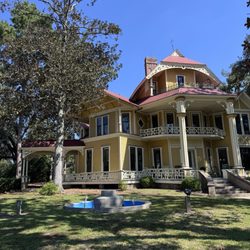
April 7,2017. I was taking my cousin from NYC on a speed traveling spree of Thomasville, Georgia in…read moretwo days. I brought her to places that catered to her taste for good wine and cheese, love of small town America, and books. I, also, brought her to places a little out her comfort zone like a taxidermy shop and a haunted National landmark, a haunted Victorian home with occult designs. The Lapham-Patterson home seems like a sunny yellow Victorian home in Thomasville, Georgia. If you look closer, you realize it is the weirdest and coolest roadside attraction in Thomasville, Georgia. It was a winter vacation home of Mr. Lapham. He designed it to reflect his soul, his fear of fire, and his love for the occult and superstition. Our tour guide was Josh. He was very accommodating, professional, and polite. My cousin enjoyed the tour. I was pleased that he could answer every question I gave him to the best of his ability. This place was the highlight of Thomasville for my cousin and I. To me, it was the most wondrous and curious place I have ever went to in the state of Georgia. It is,also, a unique way to look at Thomasville, Georgia that most locals there never see. To give more information about this home, I am including this excerpt written by Victoria W. : There's Something Disturbing About This One Victorian Home In Georgia At first, it might just look like a beautiful old house, but look closer, and you'll realize that something seems strange about the Lapham-Patterson House in Thomasville, Georgia.The home is a marvelous example of Victorian architecture, with fish scale shingles, a double-flue chimney, intricate floors and fretwork, and a magnificent porch and balcony. Not a single room or closet in the entire 19-room house is a perfect square. Not a single room or closet in the entire 19-room house is a perfect square. The reason for this is that the home's builder, a businessman named C.W. Lapham, survived the Great Chicago Fire in 1871, which wiped out a 3-mile square of the city and killed up to 300 people. Understandably, Lapham became a bit of a pyrophobe, or someone with an intense or abnormal fear of fire (beyond what is normal). Ironically, the floors were all beautiful flatwood-pine, making the house very susceptible to fire. A couple of other unique little details include the roof reminiscent of a fireman's hat and some exterior fretwork over the balcony that casts shadows in the third-floor billiard room during the springtime and fall. These sillhouettes take the shape of six-pointed stars and a cow's head. Some have speculated that this is meant to represent Mrs. O'Leary's Cow, the legendary cause of the Great Chicago Fire. In a sad twist of events, Lapham's business dwindled, and he separated from his wife. She moved to Arizona and later died in a fire caused by a kerosene lamp. One of the couple's children did pass away in the home at a young age, and the Lapham-Patterson Home is rumored to be haunted by her ghost. Haunted or not, this house is a fascinating glimpse into one man's life and mind.

Interesting tour, the guide is very knowledgeable. The house is very unique. Tickets are purchased…read moreat the Historical Society building in the next block.

Photos
Lapham-Patterson House

See all

Georgia Museum of Agriculture and Historic Village - Enjoyed the shop and it's an easy walk to all the buildings. Really neat that they have a working gristmill and we got to see it in action.

Georgia Museum of Agriculture and Historic Village

4.8(9 reviews)
16.3 mi

Georgia Museum of Agriculture and Historic Museum is part of Abraham Baldwin Agriculture College. A…read moregreat place to visit and learn about life in the south during the late 1800s. The Museum in open from 9am to 3pm - Tuesday - Saturday. Closed on Sun and Monday. The Country Store is open from 9am to 5pm - Monday - Saturday. Closed on Sunday. The Country Store is a perfect rest stop if you are just passing through the area and need to stretch your legs, pick up some snacks and make a pit stop. Easy access off I-75. Clean rest rooms. Purchase tickets for admission to the Georgia Museum of Agriculture. The museum is a living history museum that focuses on 19th century life in the rural south. It has a working farm along with all the support buildings and business operations that would have existed during that time. All of the structures have authentic furnishings of the period. After you take a guided tour of the main museum, you can spend a few hours or the entire day exploring the historic buildings and talking with the interpreters dressed in 19th century attire. The interpreters perform daily activities that would have occurred in the farmhouses, fields, sawmill, turpentine still, schoolhouse, blacksmith's shop, and the grist mill. The main street has a Feed and Seed store, print shop and the drug store. Be sure to stop by the drug store and get a root beer float! A main highlight is riding the steam train from the Country Store into the village train station. The Country Store is a unique one-stop-shop for true South GA items, offering southern hospitality along with merchandise. A lot of the items in the store were produced at the living museum such as grits and corn meal milled at the museum's water powered Grist Mill. Turpentine is produced at the museum. Ornaments are hand crafted by the museum's black smith. You will also find a preserves, honey, cane syrup - all produced by the volunteers and staff at the museum using 19th century tools and skills. Be sure to get a bag of Grits and Corn Meal. Plan to visit the seasonal farmer's market on Saturdays. Booths are setup with local vendors that sell everything from locally grown vegetables, specialty cheeses/baked goods, and arts/crafts.

We enjoyed walking around at our own pace. Nice little shop. Enjoy seeing the gristmill in action.read more

Photos
Georgia Museum of Agriculture and Historic Village - Plant Telephone history

Plant Telephone history

Georgia Museum of Agriculture and Historic Village - Farm equipment

Farm equipment

Georgia Museum of Agriculture and Historic Village

See all

Jeff Davis State Historic Site - landmarks - Updated October 2026

Loading...
Loading...
Loading...