Cancel

Open app

Search

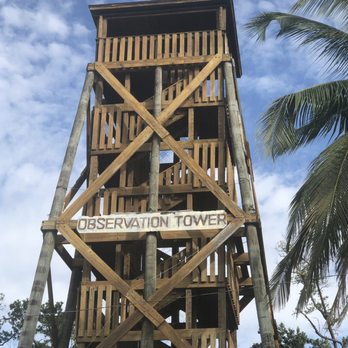
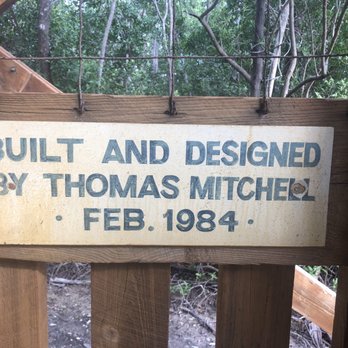
Ernest Hamilton Observation Tower

5.0 (2 reviews)

Ernest Hamilton Observation Tower Photos

More like Ernest Hamilton Observation Tower

Recommended Reviews - Ernest Hamilton Observation Tower

Your trust is our priority, so businesses can't pay to alter or remove their reviews. Learn more about reviews.
Yelp app icon
Browse more easily on the app
Review Feed Illustration
Photo of Ann C.
56
152
81

1 year ago

Helpful 0
Thanks 0
Love this 1
Oh no 0
Photo of Ariel W.
4398
5930
104190

7 years ago

Helpful 10
Thanks 0
Love this 8
Oh no 0

Verify this business for free

Get access to customer & competitor insights.

Verify this business

City Hall

City Hall

5.0(2 reviews)
0.9 mi

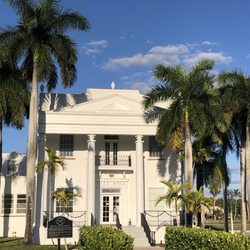
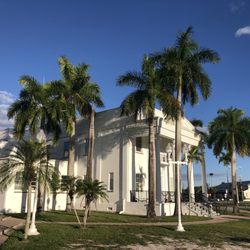
Everglades City started out as a small fishing village in the 1920's. Barron G. Collier, a New York…read moreadvertising industry millionaire, purchased the land in this area, eventually becoming the largest private landowner in Florida. When it ran out of money, Collier finished the construction of the Tamiami Trail, a road that connected Miami to Tampa in return for Collier County being named after him. Everglades City served as headquarters of the building of the Tamiami Trail and the county seat until Hurricane Donna in 1961 devasted the area. Today Everglades City retains its old Florida charm and is known as the stone crab capital. You can get the crabs right off the boats as they come in and every year there is a huge seafood festival. In Everglades City there are many places to eat the seasonal crab treats and seafood, a historic downtown, and boat rides through the Ten Thousand Islands. When I visit Everglades City in the pursuit of tasty seafood I also stop to admire the historic buildings from the 1920's in the downtown. One of the most stately buildings is the City Hall. The 1926 the concrete and stucco Classical Revival building was built by Barron Collier and designed by William O Sparkin who also designed the Bank of Everglades building and the laundry which is now a history museum, both a short distance away. This building served as the County Courthouse until 1962 when the county seat was moved to a new courthouse building in Naples. The building is now the Everglades City Hall. In 2005 the building was heavily damaged by Hurricane Wilma and has since been rebuilt. I love all of the buildings in the historic downtown which also include the laundry now a museum, a church, and the Everglades Bank Building which is currently awaiting renovation as funds permit. 1920's architecture from Florida's land boom years always catches my eye and this may be my favorite building in Everglades City.

A beautiful historic building right in the middle of the city, near the turning circle. It's closed…read moreon the weekend. Lots of parking nearby.

Photos
City Hall
City Hall
City Hall

See all

Bank of Everglades Building

Bank of Everglades Building

5.0(1 review)
0.9 mi

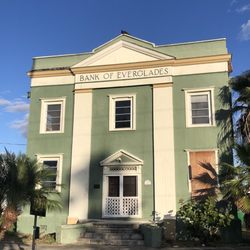
Everglades City started out as a small fishing village in the 1920's. Barron G. Collier, a New York…read moreadvertising industry millionaire, purchased the land in this area, eventually becoming the largest private landowner in Florida. When it ran out of money, Collier finished the construction of the Tamiami Trail, a road that connected Miami to Tampa in return for Collier County being named after him. Everglades City served as headquarters of the building of the Tamiami Trail and the county seat until Hurricane Donna in 1961 devasted the area. Today Everglades City retains its old Florida charm and is known as the stone crab capital. You can get the crabs right off the boats as they come in and every year there is a  huge seafood festival. In Everglades City there are many places to eat the seasonal crab treats and seafood, a historic downtown, and boat rides through the Ten Thousand Islands. When I visit Everglades City in the pursuit of tasty seafood I also stop to admire the historic buildings from the 1920's in the downtown. This time I noticed a building I had never seen before. Located across the street from the visitors center is the green Bank of Everglades Building. In 1923 Barron Collier chartered the bank in a wooden building until this bank was built in 1927. It was designed by William O. Sparkin who also designed the old court house, now city hall and the laundry, now a history museum, both a short distance away. The bank operated until 1962 before moving to Immokalee. in subsequent years the building was used as a boarding house, newspaper office, and bed and breakfast. The building currently stands empty. It was donated by its last owner to the not for profit Everglades Society for Historic Preservation. They are a group of concerned citizens who work to preserve all of the historic structures in Everglades City. The building is on the National Register of Historic Places. The group hopes to raise enough money through donations and grants to restore the building and use it for a coffee bar, community space, artist studios, and to show the movie Wind Across the Everglades which was filmed in this area. I love the 1920's architecture of Florida's land boom years as demonstrated in this building. I am dropping them a couple of bucks to help with their efforts. Hopefully there will be progress my next visit. Donations checks to help with the restoration can be made out to ESHP and mailed to PO Box 46, Everglades City Fl, 34139. A building this lovely and historic deserves another chance.

Photos
Bank of Everglades Building

See all

Murphy - Burroughs House

Murphy - Burroughs House

4.8(6 reviews)
62.9 mi

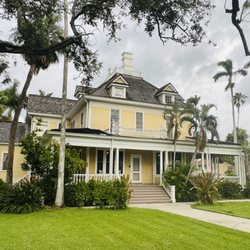
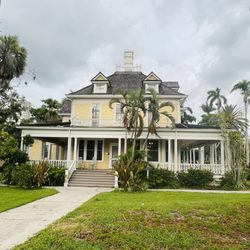
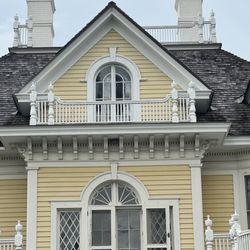
I love old houses and this yellow beauty is an architectural gem. The Murphy-Burroughs House is a…read moreGeorgian Revival style mansion built in 1901 for John T. Murphy, a cattle rancher from Montana. It is located in the River District of Fort Myers on two acres of land on the Caloosahatchee River. The house was built on First Avenue, the first house on what would become known as Millionaires Row. Materials to build the house were brought in by train and then carried the rest of the way to Fort Myers by barge. After construction was completed it drew other wealthy people to build their homes on the street. It is the only one of Millionaire Row's mansion that is still standing in its original position. Murphy was very involved in local civic and business affairs during his time in Fort Myers. He was a major shareholder of a bank and helped built a seawall that protected the downtown area. He passed away in 1914 and the house was sold to a businessman from New Jersey. In 1919 Nelson Burroughs purchased the house so his family could escape the frigid Chicago winters. Nelson made his fortune in land investments and banking. While in the home the family hosted lavish parties attended by famous winter Fort Myers residents Thomas Edison, Henry Ford, and Harvey Firestone. In 1922 Burroughs transferred ownership of the house to his daughters, Mona & Jettie. Mona bequeathed the property to The City of Fort Myers prior to her death in 1978. After her husband died in 1983 it was no longer used as a residence. On August 1, 1984, the house was added to the U.S. National Register of Historic Places. Today you can tour the home that has been lovingly restored with a grand staircase, beautiful fireplaces, and antique furnishings. Features of the house include a veranda wrapping around three sides, a large dancing porch on the east side, bay and stained glass windows, a widow's walk on the roof, and decorative woodwork. The house is a popular wedding venue. Every December, the Fort Myers Community Women's Club decorates the historic mansion for the holidays. The Uncommon Friends Foundation manages the house as well as the Burroughs family records.

What a beautiful place to throw a party, host an event or have a wedding…read more The sunset here is absolutely magnificent and there are trees and flowers everywhere.

Photos
Murphy - Burroughs House

See all

Rosemary Cemetery - Naples first pioneer.

Rosemary Cemetery

4.4(5 reviews)
36.1 mi

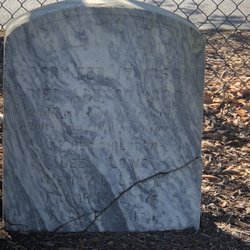
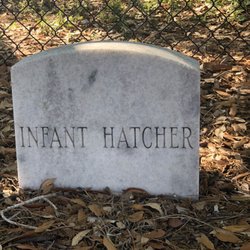
I've always remembered this little cemetery as I was born in Naples, and have been here my entire…read morelife. But, it's been decades since I have walked through here. I remember my mom explaining to me when I was a kid that this cemetery was for original settlers of Naples. It's still in great shape, and looks like it has regular visitors as there were flowers on every grave when I visited. Some of the markers have no visible lettering, so must've been worn away over time and replaced with just a new stone. Definitely an interesting piece of Naples history, and as a native of our beautiful town, I'm glad that I made the time to give my thanks and respects to those who came here long before me to establish this beautiful place I call home.

Located in literally the parking lot of a CVS is the historic Rosemary Cemetery. Some of the people…read moreburied here were originally buried at a cemetery at the corner of 3rd Street South and 10th Avenue South St. near St. Ann's Catholic Church in old Naples. As Naples became developed in the 1930's it was decided that the bodies should be moved to the outskirts of town. The Rosemary Cemetery Corp. was formed to find a suitable location for the new cemetery and a 20 acre plot was donated by Edward W. Crayton, president of the Naples Improvement Company. The name of the cemetery was taken from the highly scented rosemary bushes that once grew here. It is believed that Naples earliest settlers are buried here including John and Madison Weeks, Naples first permanent settlers. The cemetery opened in 1931 and the last known interment was in 1947. It had to be closed because the high water table caused some of the caskets to pop up back out of the ground during rainy season. It is believed that approximately 20 people remain here but who they are is a mystery because some of the headstones are no longer legible. The cemetery is listed as Unit B on a 1944 map that lists the graves in the area. In 1943 when the city registered the cemetery it listed over a hundred graves. What happened to those graves is unknown. Hurricane Donna destroyed the cemetery records in 1960. This was the only cemetery in Naples until Naples memorial Gardens opened in 1955. What was once the outskirts of town is now a major road and an empty lot is now a CVS parking lot. A historical marker was added to the cemetery in 1993. The next year the Collier County Museums restored the cemetery and added marble headstones. The city held a formal re-dedication ceremony of the cemetery on November 27, 1994. If you didn't now this cemetery was here it would be easy to drive past it. Once you pull in to the CVS parking however you can't miss it. The gate is left open so you can come by to visit the Naples pioneers.

Photos
Rosemary Cemetery
Rosemary Cemetery
Rosemary Cemetery

See all

Collier-Seminole State Park

Collier-Seminole State Park

3.8(36 reviews)
16.1 mi

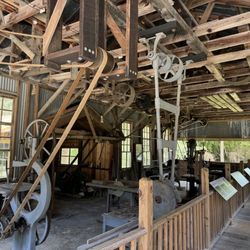
This State Park does a good job of dotting the " i's " and crossing the " t's ". There's hiking…read moretrails, camping, fishing, kayaking / canoeing, a pavilion, picnic tables, kiddies playground, and some interesting historical items. Admission is $5.00 per vehicle (maximum of 8 people), or $2.00 per person (pedestrians or bicyclists). I was on my motorcycle so I fell in the top category. I rode to the boat launch area first. This was a nice place to launch a boat or kayak. It was a protected bay like area. There was a floating boat dock nearby where one could fish from. In the same area as the boat launch was the hiking trail. It was closed (the park employee at the entrance had already told me) probably because of Hurricane Ian damages? Also the picnic and playground area was in this area. here. Restrooms are on site too. The next stop I visited while in the park was the historic Bay City Walking Dredge No. 489. This feat of engineering was used in the 1920's to help build the Tamiami Trail through the Florida Everglades. From the information provided, "Built in Bay City Michigan, this walking dredge followed the drilling and blasting rigs, averaging 80 feet per 10 hour shift. Dynamite was used to blast the limestone into small enough chunks for the dredge to lift." The road was completed, finally linking Tampa to Miami in 1928, with the help of this machine. For the mechanical and engineering nerds (like me), you'll want to see and read about this. Ha! I had a good time here and recommend you check this place out. I am going with 4 stars because the hiking trail was closed and the canoe rental cabin where one could also buy drinks was closed. Hopefully these will open in the near future.

I drove in to let my dog out for a pee real quick but I saw you gotta pay for this park so I turned…read moreright around:) I'm not paying for my dogs little walk. But maybe I'll come back one day for a planned visit

Photos
Collier-Seminole State Park - A beautiful place for kayaking

A beautiful place for kayaking

Collier-Seminole State Park - Bay City Walking Dredge No. 489

Bay City Walking Dredge No. 489

Collier-Seminole State Park - Boat Launch

See all

Boat Launch

Koreshan State Park

Koreshan State Park

4.4(78 reviews)
48.7 mi

a fascinating stop that preserves the historic site of the Koreshan Unity -- a utopian religious…read morecommunity founded in the late 19th century by Cyrus Teed. The park has a $5 per car entrance fee and plenty of parking. There are two main areas: One side leads to a picnic area and campsites -- perfect for relaxing or spending the night. The other takes you to the historical settlement, where multiple preserved buildings are open for exploration. You can take a self-guided tour using a $1 handout map from the visitor center or simply read the detailed informational signs posted around the site. Walking through the grounds feels like stepping into a ghost town, complete with original structures and remnants of a once-thriving community. Despite the eerie history, the park is peaceful, quiet, and well-shaded, making it a nice place to wander, learn, and take a break from the Florida heat. It's definitely worth a stop if you're in the area.

I have heard about the Koreshan State Park and the cult with the same name from my previous visits…read moreto the Bonita Springs area. But after reading the novel "The Magic Kingdom" written by Russell Banks recently (I do recommend) based on the history of the Koreshan cult, I wanted to visit the park during my next trip. And we did. The park is open daily from 8 am to 5 pm. They have tours and demonstrations on the property. You can browse on your own of you want. We opted for a guided tour that starts at 10 am for $10/person, you can book online ahead of time or just pay and join on the spot. It was well worth it, our guide gave us a lot of interesting information (although she didn't know about the books), about Dr. Cyrus Teed, the guru of the Koreshan who started the religious cult in New York, moved it to Chicago, then to Estero Bay in Florida where they helped develop the area. Lots of fascinating stories about their settlement, religion concepts, work in the area, business, the role of women within the cult. We lingered afterword to browse some more, lots of memorabilia on display and we were lucky to witness some demonstrations. You need at least 2-3 hours to see everything. You can bring lunch, there are picnic tables. A lot of places and houses in this big park. Wear comfy shoes, bring a hat. You will also see cool plants and animals in the wild (cool lizards, small iguanas). It's worth checking out if you're looking for an activity that opens a big window into the history of the area!

Photos
Koreshan State Park
Koreshan State Park
Koreshan State Park

See all

Fort Denaud

Fort Denaud

5.0(1 review)
62.5 mi

As white settlers flooded into Florida the government became determined to relocate all Native…read moreAmericans west of the Mississippi. This forced removal policy sparked the Second Seminole War in 1835. The Seminoles fled south into Florida to evade capture and being sent out west and they moved into the Everglades in order to hide. In response the army set up forts south of Tampa to the east coast along rivers as they chased after the Seminoles who were much more skilled at surviving in the terrain than the soldiers. Fort Denaud was established by Captain B. L. E. Bonneville and troops of the 7th Infantry in 1838 on the the south side of the Caloosahatchee River. The fort was named in honor of Pierre Denaud, A French-Canadian trapper who had traded with the Seminoles and who owned land in the area in the 1830's. The fort consisted of a blockhouse with tents around it and it served as a supply depot for troops in Lake Okeechobee. The stockade at the fort guarded a bridge over the river on a military highway between Fort Myers and Fort Meade. The Fort Denaud historical marker marks the site of the blockhouse at Fort Denaud. Fort Denaud was closed after the end of the Second Seminole War and reopened at the beginning of the Third Seminole War in 1855 under Brevent Major William Hays. Soldiers added a hospital, guardhouse, jail, Sutler's store, and stables. A fire ravaged the fort in 1856 and it was rebuilt two miles downstream on the north side of the river. The fort was abandoned in May of 1858. After the war settlers moved into the town of Fort Denaud that sprang up and began farming sugar cane and citrus but most of them left after the fort was abandoned. Although there is no trace of the fort a few historic structures still remain. Today the area is mainly citrus groves and a new housing development.

Photos
Fort Denaud
Fort Denaud
Fort Denaud

See all

Captain Francis A. Hendry House

Captain Francis A. Hendry House

5.0(1 review)
63.7 mi

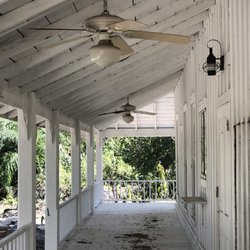
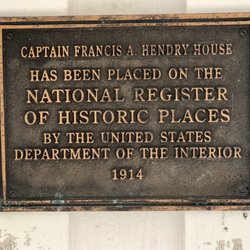
As a fan of historic architecture I was excited to find this structure on a recent trip to Labelle…read more The house is located at 512 Fraser Ave. next to the LaBelle Nature Park. This historic vernacular one and one and a half story home was built in 1914 for Captain Hendry who fought in the Confederate Army in the Civil War. After the war Hendry became a cattle rancher. Hendry hired self taught builder Benjamin F. Magill to supervise the construction of his home in the town of LaBelle which he founded on the western end of his vast ranch holdings in Monroe County. Hendry moved into the home at the age of 81 with his wife. Due to his poor health, Hendry was only able to live in the house for a few months before moving to Fort Myers for better access to medical care. He passed away in 1923 and his final resting place is a private family cemetery in Fort Myers. When Hendry County was formed in 1923 it was named after Captain Hendry. This is is the only surviving structure left associated with him. After Hendry's death, the house had numerous owners through the years. On February 5, 1998, it was added to the U.S. National Register of Historic Places. The house is not open for visitors. It looks like construction is being done on the stairs and porch. It was still fun to peek in the windows and around the outside. I love the huge wraparound porch. It looks like there are a few period furnishings inside and historic photos on the wall. I saw online that LaBelle uses the grounds for outdoor events and weddings.
Photos
Captain Francis A. Hendry House

See all

Ernest Hamilton Observation Tower - landmarks - Updated May 2026

Loading...
Loading...
Loading...