Cancel

Open app

Search

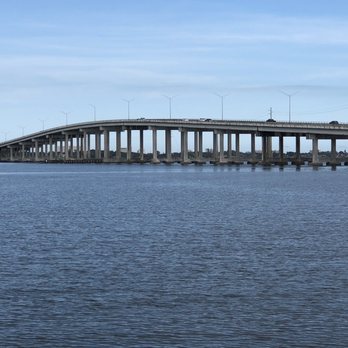
Eau Gallie Causeway Bridge

4.8 (4 reviews)

Eau Gallie Causeway Bridge Photos

More like Eau Gallie Causeway Bridge

Recommended Reviews - Eau Gallie Causeway Bridge

Your trust is our priority, so businesses can't pay to alter or remove their reviews. Learn more about reviews.
Yelp app icon
Browse more easily on the app
Review Feed Illustration

4 months ago

Helpful 2
Thanks 1
Love this 4
Oh no 0

3 months ago

Great views of the Indian River. Traffic is not a problem. Plenty of places to pull over by the shoreline.

Helpful 0
Thanks 0
Love this 0
Oh no 0
Photo of Ariel W.
4398
5929
104180

5 years ago

Helpful 101
Thanks 0
Love this 100
Oh no 0

11 years ago

Helpful 14
Thanks 0
Love this 15
Oh no 0

Verify this business for free

Get access to customer & competitor insights.

Verify this business

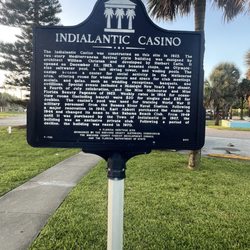
Indialantic Casino - How the casino looked in the 1920's.

Indialantic Casino

5.0(1 review)
4.1 mi

I was exploring James A. Nance Park when I discovered this historic marker at the edge of the…read moreparking area. The marker is part of the Florida Historical Marker Program, one of the Division of Historical Resources' most popular and valued public history programs. The markers raise awareness of Florida's cultural history while enhancing the enjoyment of historic sites for residents and tourists. The blue historic markers tell the stories of the people and places that were important to Florida's history and they can be found in front of schools, forts, roads, archaeological sites, battlefields, cemeteries, churches, and historic buildings that once existed like this one. Historic Marker F-730 was installed in 2011 by the Brevard County Tourist Development Council and the Florida Department of State. In 1923 the Indialantic Casino was built on the site of what is now the southeast corner of James A. Nance Park. The casino was a two-story Mediterranean Revival style building designed by architect William Christen and developed by Herbert Earle. The casino opened on December 22, 1923, and although called a casino there was no gambling involved. Instead the building had shops, an Olympic-size saltwater pool, a landmark concrete diving tower, and wading pools. It became the center of social activity in Melbourne and hosted club meetings, socials, and galas, wedding receptions, banquets, and cotillions. Special events included a Midnight New Year's Eve dinner, a Fourth of July Celebration, and the Miss Melbourne and Miss Florida Beauty Pageants of 1925. Weekly rates in 1924 for room and board of an ocean view room was $20 for singles and $35 for doubles. During WWII the casino's pool was used to train military personnel from the Banana River Naval Station. The casino was renovated in 1942. In 1944 Karl Abbott purchased it changed the name to the Bahama Beach Club. The casino then became a private club from 1949 until it was purchased by the Town of Indialantic in 1967. Following storm damage, the building was torn down in 1970 by the Indialantic Fire Department.

Photos
Indialantic Casino
Indialantic Casino
Indialantic Casino

See all

Rossetter House Museum

Rossetter House Museum

4.7(3 reviews)
0.7 mi

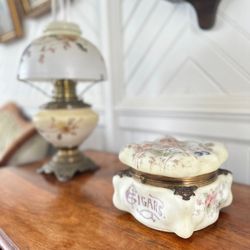
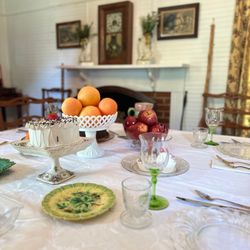
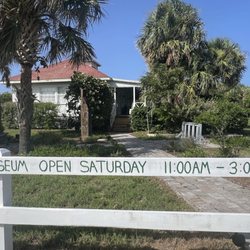
The James W. Rossiter House is it historic home of James Wadsworth Rossiter, Sr., who came to this…read morepart of the world in 1902. He purchased this property in 1903, go the history of the house can be traced to before the Civil War. I love to find Historical pieces of a community such as this. It is important that we know the footsteps of the past that led us to the present. It is hard to imagine what Florida was like not only during the Civil war, but even in the early 1900s. There was no air conditioning and I am confident that life was very difficult here in the Sunshine State. If you find yourself in melbourne, come check this place out.

I love to discover historic buildings so I was pleased to discover this museum on a recent trip to…read moreEau Gallie, now part of Melbourne. The Rossetter House Museum is made up of the 1908 Rossetter House and Gardens, the 1892 Roesch House once owned by the first mayor of Eau Gallie and the 1865 Houston Cemetery where the first white settlers to Eau Gallie are buried. James Rossetter (1863-1921) was born in Hamilton County, Florida. He arrived in Eau Gallie in 1902 and bought this property in Eau Gallie in 1904 from the first settler to the area, John Houston who fell in love with the area while conducting a Seminole Indian census in 1850. The house started as a small existing building on the property. Rossetter was a leading merchant in the fishing industry and agent for the Standard Oil Company. As his wealth increased, Rossetter purchased the winter home of John Aspinwall, a New York industrialist and moved it to his property. The Aspinwall structure was built in 1890 and makes up the west wing of the house, connected by open-air breezeways. James lived in the home with his wife Ella and their children Caroline, Ella, James, Appleton, and Charles. Caroline and Ella remained in the home until their deaths at which time the house and contents were donated to the Rossetter House Foundation. It is managed by the Florida Historical Society who gives guided tours Wednesday through Saturday. After you finish your tour you should make your way to Main Street, Eau Gallie which is just steps away with restaurants, shops, and art. I highly recommend stopping at FM Pizza Oven and Joan's Perfect Pie to complete your visit.

Photos
Rossetter House Museum

See all

Old Town Hall History Center

Old Town Hall History Center

5.0(1 review)
6.9 mi

I was passing through Melbourne Beach when I noticed this building with a historic marker. The…read moremarker is part of the Historical Marker Program, one of the Division of Historical Resources' most popular and valued public history programs. The markers raise awareness of Florida's cultural history while enhancing the enjoyment of historic sites for residents and tourists. The blue historic markers tell the stories of the people and places that were important to Florida's history and they can be found in front of schools, forts, roads, battlefields, cemeteries, churches, historic districts, archaeological sites, and buildings like this one. Historic marker F-640 was installed in 2008 by the Brevard County Historical Commission The Brevard County Tourist Development Council and the Florida Department of State. This building was built in 1908 in what is now Ryckman Park. It faced the Indian River Lagoon and held offices of the Melbourne Beach Improvement Company where Capt. Rufus Beaujean, Donald Beaujean, and Lawrence Ryckman planed the pier, lot sites, roads, and a railway. Eventually, the building became the Melbourne Beach Town Hall and Post Office. In 1953, a new town hall was built. This building was floated down the Indian River to this area. It became the Williams Building when it was used for meetings and classes and managed by Mr. and Mrs. Williams. When the Spessard Holland Golf Course was built, the building was moved to the point of land between Oak Street and Highway A1A where it continued to be a community center. In 2001, the building was scheduled for demolition. Two citizens stepped forward to save it and the community rallied behind them. In May 2007 the building opened as a history center. The museum is free and open on Saturdays. It has displays about history of the area, Ais Indians, Spanish shipwrecks, and the development of Melbourne Beach.

Photos
Old Town Hall History Center

See all

Valencia Historic District

Valencia Historic District

5.0(1 review)
15.4 mi

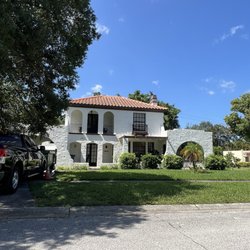
There are many historic districts throughout Florida. They are usually associated with the land…read moreboom years of the 1920's when Florida was flush with cash. I discovered the Valencia Historic District near the Indian River Lagoon in Rockledge. Rockledge was founded in 1887 making it the oldest town in Brevard County. The homes in this neighborhood are very ornate and representative of the type of homes you would see in 1920's Florida. The neighborhood is very walkable or you can drive by. The Valencia Historic District is marked by the original entrance columns from the 1920's and a historic marker that is part of the Historical Marker Program, one of the Division of Historical Resources' most popular and valued public history programs. The markers raise awareness of Florida's cultural history while enhancing the enjoyment of historic sites for residents and tourists. The blue historic markers tell the stories of the people and places that were important to Florida's history and they can be found in front of schools, forts, roads, archaeological sites, battlefields, cemeteries, historic buildings, roads, churches, and historic districts like this one. Historic marker F-600 was installed in 2007 by Brevard County Historical Commission, The Brevard Heritage Council, The Brevard County Tourist Development Council and the Florida Department of State. The Valencia Homes Company was formed in 1924 by local businessmen C. Sweet Smith, Charles D. Smith, L. S. Andrews and Horace R. Bruen. The company acquired a 22-acre tract of land that was formerly the site of the Plaza Hotel and part of an orange grove. In March 1924 the company platted the subdivision and named it after the type of oranges that grew there, and for the Valencia region of Spain. The neighborhood had entry gates, a waterworks, paved roads, installed light posts, and tropical landscaping. Each lot was 25 feet wide and most buyers purchased at least two of them. Each sale agreement required that the homes must cost $4,000 or more and be in the Spanish, Moorish, Mediterranean, or Italian architectural design. Al of the homes were designed by Richard W. Rummell, Jr., who also designed many other buildings in Brevard County. All of the contributing homes to this historic district were built between 1924 and 1926 and there are 54 historic buildings. One of the most notable homes is the 1880 Queen Anne style home of H.S. Williams, now the Lawndale Museum on Rockledge Drive. All of the other homes in the neighborhood are private but you can tour the inside of this one with period furnishings for $10 on Saturday afternoons. The Valencia Historic District was added to the National Register of Historic Places in 1992.

Photos
Valencia Historic District

See all

Myrtle Cottage - What Myrtle Cottage looked like.

Myrtle Cottage

5.0(1 review)
5.5 mi

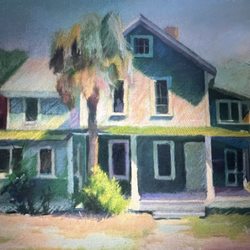
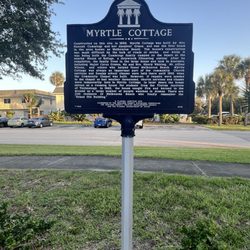
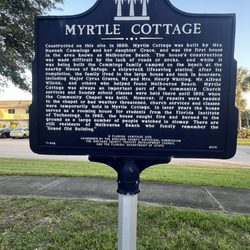
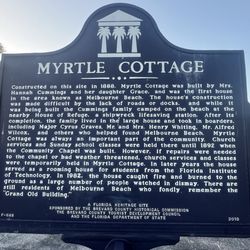
There is so much history in this section of Melbourne. Just down the street from Ryckham Park I…read morediscovered this historical marker in front of the Community Chapel of Melbourne Beach overflow parking. The Myrtle Cottage marker is part of the Florida Historical Marker Program, one of the Division of Historical Resources' most popular and valued public history programs. The markers raise awareness of Florida's cultural history while enhancing the enjoyment of historic sites for residents and tourists. The blue historic markers tell the stories of the people and places that were important to Florida's history and they can be found in front of schools, forts, roads, archaeological sites, battlefields, cemeteries, churches. and former historic buildings like the one that once stood here. Historic marker F-688 was installed in 2010 by Brevard County Historical Commission, Brevard County Tourism Development Council, and the Florida Department of State. This church is a Florida Heritage Site. Myrtle Cottage was the first house in what is now Melbourne Beach. It was built on this site in 1888 by Mrs. Hannah Cummings and her daughter Grace. Building a house back then was no easy task since there were no roads or docks. While the house was being built, the ladies camped out at the beach in front of the House of Refuge, a shipwreck lifesaving station. After their home was finished they took in boarders who were instrumental in founding Melbourne Beach. Church services and Sunday school classes were held in Myrtle Cottage until 1892. In later years the house took in students attending the Florida Institute of Technology. Sadly this historic home burned down in 1982.

Photos
Myrtle Cottage
Myrtle Cottage
Myrtle Cottage

See all

Porcher House

Porcher House

3.5(4 reviews)
16.6 mi

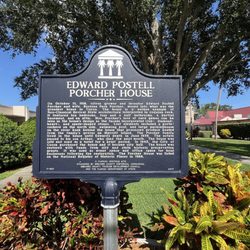
While wandering historic downtown Cocoa I discovered the stately Porcher House in Cocoa Riverfront…read morePark. As a fan of historic architecture, this is a gem worth checking out. In front of the home is a historic marker that is part of the Historical Marker Program, one of the Division of Historical Resources' most popular and valued public history programs. The markers raise awareness of Florida's cultural history while enhancing the enjoyment of historic sites for residents and tourists. The blue historic markers tell the stories of the people and places that were important to Florida's history and they can be found in front of schools, forts, roads, archaeological sites, battlefields, cemeteries, roads, churches, historic districts, and historic buildings like this one. Historic marker F-937 was installed in 2017 by Brevard County Historical Commission, The Brevard Heritage Council, The Brevard County Tourist Development Council, and the Florida Department of State. This impressive home is associated with Edward Porcher. As a young man he moved to Cocoa from South Carolina in the late 1800's. He and wife Byrnina Peck of Atlanta settled into Merritt Island where they raised their family and operated Deerfield Groves, a citrus farm. He was the first person to grade fruit for shipping, patented the first fruit stamping machine, and he invented a machine to wash the fruit. He was the founder of the Indian River Orange Growers Association. In 1962 he was inducted into the Florida Citrus Hall of Fame. Byrnina was the first postmistress on Merritt Island. In 1895 the Porcher family moved into a three story wood frame house where the Cocoa Civic Center is now located. Construction on the Porcher's Neo Classical Revival home began in 1914 based on Mrs. Porcher's design. A special feature in front of the house are the stones that were cut to represent the suits of cards in a game of Bridge. The house was built from native coquina rock and included ten bedrooms, four and one-half baths, a partial basement, and an attic. The staircase is made of teak, the floor is oak, and the wainscoting and trim are cedar. The Porcher family moved into the grandest home in Cocoa on October 31, 1916. Portions of the house are original while others are restorations. No longer on the property are the porte-cochere on the north side, the Porcher's swimming pool, and the large packinghouse that was on the river bank behind the house. The packing house was used to process produce delivered by boat the family's groves on Merritt Island. Edward Porcher passes away in June 1939. Upon his death the house passed to his son Arthur who died the next month. The house became a hotel and then in 1945 the City of Cocoa purchased it and used it for City Hall. Money from city and state historic preservation grants were used to restore the Porcher House and it was added to the National Register of Historic Places on January 6, 1986. Today the Porcher House can be rented for private events like weddings.

Porcher was in the business of oranges. Later, this house was used as city hall…read more Now it is an event venue for weddings and such. The house has been restored, but it is not furnished as a residence. Some of the rooms contain offices where you can reserve the house for an event, and arrange for catering. The front door latch is a bit hard to open, so try a little harder before giving up on it. Don't expect a guided tour of the house, but walk thru and have a look, when there is no wedding or reserved private event going on. There is an elevator to the second floor, with water fountain and restrooms nearby. Look out the first floor back porch to the river. Walk out the back and stroll to the river thru a park with an amphitheater. There is another park on the block that has swing sets for the younger folk. This Porcher House is next door to the civic center.
Photos
Porcher House
Porcher House
Porcher House

See all

Sams House at Pine Island

Sams House at Pine Island

4.8(4 reviews)
24.2 mi

I came here with my homeschooling co-op, they did a free mini class event for us. Very nice of the…read moreteacher to take the time to teach the kiddos all about navigation and she made it really fun for them as well as broke it down for them to understand in game form. I think it lasted about 25 mins or so. Only wish I would have walked more into their trail to see the water view if there is one I didn't get to see it. In all a cool spot to get a bit of history and sight seeing.
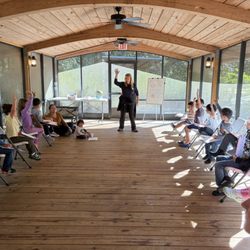
Wow! What a cool place. My husband and I have been choosing a different nature sanctuary in…read moreBrevard county to explore and walk, today we chose Sams house and Pine Island sanctuary. We decided to park at the Pine Island end of the trail, there are a couple of rustic areas to park. The trail head for the Pine Island loop which is about 3/4 of a mile is near the manatee viewing area and kayak launch. The walk from parking area to the start of the garnet trail which takes you to Sam's house is a wide open green area that is used for walking or horseback riding, there is no shade but if you're lucky there is a beautiful breeze along the lake. The trail to Sam's house is very rustic with some boardwalks and lots of root covered ground. The path is clear but some areas a a little soft due to the surrounding canals. Sam's house is one of the original homes in Merritt Island. There are areas with explanations and examples of what was grown and sold in the area. Apparently there were prehistoric animal remains found in the area as well as the burial mound of Indigenous people. This is a definite place to revisit and explore the other trails and bits of history.

Photos
Sams House at Pine Island
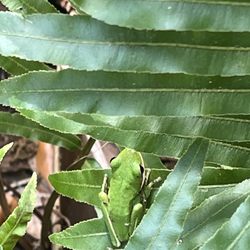
Sams House at Pine Island - Saw this little guy while walking

Saw this little guy while walking

Sams House at Pine Island - Remnants from citrus trees

See all

Remnants from citrus trees

Eau Gallie Causeway Bridge - landmarks - Updated May 2026

Loading...
Loading...
Loading...