Need a quick getaway from the busy city, Fire Island is a great place to visit. Personally…read morefascinated by the history of lighthouses.
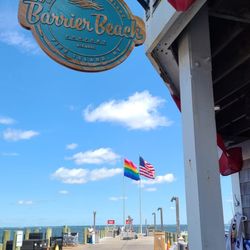
Fire Island Lighthouse is a must see attraction. There are no cars on the island, taking the ferry is a great way to visit.
If you want a quiet, relaxed visit definitely visit during the off season, which is before Memorial Day weekend.
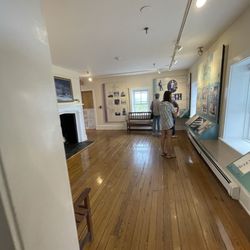
The actual lighthouse was closed for my visit but there was ship wreckage on display. In addition to skull of baby whale that washed ashore.
The current Fire Island Lighthouse was completed in 1858, with a state-of-the-art revolving first order Fresnel lens produced in France by the Henry-Lepaute company. It was equipped with a first order hydraulic lamp, with 5 concentric wicks, and used Colza oil or whale oil. The 16-foot-tall, beehive-shaped glass and brass apparatus was rotated by means of a clockwork mechanism with flying pendulum. It emitted a 5-second flash once every minute. With a focal plane of 166 feet above sea level, this light could be seen from ships at least 21-23 nautical miles at sea.
This original first order Fresnel lens served as a beacon to mariners from the top of the Fire Island Lighthouse from 1858 through 1932. In 1933, it was taken out of service and displayed at the Franklin Institute in Philadelphia until 2000.
For history buff's I am providing information on the Savannah ship wreckage below:
The sea brings us many gifts. One that recently arrived at Fire Island Lighthouse is a 13' x 13' piece of wreckage, possibly a remnant of the last voyage of the ship Savannah.
This was no ordinary ship that came to grief on our shores. The Savannah was the first steam-powered ship to cross the Atlantic Ocean.On May 22, 1819, she left Savannah Harbor and sailed across the Atlantic Twenty-nine days later she arrived at Liverpool to the cheers of thousands who came to see the smoke and sparks bursting from her single stack. Under steam for about 80 hoursof her voyage, her notoriety caused quite a sensation in Europe, where she visited many ports, including Stockholm, St. Petersburg, and Copenhagen.Returning to Savannah in November 1819, she failed to attract passengers and cargo because steam technology was still considered dangerous and unreliable. She was sold and converted to full sail, then carrying cargo between Savannah and New York.On November 5, 1821, during a terrible storm, she missed New York Harbor and wrecked off the shore of Fire Island where she remained buried for more than 200 years.Tropical Storm Ian uncovered the piece of her wreckage that began its journey westward with the tides, where it was pulled from the beach east of Robert Moses Field 5.On November 17th, 2022, National Park Service staff delivered the wreckage to the Lighthouse. Currently, N. P. S. staff is conducting research to positively identify the wreckage, including evident construction particulars and other anecdotal evidence of size, circumstance, and location of the wreck.
The historic impact of the transatlantic voyage of Savannah will never be overlooked. Memorialized by President Franklin D. Roosevelt in 1933, he designated the day that the Savannah began its historic transatlantic voyage, May 22nd, as National Maritime Day.The sea has presented us with an extraordinary gift, delivered right to our doorstep: a remarkable piece of Maritime Heritage, now on view at the Fire Island Lighthouse for all visitors to appreciate.Angela ReichAuthorShipwreck of Hopes