
Vietnam War Memorial Photos


You might also consider

More like Vietnam War Memorial
Recommended Reviews - Vietnam War Memorial
Start your review...


Reviews With Photos


Nostalgia, grief, and appreciation washes over me as an American-born daughter of 2 refugees from the Vietnam war. This place makes me feel closer to a homeland I've never laid eyes or feet on.


In response to a competition invitation while at Yale University, Maya Lin's creation of the Vietnam Memorial in Washington, D.C. was one of her earliest works as an architect. Her initial idea was to represent the pain of war. Thus, the Earth is pierced in Maya Lin's design to represent the pain suffered by the dead and those left behind. The black marble was meant as a reflection opportunity for the living. The memorial later dedicated in Westminster mirrors with Maya Lin's original design. It also incorporates her Civil Rights Memorial with its circular design. The Vietnam War Memorial in Westminster, California--unveiled on April 27, 2003--contains black marble similar to the one in Washington, D.C. It does not, however, contain names of fallen soldiers on the black marble. It includes influences from Maya Lin's Civil Rights Memorial such as the running water in the center in addition to the waterfall incorporated into the black marble. In the center of the memorial is also a huge censer that is reflective of an Asian tradition to honor the dead. It is customary to worship ancestors in the Asian culture by burning incense in a censer. The Vietnam Memorial in Westminster attempts to capture Maya Lin's original design while integrating the culture of the Vietnamese community it attempts to honor.


Imagine my surprise when I hear that Orange County CA has its own Vietnam War Memorial. As a long-time DC Metro resident, I'd always thought DC is the only home of the Vietnam Memorial. Well, it turns out there's a subtle naming difference: Westminster's version is called the Vietnam War Memorial, whereas the national monument in DC is the Vietnam Veterans Memorial. Who knew? The difference in their history, architecture, and impact are pretty significant on the other hand. Whereas the design and construction of the DC monument was rife with controversy and the memorial wall itself consists of two somber granite walls with inscribed names that pack an emotional wallop no matter how many times I've visited it, the OC version was designed and built in a straightforward manner by a local Vietnamese sculptor and is located in a sunny cheery park surrounded by flowers. If you're ever in the area and find yourself in need of killing an hour or so that's not eating-related, as one so often finds oneself doing in bountiful Little Saigon, this is an interesting place to visit to get a little history on the VN war.

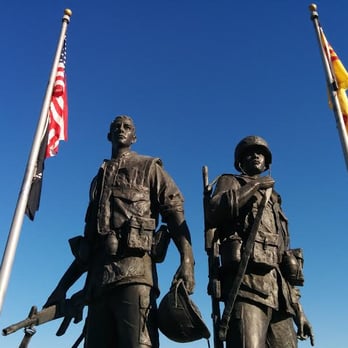
Grateful to this nation. Grateful to the American and South Vietnamese soldiers who sacrificed for our fight for freedom. Grateful to the city of Westminster for creating a beautiful homage to these heroes. The statues are breathtaking and the peaceful quiet is accompanied by the warmth of the ever burning fire. Looking at past reviews, it looks as if this monument once had a water feature alongside the marble, but it does not look as if it runs anymore. I met a Vietnam vet there today who states there are monthly meetings every 1st Sunday at this location from 12-1 for soldiers of the war and supporters to spend time to connect and share stories. I cannot wait to go back.


The Vietnam War Memorial is located in Sid Goldstein Freedom Park, near the Westminster Public Library and across the street from the Westminster PD. It features statues of an American and a South Vietnamese soldier, honoring those who fought and died in the war, and commemorates the fall of Saigon. It also features a bronze urn with an eternal flame. Black April is celebrated by Vietnamese people on April 30th every year in remembrance of the Fall of Saigon and honoring the lives lost. The memorial was dedicated in 2003. Yelp Review #17- 2026 read more
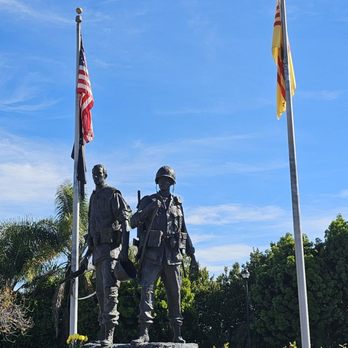


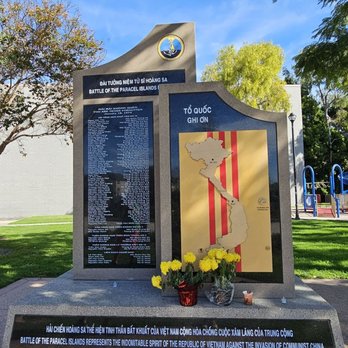


It was a bit underwhelming. I thought it would be a bit more impressive, have more to say, have statistics, a recap or something other than a statue, flags, some water to memorialize the carnage suffered by both sides of this tragic war. Westminster is a city I grew up in during the Viet Nam war and I am happy to say that the refugees that came to America in the late 70s that settled in Westminster have made a remarkable life for themselves and revitalized this city. Congrats and thank you to this hard working, loyal and patriotic community for building a vibrant business section in Westminster and Garden Grove. read more


5 years ago
Nostalgia, grief, and appreciation washes over me as an American-born daughter of 2 refugees from the Vietnam war. This place makes me feel closer to a homeland I've never laid eyes or feet on. read more


6 years ago

In response to a competition invitation while at Yale University, Maya Lin's creation of the Vietnam Memorial in Washington, D.C. was one of her earliest works as an architect. Her initial idea was to represent the pain of war. Thus, the Earth is pierced in Maya Lin's design to represent the pain suffered by the dead and those left behind. The black marble was meant as a reflection opportunity for the living. The memorial later dedicated in Westminster mirrors with Maya Lin's original design. It also incorporates her Civil Rights Memorial with its circular design. The Vietnam War Memorial in Westminster, California--unveiled on April 27, 2003--contains black marble similar to the one in Washington, D.C. It does not, however, contain names of fallen soldiers on the black marble. It includes influences from Maya Lin's Civil Rights Memorial such as the running water in the center in addition to the waterfall incorporated into the black marble. In the center of the memorial is also a huge censer that is reflective of an Asian tradition to honor the dead. It is customary to worship ancestors in the Asian culture by burning incense in a censer. The Vietnam Memorial in Westminster attempts to capture Maya Lin's original design while integrating the culture of the Vietnamese community it attempts to honor. read more



18 years ago
Imagine my surprise when I hear that Orange County CA has its own Vietnam War Memorial. As a long-time DC Metro resident, I'd always thought DC is the only home of the Vietnam Memorial. Well, it turns out there's a subtle naming difference: Westminster's version is called the Vietnam War Memorial, whereas the national monument in DC is the Vietnam Veterans Memorial. Who knew? The difference in their history, architecture, and impact are pretty significant on the other hand. Whereas the design and construction of the DC monument was rife with controversy and the memorial wall itself consists of two somber granite walls with inscribed names that pack an emotional wallop no matter how many times I've visited it, the OC version was designed and built in a straightforward manner by a local Vietnamese sculptor and is located in a sunny cheery park surrounded by flowers. If you're ever in the area and find yourself in need of killing an hour or so that's not eating-related, as one so often finds oneself doing in bountiful Little Saigon, this is an interesting place to visit to get a little history on the VN war. read more


11 years ago

14 years ago

8 years ago
Grateful to this nation. Grateful to the American and South Vietnamese soldiers who sacrificed for our fight for freedom. Grateful to the city of Westminster for creating a beautiful homage to these heroes. The statues are breathtaking and the peaceful quiet is accompanied by the warmth of the ever burning fire. Looking at past reviews, it looks as if this monument once had a water feature alongside the marble, but it does not look as if it runs anymore. I met a Vietnam vet there today who states there are monthly meetings every 1st Sunday at this location from 12-1 for soldiers of the war and supporters to spend time to connect and share stories. I cannot wait to go back. read more


15 years ago

15 years ago

10 years ago

15 years ago
this place is very small but it is very relaxing :P i come here to study before class its very peaceful. read more

More info about Vietnam War Memorial
Ask the Community - Vietnam War Memorial
Review Highlights - Vietnam War Memorial






















Why does Yelp recommend reviews?
1 review that is not currently recommended
The reviews below are not factored into the business's overall star rating.

1 year ago


