The Severn Bridge Aust-Chepstow Photos


Recommended Reviews - The Severn Bridge Aust-Chepstow
Start your review...



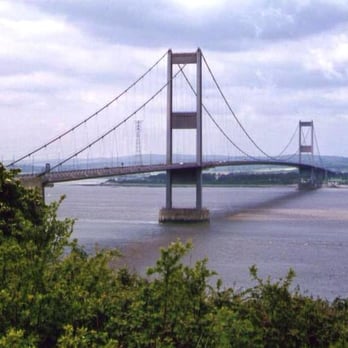
The Severn Bridge is the UK's third longest single-span bridge and crosses the River Severn between Aust (in England) and Chepstow (in Wales). It is currently (2008) the 22nd longest span in the world, and was the seventh longest when built. Plans to build a road crossing across the River Severn had been discussed since the 19th century, and a rail bridge was built further upstream in 1879 and a rail tunnel (still in operation) downstream in 1886. An attempt to build a road bridge in 1935 was scuppered by opposition by the Great Western Railway, and it was to be another 30 years before plans for a road bridge finally came to fruition. Prior to that, road traffic from South Wales to Bristol and London had the unenviable choice of a long, slow detour via Gloucester or the shorter but heavily congested car ferry route which ran between Beachley near Chepstow and Aust in Gloucestershire. A major problem for both the ferry and any bridge design is the incredible tidal flow of the Severn - Britain's longest river - which has the second highest tidal range in the world (over 15.4m) - and fierce currents of up to 8 knots (9 mph or 15kph). A decision to build a bridge was taken as part of post-War plans to develop the UK's long-distance road network, and a crossing was essential for the route of the proposed M4 motorway from London to Bristol and South Wales. Plans were developed and the contract awarded in 1961 to Mott, Hay and Anderson with designers Freeman Fox & Partners. The design was for a classic suspension bridge, but with a novel deck of box-girder type. This has an aerodynamic profile to reduce the lateral pressure produced by the fierce gales which blow up the Bristol Channel from the Atlantic. Another novel feature was the use of inclined drop cables from main suspension cables. The structure is designed to withstand a wind of 100mph (160kph). The statistics are impressive, as you might expect: the main span is 3,240ft (988m) with approach spans each of 1,000ft, making the bridge 5,240ft (1.6km) long in total, and incorporating over 18,500 tonnes of steel. The main towers are each 443ft (136m) high, and lean slightly away from each other to account for the curvature of the earth. The decks include a 4-lane dual-carriageway road and outer cantilevers which carry cycle tracks and a footpath. The bridge also has approach viaducts on both English and Welsh sides, and on the Welsh side immediately crosses a 1,340 ft (408m) long cable-stayed bridge to span the River Wye. (This is the boundary between England and Wales, so technically the main bridge is wholly in England). The whole 3.0km double-bridge structure is stunningly impressive. The bridge was opened by Queen Elizabeth in 1966, and rapidly became an essential link to South Wales. Tolls (at 2/6 - 12.5p for those too young top remember LSD currency!) were charged from the outset, and are currently £5.30 for cars and £15.90 for HGVs. Motorcycles go free. On the English side at Aust is a large motorway service station, with a viewing point for the bridge. A victim of its own success, increasing traffic volumes and especially the increase in goods vehicle weights meant that within 10 years the bridge was being strengthened, and by 1995 was carrying 50,000 vehicles a day. It was also vulnerable to very high winds: although the structure itself was safe, vehicles crossing could be blown over, necessitating restrictions in stormy weather. It was therefore inevitable that plans for a new, additional bridge should be brought forward and the Second Severn Crossing was opened several miles downstream: although much longer, at over 3 miles (5km), most of this is on viaduct and the main navigation span is shorter at 1,500ft (456m). It has 6-lane dual carriageways and is has a wind baffle to enable vehicles to cross in high winds. The M4 now crosses on this new bridge, with the old bridge road renamed the M48. It was opened by Prince Charles in 1996. The same company now operates both bridges. The bridge has become iconic for me, as my parents lived in Somerset and my grandparents all lived in South Wales, which meant regular ferry crossings until 1966, after which we used the bridge almost every weekend for several years. Painted grey for most of its life, in more recent years it has been painted white to reduce heat absorption. It's still an iconic structure, and carries over 15,000 vehicles a day. I should add that there are some fantastic photographs of both bridges during their construction on the bridge website - including some of the old Beachley-Aust ferry, with its wooden on-deck turntable. No longer it took so long to load cars - it's hard to realise now just what a difference the bridge made back in 1966! read more

18 years ago