Cancel

Open app

Search

The Godstone Dental Practice

5.0 (1 review)

The Godstone Dental Practice Photos

Recommended Reviews - The Godstone Dental Practice

Your trust is our priority, so businesses can't pay to alter or remove their reviews. Learn more about reviews.
Yelp app icon
Browse more easily on the app
Review Feed Illustration

18 years ago

Helpful 0
Thanks 0
Love this 0
Oh no 0

Verify this business for free

Get access to customer & competitor insights.

Verify this business

The Home of Charles Darwin - Charles Darwin

The Home of Charles Darwin

5.0(3 reviews)
7.5 mi•Downe
•££

If I was giving a review for what a pain it is to get to Down House on public transport, this would…read morebe a 1 star (there are two buses you can take - one is every 90 minutes, the other every 60...). But once you drag yourself there, Down House is simply lovely. I actually only quickly flew through the ground floor of the house, but even on my quick visit I could see it was full of interesting things and I will definitely be back to explore more properly. However, this visit was for a garden tour, which I wholeheartedly recommend. We were in a private group - about 15 of us, and the tour was £75 on top of the normal entrance fee (£12.30 if you want to gift aid it). They do offer the garden tour for everyone on Wednesdays and Sundays in July and August for a small fee on top (£4). Our tour was lead by the gardener, Christina, a knowledgeable and enthusiastic lady from Prague. She knew the garden inside out, but also had plenty of Darwin spiel. It was interesting to learn how much of the garden is planted to Darwin's specifications. The kitchen garden is spectacular, and they try to plant strains popular from the 1800s, even if there's often something 'better' developed now. They use the vegetables in the café, and also sell some (I was eyeing up, but too slow, courgettes with the flower attached - 3 for £1!) The garden also still does some of Darwin's experiments. It's all in a lovely setting and the nearby village of Downe is quaint with a couple of pubs and a church. All in all, a fine day out that you can get to on London transport, but feel like you're in the middle of the countryside (and well, you are!)

Visit this amazing and remarable house where Charles Darwin the Victorian scientist revolutionised…read morethe world with his groundbreaking theory regading evolution.I was touched by his spirit when I visited this place to see the room where the origins of the species was written.There are extensive interactive exhibitions on Darwin's life and theories and will captivate all age groups.

Photos
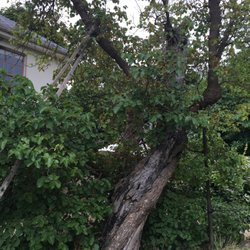
The Home of Charles Darwin - Mulberry tree, original to when Darwin lived here. It's nearing the end of life; cuttings have been taken & replacement trees being grown!

Mulberry tree, original to when Darwin lived here. It's nearing the end of life; cuttings have been taken & replacement trees being grown!

The Home of Charles Darwin

See all

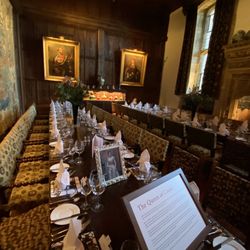
Hever Castle - Hever Castle's dining hall, laid up for a private event

Hever Castle

4.8(20 reviews)
9.0 mi

Thatcher would be proud…read more Looking around Hever, many would be left with the impression that the owners are enormous fans of Anne Boleyn. The unfortunate wife of Henry VIII is, after all, the main focus of the exhibition and makes an appearance on much of the marketing material. But look a bit closer, and the more astute visitor may notice a different, more 'true blue', streak permeating the house. Yes, Labour voters clutch your pearls, but the proprietors appear to be worshippers of none other than Margaret Thatcher. (More so than Ms Boleyn, I would wager.) In the castle, visitors are treated to a near life-size oil painting of the union basher. And for those lucky enough to stay in the guest house for the price of £300 per night, they will find a letter written by the Iron Lady to thank the castle for her stay that has been framed and hung in one of the hallways. Among the owners personal possessions, I note Ms Boleyn has not received a similar dose of affection. Of interest is also the fact that this castle, its stunning gardens and water maze, owe their amazing condition to our friends across the Atlantic. Most stately homes in Britain are now virtually on their knees, with years of decline and underinvestment in the country reflected in their faded carpets, moth-eaten curtains and peeling paintwork. Hever, however, has avoided this fate for the good reason that it was bought by... gasp... an AMERICAN. Horrifying as it may sound, Mr Astor - who owes his astounding wealth to the rise of New York City - purchased the castle and injected nothing short of a fortune into it in order to create the attraction that we see today. Demonstrating an entrepreneurial spirit so often absent in Britain, he then had the vision to order the construction of a second moat, a lake, a walled Italian garden complete with artefacts from Pompeii, a 'wall waterfall' and to direct the gardeners to shape some bushes like a chess set. I don't think he was involved in the water maze, so loved locally, but its presence reflects Hever's enduring ambitious spirit. Perhaps it was this spirit that so inspired Margaret Thatcher to write of Hever: 'I have seen several castles and large country houses but none as perfect as Hever.'

If you are visiting London, Hever Castle is a must do. Only a 90 minute drive from London hotels,…read morethe trip is well worth the wait upon arrival. From its sprawling vistas to the castle itself this place is a real treat. There is a large lake on site that offers rowing, an area that allows you to try your hand at archery and even a place to see falconry. There are jousting exhibitions and plenty of food from the cafe or restaurant on site. The REAL gem is the castle. Home for Queen Anne Boleyn from 5 years old to 12 one can only imagine the wonder this place brought her. The castle provides an audio tour in several languages so there is no issue there. (The staff are marvelously kind and helpful in the castle and in the dining areas and gift shop.) It's small but chock full of informative history about Anne Boleyn as well as those who lived in the castle after her death. If you are looking for a respite from the concrete jungle and noisy planet that is London, Hever provides you with lots of peace and quiet Tour the rose garden or just sit and enjoy the views and shade from the trees. It's an idyllic setting and a trip that will make your visit to the UK complete.

Photos
Hever Castle - Lovely walkway to the castle

Lovely walkway to the castle

Hever Castle - Billard Room

Billard Room

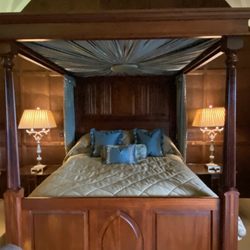
Hever Castle - Tulip room's four poster bed - Do not be mislead by the beauty of this bed.  It is the most uncomfortable bed we have ever slept in.

See all

Tulip room's four poster bed - Do not be mislead by the beauty of this bed. It is the most uncomfortable bed we have ever slept in.

Crossbones Graveyard

Crossbones Graveyard

4.6(5 reviews)
17.4 mi•Borough

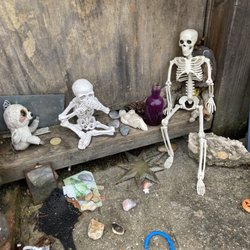
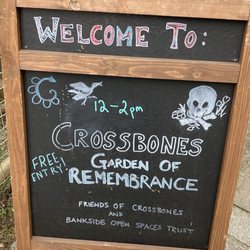
This little garden was on a list of strange/offbeat attractions to see on my trip to London because…read moreof the dark history around it. It's basically a garden grown atop a mass grave for poor, unmarried women, sex workers, and children. Small but lovingly cared for by volunteers, it is only open from noon to 3PM on weekdays during the summer. There is some artwork and little memorials. It's a little out of the way, but if you're in the area it's a nice quick stop to pay tribute to the forgotten women and children.

Another Halloween visit? This one holds a celebration here…read more Cross Bones Graveyard was a mediaeval burial ground, situated in St Saviours parish, now Redcross Way SE1. There is a long established tradition that it was a final resting place for Winchester Geese, ie prostitutes, from the legalised brothels or 'stews' of Bankside. This dates back to the days when the Bishop of Winchester ran Bankside and licensed the Geese. Recent archaeological digs for the Jubilee Line extension have uncovered evidence of a highly overcrowded graveyard where bodies are piled up on top of each other and tests have shown that many of the bodies are women and children with diseases ranging from smallpox, TB and pagets disease to osteoarthritis and vitamin D deficiency. This is Cross Bones, an unconsecrated graveyard going back to medieval times. The Tudor historian John Stow refers to it as a burial ground for 'single women' - a euphemism for the prostitutes who worked in Bankside's legalised brothels or 'stews'. In his 1603 Survey of London, Stow writes: 'I have heard of ancient men, of good credit, report that these single women were forbidden the rites of the church, so long as they continued that sinful life, and were excluded from Christian burial, if they were not reconciled before their death. And therefore there was a plot of ground called the Single Woman's churchyard, appointed for them far from the parish church.' The burial registers of St Saviour's parish don't distinguish between burials in Cross Bones and those in the churchyard adjoining what is now Southwark Cathedral. However, the long-established local tradition - that Cross Bones was a prostitutes' graveyard - is restated in the Annals of St Mary Overy (1833): 'There is an unconsecrated burial ground known as the Cross Bones at the corner of Redcross Street, formerly called the Single Woman's burial ground, which is said to have been used for this purpose' Such women were condemned to be buried in unhallowed ground. Yet many were actually licensed by the church. For some 500 years, the Bishop of Winchester exercised sole authority within Bankside's 'Liberty of The Clink', including the right to licence prostitutes under a Royal Ordinance dating back to 1161. These women became known as 'Winchester Geese'. Cromwell and the Puritans shut down the Bankside pleasure quarter, with its bear-pits, theatres, taverns and stews. By Victorian times, the area around Cross Bones was known as The Mint - an overcrowded, cholera-infested slum, and a notorious thieves quarter. When William Booth was conducting his survey of poverty, his researcher George Duckworth described it as: ' a set of courts and small streets which for number, viciousness, poverty and crowding, is unrivalled in anything I have hitherto seen in London.' Duckworth walked around The Mint with a policeman who told him: 'Police don't go down here unless they have to, and never singly.' Around this time, Cross Bones witnessed many a pauper's burial. It was also the haunt of body-snatchers, seeking specimens for the anatomy classes at nearby Guy's Hospital. The graveyard was finally closed in 1853, on the grounds that it was 'completely overcharged with dead' and that 'further burials' would be 'inconsistent with a due regard for the public health and public decency'. In 1883, it was sold as a building site, prompting Lord Brabazon to write to The Times: ' with a view to save this ground from such desecration, and to retain it as an open space for the use and enjoyment of the people.' (10th November 1883) The following year the sale was declared null and void, under the Disused Burial Grounds Act (1884). Subsequent attempts to develop the site were fiercely resisted by local people. The land was briefly used as a fair-ground until an action was taken against the showmen for abatement of the nuisance caused by steam organs and noisy music. Apart from these minor intrusions, the graveyard slept peacefully and unmolested for the best part of a century. Then, in the 1990s, London Underground built an electricity sub-station to supply power for the Jubilee Line Extension. Prior to the work, Museum of London archaeologists conducted a partial excavation of the site, removing some 148 skeletons. By their own estimate, these represented: 'less than 1% of the total number of burials that were made at this site.' Some were exhibited at the Museum's 1998 London Bodies exhibition, including: ' a young woman's syphilitic skull with multiple erosive lesions, from Red Cross Way, Southwark, 18th century'.' 'For tonight in Hell, they are tolling the bell For the Whore that lay at The Tabard And well we know how the carrion crow Doth feast in our Cross Bones Graveyard.' They have since conducted many rituals and community events at the graveyard. The rituals are simple, inclusive and non-dogmatic, emphasising respect for 'the Ancestors', and honouring the spirit of


Photos
Crossbones Graveyard

See all

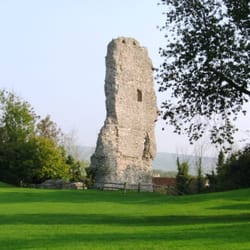
Bramber Castle - Bramber castle - dry moat

Bramber Castle

3.8(6 reviews)
27.7 mi

Built to defend an important port on the River Adur, Bramber Castle was constructed as a motte and…read morebailey castle around 1073 by William De Braose, who fought alongside William the Conqueror at the battle of Hastings in 1066. Apart from a period of confiscation during the reign of King John, it remained in the ownership of the De Braose family until themale line died out in 1324. Thereafter, it passed via the Mowbray and Howard families into the estate of the Dukes of Norfolk, who held it until it until 1926. It was given to the National Trust in 1946. Very little survives of the original castle, thanks to a gradual decline over the years, damage during the Civil War in 1642 and looting of the stones as a quarry for building by the locals. The most prominent feature is the tall and unsteady-looking fragment of the Gatehouse tower, still standing to almost its full original height. In the centre of the grounds is the impressive original motte, its earthen mound rising some 30ft (10m). A short distance away is a section of the curtain wall which survives up to 10ft (3m) in places. Around the perimeter are also the remains of the castle's impressive moat. (NB be careful with small children, as there are some sheer drops in places). Although the ruins are rather fragmentary, the grounds are beautifully kept by the National Trust, and make a wonderful place for a picnic, as well as affording excellent views of the surrounding countryside.

This place is a bit of a let down. There seems to be no effort to make it obvious where/what parts…read moreof the ruins were. They have a lame sign at the entrance but little else. It just seems like an enclosed play field.
Photos
Bramber Castle
Bramber Castle - Bramber Castle - remains of main gatehouse

Bramber Castle - remains of main gatehouse

Bramber Castle

See all

Church of St Michael and All Angels, Southwick

Church of St Michael and All Angels, Southwick

5.0(1 review)
29.8 mi

Southwick is now firmly part of the suburban sprawl running from Brighton and Shoreham, and is…read moreknown to most people for the power station that dominates the far side of Shoreham Harbour. But there was a community here in Saxon times, and its church is surprisingly ancient. In fact, the walk from the station crosses the Green, an attractive and villagey stretch of tree-lined common which splits Southwick into two halves. There are some handsome cottages surrounded by well appointed semi-detached suburban homes, and a rather less appealing row of post-war shops. St Michael and All Angels was, until the 18th century, dedicated to St Margaret, and sits among a very pretty churchyard, thickly studded with trees. Although there was probably a church here in Saxon times, it first recorded in 1086, and in 1206 the right to appoint the rector was granted to the Templars, and then to the Hospitallers, although much of the early mediaeval period was taken up with disputes over these rights with the monks of Sele Priory. The ownership passed from Sele Priory to Magdelene College at the Dissolution, and patronage thereafter passed to the Crown until the 20th century. Fire in the 19th Century damaged the nave and an unexploded bomb (and the subsequent excavation to remove it) damaged the tower in 1941. The church itself is built of flint, and is essentially in three parts: the tower, nave and chancel. The tower is by far the most impressive part: its foundations and lower walls are said to be Saxon, although it mostly dates from the late 12th and 13th centuries. It is an attractive composition, with paired round-headed arches with narrow openings surmounted by paired gothic lancets and, above that, a shingle broach spire. The west door is also attractive, but a modern addition: the tower was carefully taken down and faithfully rebuilt in 1950 after the bomb damage, with vestries built either side. The chancel is mostly 13th century, with two original lancets, framed by a 14th century chancel arch. There are two round headed arches to the south, although the central column probably dates from the Victorian rebuilding. A 14th wooden screen with narrow lancets also survives in the south aisle. The nave burned down in the 1830s and was rebuilt with narrow lean-to aisles in 1834, with round-headed arcades and lancet windows. Pevsner's Buildings of England described the nave as a 'loveless cover for pew-space', which I think is a bit harsh, although there's no doubt it doesn't match the quality of the tower. The furnishings other than the south aisle screen - are limited in interest to what appears to be a mediaeval aumbry, some 18th and 19th century tombs and memorials, and a sturdy, square font, probably from the 13th century. The church is today the centre of large and busy parish, and has a vibrant church life, with services daily through the week.

Photos
Church of St Michael and All Angels, Southwick

See all

The Whitgift Almshouses Croydon - View of the North End facade - sadly a bit messy because of the tram wires!

The Whitgift Almshouses Croydon

5.0(2 reviews)
8.7 mi•Croydon

An astonishing survivor in central Croydon is this lovely complex of almshouses. Located right in…read morethe heart of the shopping district, and surrounded by bars and clubs, it seems oblivious of the world beyond. The building was the brainchild of Archbishop Whitgift (c. 1530-1604) who, resident in the nearby Archbishop's Palace, sought permission from Elizabeth I to build some almshouses for the poor of the parish. Begun in 1596, and built in brick with stone detailing, it survives essentially unaltered; a quadrangle of individual houses, each with their own entrance and porch, surrounds a delightful courtyard of pretty gardens. The chapel contains a memorial to Whitgift himself, and other Tudor fittings, including the original benches. There are two entrance porches, sensibly gated off, but the one at North End allows passers-by a glimpse into this secluded world. It still fulfils its original purpose, providing sheltered accommodation for the elderly. The present Queen Elizabeth described it as 'An oasis of peace and tranquility'. It's hard to disagree. ############################################# Photographs added 01-12-2007

It's astonishing how many people must walk past the almshouses every day without giving a second…read morethought to what they are and why there are there. This beautiful building is just one of the legacies which John Whitgift left to Croydon about 500 years ago. That it still survives when so much of the town has been replaced with concrete and glass is a small miracle. Opposite the almshouses, you used to able to sit in a small raised area (dubbed locally 'pigeon s**t square' until it was demolished to make way for the tram), but now the corner is very much busier, and it is increasingly difficult to stop and take in the Tudor brickwork, the tiny windows and over-sized chimneys. If you turn your back to Primark, and claim one of the benches for 5 minutes, you might start to imagine what Croydon was like before the advent of the high street.

Photos
The Whitgift Almshouses Croydon - View into the garden. The present Queen Elizabeth described it as 'An oasis of peace and tranquility'. It's hard to disagree.

See all

View into the garden. The present Queen Elizabeth described it as 'An oasis of peace and tranquility'. It's hard to disagree.

The Godstone Dental Practice - dentists - Updated May 2026

Loading...
Loading...
Loading...