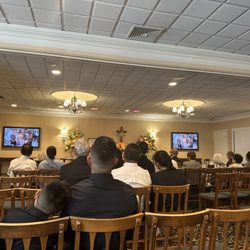
My parents, ardent Protestants both (well, my mother anyway-- I don't know that my father was so "ardent"), were always trying to get me interested in their religion, but it never really took. Once I got past the "brainwashing" stage of early childhood (which is when you believe in Santa Claus and accept everything else your parents tell you about without any doubts, without any reservations), church became something you had to do, like school, a mind-numbing obligation that was thankfully...unlike school... confined to once a week. As a kid, all my friends were Catholic, and it seemed like that religion was a much more colorful and exotic "club" that I wasn't allowed to join. On Sunday mornings, my friends would be playing outside while I...in my Robert Hall suit and clip on tie...had to attend church. As I got older, and more defiant about church attendance, my father told me, "Y'know, your Grandfather used to be Catholic, but he converted." Telling me this was supposed to appeal to my increasingly rebellious adolescent nature...Grandpa was a "rebel" because he converted to Protestantism...but my reaction was, "If he really wanted to be a rebel, he would have become a Buddhist or a Muslim...or maybe even an atheist." Still later, I learned that much of my genetic family had been, and still was, Roman Catholic. But at that point, I was questioning the validity of religion...any religion.
I had never been aware of this particular cemetery until the mid-1980's when my father, motivated by an awakening interest in his roots and knowing of my interest in cemeteries, asked if I wanted to accompany him here to see if we could find the graves of his paternal grandfather and grandmother. I was game.
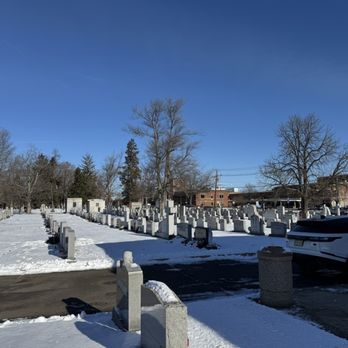
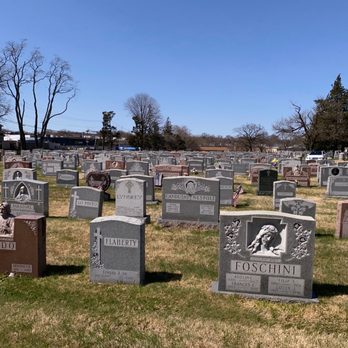
I'm not sure how large this cemetery actually is, but it's not quite as large as the non-sectarian Hackensack Cemetery, which is located right next to it. It's certainly as old, having been established in 1868. You pass through the gate, pass by some mausoleums, pass a large cross with the figure of Jesus on it. The cemetery is roughly shaped like a square, and is pretty densely packed, but doesn't come across as a stereotypical urban cemetery. It has some nice, shady trees strategically placed throughout that remind one of the constant vitality of life in the midst of death.
I've always been fascinated by the enamel portraits that early European immigrants tended to attach to their headstones, and St. Joseph's has plenty of them.
We finally located the family plot. My great grandfather, a local businessman, had died of a burst appendix in 1900. My great grandmother was buried alongside him, as well as some of their children. My great uncle, who was 23 years old when he died on a motorcycle in 1915, has the same name as I do. I joked to my father that when I died, they could bury me in the same grave and just add my dates of birth and death to his. My father didn't appreciate the joke.
As to "famous" permanent residents, I know of only one-- and he's more "infamous" than "famous." Anthony "Tony Pro" Provenzano, a Teamster leader (his slogan used to be, "Grow, grow with Tony Pro"), Mafia capo, and a suspect in the disappearance of Jimmy Hoffa, is buried near the front of the cemetery, near the gate. He died in prison of a heart attack, and I assume that at the end he made his peace with God, and the Church hierarchy, in order to secure his burial in hallowed ground. But if he actually did know what happened to Hoffa, he took that secret with him to the grave.
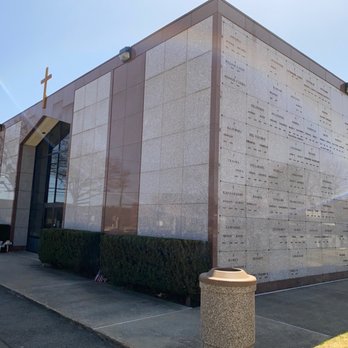
As is pretty common with old, urban (or semi-urban, in this case) cemeteries, the roads are narrow, and parking can become complicated if it's crowded. On the other side, near the exit, a large, new mausoleum has been built, a sign of modernity in the age-old cemetery. If you have no one you're related to or were friendly with buried here, it's not a "must see" historic cemetery like Woodlawn in the Bronx or Greenwood in Brooklyn, but I've always found it a peaceful space conducive to mourning, remembering, and the contemplation of life and death that seems an intrinsic element to all burial grounds, whatever the faith or culture.
I suppose some might find cemeteries frightening places; an in-your-face reminder of our own mortality. But as I get older, perhaps surprisingly, I find the prospect of death less and less threatening. After all, death is as natural as birth. And cemeteries, in my mind at least, can connect us to those who came before us, as well as with those who will come after.
If you're religious, a cemetery like St. Joseph's can be seen as the doorway through which one must pass in order to reach Heaven and eternal life.
If you're not religious, it's a serene, pastoral setting in which to spend a peaceful eternity, liberated from pain and torment...(although, if you're not religious, it's perhaps more likely that you'll be buried in non-sectarian Hackensack Cemetery next door, or George Washington Memorial Park in nearby Paramus)... read more