Cancel

Open app

Search

Samuel Spencer Historical Marker

3.0 (1 review)

Samuel Spencer Historical Marker Photos

More like Samuel Spencer Historical Marker

Recommended Reviews - Samuel Spencer Historical Marker

Your trust is our priority, so businesses can't pay to alter or remove their reviews. Learn more about reviews.
Yelp app icon
Browse more easily on the app
Review Feed Illustration

5 years ago

Helpful 18
Thanks 0
Love this 14
Oh no 0

Verify this business for free

Get access to customer & competitor insights.

Verify this business

Cotton Press Historical Marker - Cotton Press Historical Marker, Latta SC

Cotton Press Historical Marker

5.0(3 reviews)
49.1 mi

Located just a quarter mile south of I-95 on South Carolina Highway 38, this marker has a small…read morespace for parking and a view. There is a "historical marker ahead" sign and you shouldn't miss the hulking shape of the machinery it points out. The marker reads, "This cotton press, built in 1798 according to tradition, is thought by many to be the oldest in existence. It was first owned and used by John Bethea, III, and later by Henry Berry. Powered by oxen or mules rotating the beam to tighten the press, it was rendered obsolete by modern machinery. A Berry descendant moved it to this site about 1948 to preserve it." The marker was added to the National Register of Historic Places in 1972. It had been built in 1798 for bailing ginned cotton and is made of pegged and doweled oak. Turning the screw (powered by mules) compressed the cotton into a wooden frame to form a bale. A very clever piece of machinery, all built by hand well prior to modern power tools. Except for minor repairs of the base and roof, it is still the original materials and is the only press of this era in South Carolina. [Review 14328 overall, 1652 of 2020, number 706 in South Carolina.]

This cotton press, built in 1798 according to tradition, is thought by many to be the oldest in…read moreexistence. It was first owned and used by John Bethea, III, and later by Henry Berry. Powered by oxen or mules rotating the beam to tighten the press, it was rendered obsolete by modem machinery. A Berry descendant moved it to this site about 1948 to preserve it. Erected by Dillon County Historical Society - 1974

Photos
Cotton Press Historical Marker - Cotton Press Historical Marker, Latta SC

Cotton Press Historical Marker, Latta SC

Cotton Press Historical Marker - Cotton Press Historical Marker, Latta SC

Cotton Press Historical Marker, Latta SC

Cotton Press Historical Marker

See all

House-In-the-Horseshoe

House-In-the-Horseshoe

4.3(7 reviews)
47.1 mi

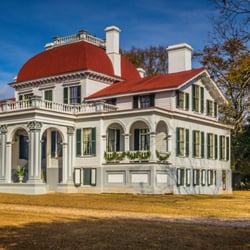
The House In the Horseshoe is a historical gem for North Carolina. The property is on over 2500…read moreacres of land. The house is named after the Deep River that bends like a horseshoe. The house is a mile from the river but the views are stunning. The cotton gin has been turned into a museum. There are a lot of displays you can read to learn more about the property. There is also a short video that is a great introduction to the house. Guided tours of the house occur on the top of the hour. A $2 donation is asked at the visitor's center to help reserve the property. The tour ran about 45 minutes and covered the history of the time, the residents of the house and the architecture. The house is also known as the Alston House. Alston was attacked in his house during the Revolutionary War and there are still bullet holes from the pellet guns. Governor Benjamin Williams also lived in the house. He planted the cotton and had a racetrack. The house is furnished with period pieces of the Colonial and Revolutionary Wars. Four rooms are on the tour. It was worth the drive to see this property and learn of its historical background.

A well preserved colonial house in a rural setting with beautiful vistas over fields of grain. A…read moreskirmish was fought in the house during the Revolutionary War. Many bullet holes were left unfixed. A very interesting story of the skirmish and the actions of the wife of the house is told by the tour guide. The tour guide was very knowledgeable and provided a detailed description of the house and the events that occurred there. The experience was interesting and relaxing.

Photos
House-In-the-Horseshoe

See all

Carhartt Mansion Ruins

Carhartt Mansion Ruins

5.0(1 review)
57.9 mi

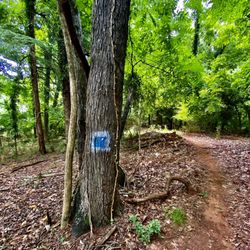
Very cool urban "archaeological" find...nobody but locals "in the know" seem to be aware it's even…read morethere! Found out about it from the very nice & informative bartender at Dust Off Brewing (check out doing to the YoCo Brew Trail; check into 6 breweries on the app & get a t-shirt). He couldn't quite remember how to get to it, but after some intensive research, found the geo coordinates. That was honestly the only way to find this place, plus a little guts & guesswork. You can quasi see some portion of the rockwork of the ruinous remains from the paved Riverwalk trail. The "easiest" way to get to the ruins is to follow the Riverwalk Piedmont Medical Center Trail to just before mile marker 1.25; you will see this steep wooden thing with awkwardly placed planks. You basically have to rock-wall climb your way up. From there you are on a mountain biking trail. Follow the arrows for just over a quarter mile and you will see some indicators of the ruins before they open up in front of you. You will most likely have the place to yourself. Really cool to wander around and take it all in. Just be careful with holes and don't walk on or within the actual ruins as they are pretty sketch & unsteady. There are spiders, snakes, and flying insects galore, so put on repellent and stay vigilant cuz it is deep woods! You can either get back down the way you came; I found this gray rock slope that I found easier to navigate than sliding down the wood thing I climbed up. Either way, really neat find and I'm so glad I explored to find it! The paved walkway along the Catawba is also a nice walk to and from!

Photos
Carhartt Mansion Ruins

See all

Pisgah Covered Bridge

Pisgah Covered Bridge

4.3(16 reviews)
40.3 mi

This place feels wonderfully remote, so a little heads up that cell service is spotty and it's…read moreworth being mindful as you arrive. Once you're there, the quiet really sets in, with wildlife sounds all around and very few cars passing by. The atmosphere is incredibly relaxing and peaceful, perfect for slowing down and taking a breath . Picnic benches are scattered nearby, along with trash receptacles, which makes it easy to linger responsibly . The bridge itself is beautiful and well maintained, showing only moderate signs of wear that add character rather than distraction . During our mid autumn visit, the waterway and surrounding landscape were bursting with color , making the views especially memorable. I later realized there was a walking trail close by that I missed, so that's something I'd definitely suggest checking out when you visit ‍. Parking isn't clearly marked or abundant ‍, but with a bit of patience, you'll manage just fine. Overall, it's a quiet, scenic spot that feels refreshingly untouched and worth the effort to find .

Fantastic little country roadside find! This historic bridge, one of the two remaining covered…read morebridges in the state of NC and designated a local/federal historical landmark, was built in 1911 at a whopping cost of $40. It was built to span the west fork of the Little River when horse & carriages were the main mode of transportation. There is a great little loop trail that circumvents this section of the Little River w/a little footbridge on the other side and a couple of off-shoots to go down to the water's edge and even rock hop to the middle (do so at your own risk ). Fantastic hues at Golden Hour and the soothing sound of the babbling waters make you quickly forget civilization is right there. I had the place to myself when I went, so the solitude was welcome. Definitely worth a visit when the weather is as gorgeous as it has been!

Photos
Pisgah Covered Bridge - Quinceañera in pisgat

Quinceañera in pisgat

Pisgah Covered Bridge

See all

Sherman's March Historical Marker - Sherman's March Historical Marker, Rockingham

Sherman's March Historical Marker

3.0(1 review)
10.5 mi

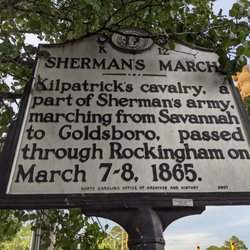
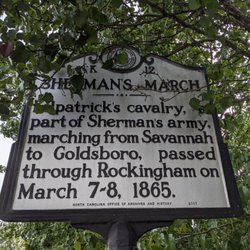
This marker is located just east of the city of Rockingham on US-1 opposite a gas station. It…read morepoints out some Civil War history that happened here. The marker reads, "Sherman's March. Kilpatrick's Cavalry, a part of Sherman's Army, marching from Savannah to Goldsboro, passed through Rockingham on March 7-8, 1865." Online, there is more information. "In late 1864, Union General William T. Sherman began moving his forces, some 60,000 battle-hardened soldiers strong, northward from Atlanta to "divide the Confederacy in two." The plan was to march the Union forces through Georgia, South Carolina, and North Carolina in order to squeeze Confederate forces under General Robert E. Lee in Virginia between Sherman's men to the south and those of General Ulysses S. Grant to the north. Along the way, Sherman hoped to disrupt Confederate supply lines and break the will of southerners on the home front. This "total war" assault on civilians - women and children included - by Union forces was a break from traditional warfare that had, up until this time, focused largely on military targets." "In Georgia and South Carolina Sherman's men freely plundered their surroundings as they marched, leaving whole towns in ashes. As they approached North Carolina, Sherman's forces were divided into separate divisions or corps. They traveled across the state to protect each other's flanks, forage for supplies and to spread their influence throughout the state." "Sherman's army entered North Carolina in stages, with one contingent entering the state in modern-day Richmond County. A portion of General Judson Kilpatrick's cavalry unit entered Richmond County on the March 7 and engaged Confederate troops under the command of Matthew Butler in Rockingham. Kilpatrick's troops returned the next day and destroyed a cotton factory and a shipment of firearms before destroying track, rails and other equipment of the nearby Wilmington, Charlotte, and Rutherfordton Railroad." [Review 15461 overall, 965 of 2021, number 3005 in North Carolina.]

Photos
Sherman's March Historical Marker - Sherman's March Historical Marker, Rockingham

See all

Sherman's March Historical Marker, Rockingham

Site of the Surrender of Columbia - This marks the site of the surrender of the city of Columbia. It is a must for Civil War buffs, history buffs, and Carolinians.

Site of the Surrender of Columbia

5.0(2 reviews)
90.3 mi

Site of the surrender of Columbia South Carolina. It is very…read moreclose to downtown, will not take much time to visit, but is an absolute must. An engraved rock marks the location and serves as a remembrance of the occasion of the surrender of the city of Columbia South Carolina. Columbia, a major city in the confederacy and the birthplace of the secession movement, was a strategic target for general Sherman and the Union forces. The succession convention, was the first, and it was the only convention to unanimously vote to leave the Union. Sherman and his troops' desire to exact revenge on the city was deep, according to historical documents. In advance of the Union forces attacked in the city, the Confederate troops burn down the bridges leading to the city on February 16, 1865, under the direction of General Wade Hampton III. Hampton, The grandson of a Revolutionary War hero, and considered a hero in his own right, evacuated his troops and placed the mayor, TJ Goodwyn in charge. Union forces began to shell the city from across the river. Seeing what happened to other cities, and hoping to spare Columbia, he ordered Mayor Goodwyn to surrender the city on the morning of the 17th just north of the city. Between 8 AM and 9 AM, the city's Aldermen and the Mayor surrendered formally to Sherman's troops. Unfortunately, this did not help as Sherman and his troops proceeded to torch the city at night. At least two thirds of the city burned as troops set fire to homes, businesses, schools, municipal buildings, and churches. In 1914, the United daughters of the Confederacy held a dedication ceremony featuring the sole surviving witness, Norton W. Brooker, and six descendants of the mayor. The engraved rock sits in front of the church on the corner of River Road and Beaufort Street in the historic Earlewood neighborhood.

Thanks so much for this valuable information! I've been trying to find the location of the site of…read moreColumbia's surrender. I grew up there and have lived in Charlotte for the last 19 years, but plan to ride by tomorrow! Is there not a marker for the site of Camp Sorghum? I have the general area mapped out but I guess there are no traces left. Thanks again!

Photos
Site of the Surrender of Columbia

See all

Samuel Spencer Historical Marker - landmarks - Updated May 2026

Loading...
Loading...
Loading...