Romero Overlook Visitors Center
Romero Overlook Visitors Center Photos


More like Romero Overlook Visitors Center
Recommended Reviews - Romero Overlook Visitors Center
Start your review...


Reviews With Photos


Do you drink water? Shower? Eat anything grown or raised in California? Drink wine? Then I HIGHLY suggest you make your way to the San Luis Reservoir and the Romero Outlook! I have driven past here a handful of times on work trips and always wondered what this place was, so on my way home from a recent work trip, I decided to stop by and check it out. First, the views are amazing. Get your camera ready! Second, go inside and check out the history and cool info. Caitlin at the Visitor's Center was a fountain of fascinating and useful information. I had no idea where my water came from until I met her and she pointed out spots on the giant map near the front desk. She encouraged me to look around the Center and gave me useful brochures to boot. This place has everything for kids and adults and adults who act like kids (me). It would be a perfect stop on a family summer vacation (note: the bathrooms are bright and clean). A warning: Getting here can be really nerve-wracking with the traffic going speeds close to 80 mph, but just stay in the right lane, use your blinker, and don't make any sudden lane changes. When I drove here most recently, a nasty crash was just being cleared by the fire department. Even though the VC sits around 500 feet above sea level, strong wind gusts make getting here interesting, so maybe leave the hat in the car and rethink that flowy skirt. Cool things I learned: The shoreline is 65-miles long, very close to the length of Lake Tahoe's, but with a lot more jagged edges. The water in here comes from Mount Shasta and Oroville in NorCal, is both federal AND state owned, and goes to agriculture AND residential areas. (If California ever splits up the state, there's going to be a LOT of water problems.) I'm so glad I finally took some time to check this place out and am kicking myself for not doing it sooner. Don't be like me--go now!


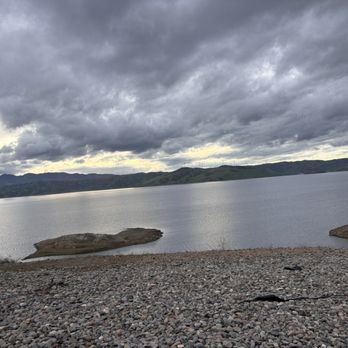
The San Luis Reservoir has been around a while, mostly serving Southern California, according to meteorologists' revelations during the drought. Since I was returning to California, the levels have been so low that it didn't look as though it would survive--13% or something like that. When I visited a bit over a week ago, it was at 91%--most of it in the last few weeks. What was in horrific drought is almost all in good condition now, but sadly flooding has been a problem. I arrived here to get some photos because there is a good view from a makeshift parking lot below the visitors center, and you don't have to walk forever into Pacheco State Park. I missed out on the history and the goodies--you shouldn't, and I won't miss them next time. The reservoir is huge and getting photos from the makeshift parking lot is good, but going out onto the little peninsula gives you a close up view of the greatness of the reservoir. Leaving the drive is tricky. Driving toward the freeway and Los Baños is less difficult. Going toward Gilroy means crossing two lanes of high speed traffic. Be safe!


Driving back to LA from San Fran...we made a stop to see what this place was that was so beautiful. A huge lake in the middle of the dessert that was 108 degrees. At first it was a simple bathroom stop but when I entered, I was blown away at what I saw. Several fully built audio visual rooms with a huge flatscreen on the wall in a theater like setting with seating for 25. But it was eerily empty with only 1 lady in her office doing office work. This welcome center clearly is missed by almost every traveler driving by and it's ashamed. The lookout point in the back with observation deck is a pretty cool place to hang out.


Romero Overlook Visitor's Center (San Luis Reservoir) - aka the Vista Del Lago Visitors Center. Photo - https://www.yelp.com/biz_photos/romero-overlook-visitors-center-gustine?select=J160C2CDUfqnxRj2cOEYcA&userid=O6EBodP3Fgu_n67efSKnBQ A lot of people don't appreciate most things until they're gone and even more sad is when those things are in your own "backyard;" I'm equally guilty. For example, California's water supply had been in bad shape for past five years. (Drought: 2012 - 2017) For nerds/geeks like myself, a brief CA drought history: 1841 1864 1924 1928-1935 1947-1950 1959-1960 1976-1977 2006-2010 2012-2017 I've stopped here a few times over the years and with the last rash of storms, water levels have risen but still not where they should be. (Still below the waterline/shoreline as indicated by the landscape.) The Romero Visitor's Center is a great place to stretch your legs, use the restroom, and catch up on what's going on with the state's water supply. Some of the nicest restrooms you will find on your I-5 road trip; Harris Ranch has the best bathrooms and they make a great prime rib sandwich too. They recently opened up the HR BBQ Express just across the street from their restaurant @ the Shell Gas Station; it's good! Photo - https://www.yelp.com/biz_photos/romero-overlook-visitors-center-gustine?select=hCDh7Zn825p_Red3IN1aAw&userid=O6EBodP3Fgu_n67efSKnBQ Great panoramic view of the San Luis Reservoir. Photo - https://www.yelp.com/biz_photos/romero-overlook-visitors-center-gustine?select=aCrJWelR2Ftw2mY7WW4lZg&userid=O6EBodP3Fgu_n67efSKnBQ I always learn something new whenever I make a pitstop here. The Romero Overlook Visitor's Center showcases the California water system via edutainment; an interactive walk-through exhibit that's more than a cardboard cut out, display at a middle school science fair. Photo - https://www.yelp.com/biz_photos/romero-overlook-visitors-center-gustine?select=MVyFNeeZRFTga8g34BLQeA&userid=O6EBodP3Fgu_n67efSKnBQ Overall, it's actually an impressive exhibit; I learn a little bit of something new every time I drop by. Did you know it takes close to 700 gallons of water to make a hamburger? Photo - https://www.yelp.com/biz_photos/romero-overlook-visitors-center-gustine?select=FOc96bKQaAUp5fe388BoKQ Topics: - How this joint state & federal complex of facilities serves both the State Water Project and the federal Central Valley Project. - Learn about the California Aqueduct and other associated facilities. - How you as a consumer can help in the keeping our water safe & clean as well as the conservation. Parking lot - https://www.yelp.com/biz_photos/romero-overlook-visitors-center-gustine?select=740sS5bQC0EegMaxrxVjWg&userid=O6EBodP3Fgu_n67efSKnBQ There are guides on-site who can give you an informal walk-thru and provide some information about available recreational activities available and the area's history. Did I mention I was a geek? I'm a believer of continual growth and learning, it doesn't all need to be academic based... 'Strive to learn, to be more, to know more than you did before. (Keep moving forward) So, if you want to change up the standard routine of potty break @ the Quicky Mart, fast food chain, or while your refueling the car, the Romero Overlook Visitor's Center is a great place to do just that! Also, during the summer days it can get warm... 'Real warm. Visitor Center Hours - https://www.yelp.com/biz_photos/romero-overlook-visitors-center-gustine?select=jNHtVtD8al0sWJl6Gopvzw&userid=O6EBodP3Fgu_n67efSKnBQ Safe travels and Big Aloha! Food: n/a Ambiance: 4 Service: 5 Value: 5+
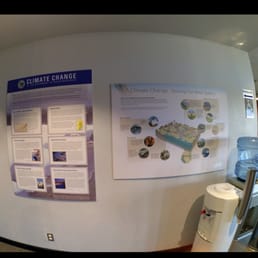

Unless you miss the depleting, yet gigantic, reservoir while driving on the 152 to or from the Central Valley, you owe it to yourself to stop and learn about the water supply/use in California. The Romero Overlook has a visitor's center with educational displays/movies/brochures from which you can learn about the really incredible California State Water Project, Central Valley Project, and California Aqueduct System. For example, I learned the largest water irrigation system in the world is in California and that it's divided between federal, state, and local control; the story of water getting to and from California is an interesting read. Anyway, this visitor's center is also great because there are very clean bathrooms and filtered water available. It's really eye-opening to learn about the water in California. Most striking to me was the recession of water levels in the reservoir; it's hard to tell in my pic but it's shocking how much lower the levels are.


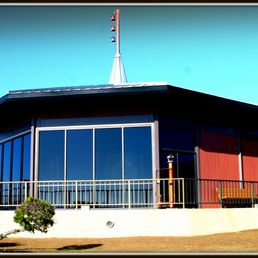
Romero Overlook Visitors Center is a part of the San Luis Reservoir SRA. Located on Highway 152 between Highway 101 and Interstate 5, this is what you'd want a visitor center to be in California if you built one yourself. Super easy parking, a spectacular view, friendly staff and information about a place I never knew existed until I decided to stop to go to the bathroom. They have a memorial plack dedicated to workers that died keeping the California water supply safe for it's citizens. I honored them with a moment of silence as I passed through. More information about the San Luis Reservior SRA can be found here: http://www.parks.ca.gov/?page_id=558


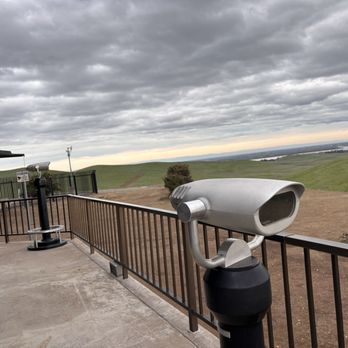
If you ever find yourself rolling through 152 on the way to the Valley or Bay Area This small visitors point has lots of Info on the History of San Luis Reservoir and where the water comes from Very friendly staff and hands on exhibits to a nice View of the Reservoir with free telescopes to look over this beautiful Dam Plus there are some of the cleanest restrooms available Great for the kids


This was a great place to stop and walk around, and use the bathroom, and learn some stuff, in the middle of a very long drive. I think it would be fun to get info on some trails and start from here, or maybe a picnic. They had two different movies running at the visitors center, and it's interesting to learn about (1) dams/construction, (2) water in the state of California in general, (3) wildlife in this area. Parking appears to be abundant, free, and easy. Also, I liked the nice viewing area in the back.

7 months ago
I have driven past this at least 20 times. We finally pulled off to stop and why would a treat the views are breathtaking and the visitor center is modern it has a fun 3-D interactive tour of the damn very clean restrooms and lots of information written on walls for people who like to read that. It was warm, but there are lots of shady spots under the trees and a nice set of benches to just sit and take in the reservoir. Kid friendly. Not pet friendly. read more


If you want to have a newly experience in nature, put this on your lists. They got a mini theater for the public information. So nice about it i saw Pres. Kennedy speech did a speech . Try it! Be ready to have your jacket, it's kinda cold and windy too. So come a have a day tour with your friends and families. read more


8 years ago
Do you drink water? Shower? Eat anything grown or raised in California? Drink wine? Then I HIGHLY suggest you make your way to the San Luis Reservoir and the Romero Outlook! I have driven past here a handful of times on work trips and always wondered what this place was, so on my way home from a recent work trip, I decided to stop by and check it out. First, the views are amazing. Get your camera ready! Second, go inside and check out the history and cool info. Caitlin at the Visitor's Center was a fountain of fascinating and useful information. I had no idea where my water came from until I met her and she pointed out spots on the giant map near the front desk. She encouraged me to look around the Center and gave me useful brochures to boot. This place has everything for kids and adults and adults who act like kids (me). It would be a perfect stop on a family summer vacation (note: the bathrooms are bright and clean). A warning: Getting here can be really nerve-wracking with the traffic going speeds close to 80 mph, but just stay in the right lane, use your blinker, and don't make any sudden lane changes. When I drove here most recently, a nasty crash was just being cleared by the fire department. Even though the VC sits around 500 feet above sea level, strong wind gusts make getting here interesting, so maybe leave the hat in the car and rethink that flowy skirt. Cool things I learned: The shoreline is 65-miles long, very close to the length of Lake Tahoe's, but with a lot more jagged edges. The water in here comes from Mount Shasta and Oroville in NorCal, is both federal AND state owned, and goes to agriculture AND residential areas. (If California ever splits up the state, there's going to be a LOT of water problems.) I'm so glad I finally took some time to check this place out and am kicking myself for not doing it sooner. Don't be like me--go now! read more


10 years ago
The San Luis Reservoir has been around a while, mostly serving Southern California, according to meteorologists' revelations during the drought. Since I was returning to California, the levels have been so low that it didn't look as though it would survive--13% or something like that. When I visited a bit over a week ago, it was at 91%--most of it in the last few weeks. What was in horrific drought is almost all in good condition now, but sadly flooding has been a problem. I arrived here to get some photos because there is a good view from a makeshift parking lot below the visitors center, and you don't have to walk forever into Pacheco State Park. I missed out on the history and the goodies--you shouldn't, and I won't miss them next time. The reservoir is huge and getting photos from the makeshift parking lot is good, but going out onto the little peninsula gives you a close up view of the greatness of the reservoir. Leaving the drive is tricky. Driving toward the freeway and Los Baños is less difficult. Going toward Gilroy means crossing two lanes of high speed traffic. Be safe! read more


14 years ago

Driving back to LA from San Fran...we made a stop to see what this place was that was so beautiful. A huge lake in the middle of the dessert that was 108 degrees. At first it was a simple bathroom stop but when I entered, I was blown away at what I saw. Several fully built audio visual rooms with a huge flatscreen on the wall in a theater like setting with seating for 25. But it was eerily empty with only 1 lady in her office doing office work. This welcome center clearly is missed by almost every traveler driving by and it's ashamed. The lookout point in the back with observation deck is a pretty cool place to hang out. read more


9 years ago
Romero Overlook Visitor's Center (San Luis Reservoir) - aka the Vista Del Lago Visitors Center. Photo - https://www.yelp.com/biz_photos/romero-overlook-visitors-center-gustine?select=J160C2CDUfqnxRj2cOEYcA&userid=O6EBodP3Fgu_n67efSKnBQ A lot of people don't appreciate most things until they're gone and even more sad is when those things are in your own "backyard;" I'm equally guilty. For example, California's water supply had been in bad shape for past five years. (Drought: 2012 - 2017) For nerds/geeks like myself, a brief CA drought history: 1841 1864 1924 1928-1935 1947-1950 1959-1960 1976-1977 2006-2010 2012-2017 I've stopped here a few times over the years and with the last rash of storms, water levels have risen but still not where they should be. (Still below the waterline/shoreline as indicated by the landscape.) The Romero Visitor's Center is a great place to stretch your legs, use the restroom, and catch up on what's going on with the state's water supply. Some of the nicest restrooms you will find on your I-5 road trip; Harris Ranch has the best bathrooms and they make a great prime rib sandwich too. They recently opened up the HR BBQ Express just across the street from their restaurant @ the Shell Gas Station; it's good! Photo - https://www.yelp.com/biz_photos/romero-overlook-visitors-center-gustine?select=hCDh7Zn825p_Red3IN1aAw&userid=O6EBodP3Fgu_n67efSKnBQ Great panoramic view of the San Luis Reservoir. Photo - https://www.yelp.com/biz_photos/romero-overlook-visitors-center-gustine?select=aCrJWelR2Ftw2mY7WW4lZg&userid=O6EBodP3Fgu_n67efSKnBQ I always learn something new whenever I make a pitstop here. The Romero Overlook Visitor's Center showcases the California water system via edutainment; an interactive walk-through exhibit that's more than a cardboard cut out, display at a middle school science fair. Photo - https://www.yelp.com/biz_photos/romero-overlook-visitors-center-gustine?select=MVyFNeeZRFTga8g34BLQeA&userid=O6EBodP3Fgu_n67efSKnBQ Overall, it's actually an impressive exhibit; I learn a little bit of something new every time I drop by. Did you know it takes close to 700 gallons of water to make a hamburger? Photo - https://www.yelp.com/biz_photos/romero-overlook-visitors-center-gustine?select=FOc96bKQaAUp5fe388BoKQ Topics: - How this joint state & federal complex of facilities serves both the State Water Project and the federal Central Valley Project. - Learn about the California Aqueduct and other associated facilities. - How you as a consumer can help in the keeping our water safe & clean as well as the conservation. Parking lot - https://www.yelp.com/biz_photos/romero-overlook-visitors-center-gustine?select=740sS5bQC0EegMaxrxVjWg&userid=O6EBodP3Fgu_n67efSKnBQ There are guides on-site who can give you an informal walk-thru and provide some information about available recreational activities available and the area's history. Did I mention I was a geek? I'm a believer of continual growth and learning, it doesn't all need to be academic based... 'Strive to learn, to be more, to know more than you did before. (Keep moving forward) So, if you want to change up the standard routine of potty break @ the Quicky Mart, fast food chain, or while your refueling the car, the Romero Overlook Visitor's Center is a great place to do just that! Also, during the summer days it can get warm... 'Real warm. Visitor Center Hours - https://www.yelp.com/biz_photos/romero-overlook-visitors-center-gustine?select=jNHtVtD8al0sWJl6Gopvzw&userid=O6EBodP3Fgu_n67efSKnBQ Safe travels and Big Aloha! Food: n/a Ambiance: 4 Service: 5 Value: 5+ read more

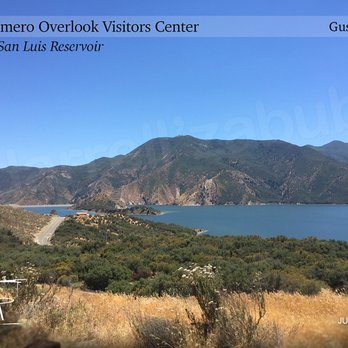


Unless you miss the depleting, yet gigantic, reservoir while driving on the 152 to or from the Central Valley, you owe it to yourself to stop and learn about the water supply/use in California. The Romero Overlook has a visitor's center with educational displays/movies/brochures from which you can learn about the really incredible California State Water Project, Central Valley Project, and California Aqueduct System. For example, I learned the largest water irrigation system in the world is in California and that it's divided between federal, state, and local control; the story of water getting to and from California is an interesting read. Anyway, this visitor's center is also great because there are very clean bathrooms and filtered water available. It's really eye-opening to learn about the water in California. Most striking to me was the recession of water levels in the reservoir; it's hard to tell in my pic but it's shocking how much lower the levels are. read more
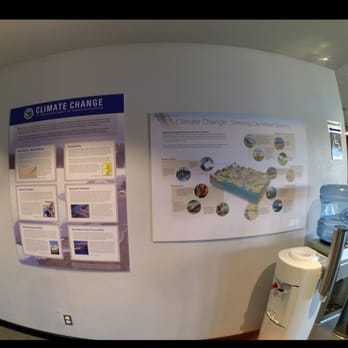


Romero Overlook Visitors Center is a part of the San Luis Reservoir SRA. Located on Highway 152 between Highway 101 and Interstate 5, this is what you'd want a visitor center to be in California if you built one yourself. Super easy parking, a spectacular view, friendly staff and information about a place I never knew existed until I decided to stop to go to the bathroom. They have a memorial plack dedicated to workers that died keeping the California water supply safe for it's citizens. I honored them with a moment of silence as I passed through. More information about the San Luis Reservior SRA can be found here: http://www.parks.ca.gov/?page_id=558 read more


2 years ago
4 years ago

If you ever find yourself rolling through 152 on the way to the Valley or Bay Area This small visitors point has lots of Info on the History of San Luis Reservoir and where the water comes from Very friendly staff and hands on exhibits to a nice View of the Reservoir with free telescopes to look over this beautiful Dam Plus there are some of the cleanest restrooms available Great for the kids read more


This was a great place to stop and walk around, and use the bathroom, and learn some stuff, in the middle of a very long drive. I think it would be fun to get info on some trails and start from here, or maybe a picnic. They had two different movies running at the visitors center, and it's interesting to learn about (1) dams/construction, (2) water in the state of California in general, (3) wildlife in this area. Parking appears to be abundant, free, and easy. Also, I liked the nice viewing area in the back. read more




10 years ago
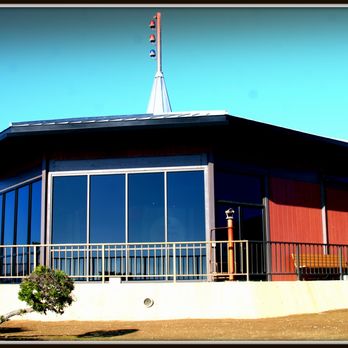
If you are heading east on CA-152 between Gilroy and the I-5 interchange near to Los Banos, you will encounter several roadside attractions that vie for your interest: Casa de Fruta, a nut, candy, and dried fruit emporium that also features live peacocks, a carousel, coffee shop, restaurant, and numerous other marketing gimmicks; multiple roadside farm stands offering avocados and other produce for jaw-droppingly low prices (8 for $1, 10 for $1, etc.); and - the best one of all - a sapphire-hued pool of water that catches the rays of intense sunlight and reflects them skyward once more as you speed by at 65mph+ while cruising down from windswept Pacheco Pass, one of the iconic stretches of Golden State highway if ever there were one. It's all quite a rush, and well worth a pit stop before I-5 to catch your breath, refill a reusable water bottle (you do have one in your car at all times, right?), visit a clean, well-stocked restroom, and ask yourself: what's a huge lake doing in the middle of all this dry land? That's what the Romero OVC is all about: clean restrooms, shelter from the wind and sun and occasionally the rain, time to clear the mind and stretch out those weary neck and back muscles, and the chance to learn some valuable bits and pieces of California history. Moving water. Lots of it! The "Romero" overlooks not a natural lake like Tahoe, nor an irrigation dam lake like Shasta, but something else: an overflow and holding tank style reservoir, the San Luis Reservoir, that temporarily stores vast quantities (measured in acre feet) of fresh water that has been pumped UP here from the Sacramento River and Central Valley aqueducts, as it waits to be sent further south to farms, communities, and orchards all over the Central Valley and as far away as Greater Los Angeles and surrounding mega cities. This isn't a visitor center at all, not in the usual sense. It's a showcase piece for the California Water Project, one of the biggest feats of human engineering since the pyramids of Egypt and the Great Wall of China. While you won't find out much about the controversial nature of the undertaking at the visitor's center (you'll need to visit a local library for that), you will see lots of exhibits inside that map out how much of California's water gets moved about from one place to the next, using the rolling, mountainous landscape as one big series of pipes and bathtubs to make it all work. Remember those nuts and dried fruit at Casa de Fruta? And those 10 avocados for $1? That's possible because of San Luis Reservoir and others like it. So stop next time, park a while, admire the view, get some drinking water inside, spend 10-15 minutes at the exhibits, and then move on. You'll feel better if you do: refreshed, educated, and enlightened, if perhaps a little more ambivalent about the whole water thing than before. That's OK. The "Romero" has got you covered. Hopefully, the journey of discovery will start, not end, here. These issues will only get more critical in the years to come. Thanks to the powers that be for making this place open to the public and keeping it in such great shape. Road warriors the world over are grateful! read more


7 years ago


11 years ago

11 years ago

More info about Romero Overlook Visitors Center
Ask the Community - Romero Overlook Visitors Center
Review Highlights - Romero Overlook Visitors Center










Why does Yelp recommend reviews?
2 reviews that are not currently recommended
The reviews below are not factored into the business's overall star rating.
3 years ago

11 years ago





