Rochester Castle
Rochester Castle Photos


Recommended Reviews - Rochester Castle
Start your review...



I remember watching a movie a while back about how King John, after signing, and then ripping up, the Magna Carta, laid siege to this castle. I don't think it has been repaired since (though I think there are other reasons it is in the state it is in). It is one of William's castles, namely because they all pretty much look the same. It is still cool to go in and explore, and even though it is ruined, there is still a lot to check out here. read more

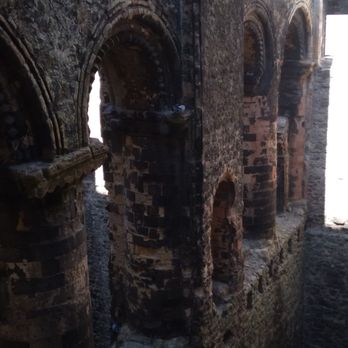


One of my favorite castle ruins, the imposing Rochester Castle, a mighty Norman tower-keep of Kentish ragstone standing 113 feet, was built c. 1127 by William of Corbeil, Archbishop of Canterbury. It stands on the east bank of the River Medway. Rochester is the tallest keep (central tower) in England and has been the commanding presence of the city and river crossing for over nine centuries. The castle and keep take up half of the Roman-built walled city. From the 12th into the 14th centuries Rochester Castle played an important role in defending against invasion and uprising threats. After falling into disrepair, King Edward III reconstructed the castle and it was fully functional by 1400. Over the next three centuries it was, once again, neglected and vandalized until the city took command of the property. Though the castle's center wooden flooring no longer exists there are passageways and stairs that carry visitors to the top of the keep, offering impressive views in all directions. The English Heritage now has responsibility for preservation and its doors are open to the public. This castle is a must see when visting the South of England. read more

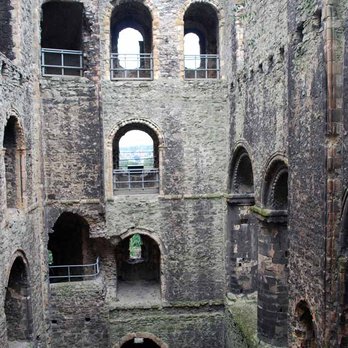


Rochester Castle is one of the most impressive and best preserved Norman castles in the country, and witness to a turbulent history. As others have said, with the adjacent cathedral it dominates the small Medway town, and makes for an interesting day trip, combined with the adjacent cathedral. History The first fortification was built here in the early Roman period, around 43AD, as part of their campaign of conquest and in recognition of its strategic importance at the crossing of the River Medway, where they built a wooden bridge. Little is known about the castle in the Saxon period: although the cathedral was founded in 604AD, the Roman fortifications seem to have been neglected and the Danes destroyed the bridge on a raid in 872AD. Things picked up with the arrival of the Normans, and in 1087 Gundulf, the new Norman Bishop of Rochester, built a motte-and-bailey castle on the site. After being besieged in 1088, Gundulf rebuilt the fortifications in stone, and part of the southern curtain wall survives from this period. The Keep, however, was rebuilt in stone on a lavish scale 40 years later in 1127 by Archbishop of Canterbury, William de Corbeil, on the instructions of Henry I. It is this which forms the centrepiece of today's castle. The keep witnessed one of the greatest castle sieges to take place in UK history, when it was famously besieged by King John in 1215. Held by rebel Barons, it stood firm against stone-throwing engines and siege castles, and even partial collapse of the south east tower as a result of siege mines built beneath and furnaced with the fat of 40 pigs. The defenders continued fighting amongst the rubble and were only forced out by starvation after nearly two months. The siege cost the enraged King John an estimated £1,000 a day: a fantastic sum for the time. The Keep was not rebuilt until Henry III's reign, in 1227, when it was furnished with a new round tower to replace the damaged one, and additional external fortifications. This was just as well, as it was again besieged by Simon de Montfort's rebels in 1264. Although the Keep held, some of its outbuildings were damaged, and were not repaired until Edward III's reign in 1367. It last saw action in the Peasant's revolt in 1381, when it was briefly surrounded by the Peasant forces, before they moved on to London. The castle fell into disrepair after the 15th century, when its design became obsolete, and saw no action in either the Wars of the Roses or the English Civil War. Restored in the 20th century, it now ranks with the Tower of London as one of the finest and best preserved 12th century fortresses in the UK: from the cathedral side, little has changed to the view since it was built in 1227. The castle The curtain wall is best preserved on the southeast and south west sides, and still retains the remains of several square towers. It encloses a very pleasant area of green lawns and trees - perfect for picnics, and great for children to burn off energy! However, everything is dominated by the Keep, which although roofless, still stands impressively over 113ft high. Although the central rooms have long since disappeared, the corner towers still have their rooms and it is possible to climb up for a fantastic view over the cathedral, town and river, as well as down upon the decoration of the interior walls. Also clearly visible are the repairs done after the siege in 1215 in the south east corner. Practicalities The site is now in the care of English Heritage. Entry to the Keep is £5 and audio tours are available. There are toilets and a shop in the grounds. The Keep itself has steps at the entrance, so wheelchair users have to content themselves with views from the castle grounds. The climb to the top of the towers involves uneven steps and narrow staircases, and is quite strenuous. There is no dedicated car park, but there are municipal pay-and-display car parks nearby. read more


11 years ago

18 years ago

18 years ago

18 years ago
This tall and imposing building is the first thing you notice in Rochester. It is a remnant of Norman times in this part of the country and at stark contrast with the picturesque, Dickensian town of Rochester. The castle stands on a mound and is surrounded by grounds perfect for strolling and exploring. Rochester castle is a part of the English Heritage and is kept in reasonably good state, considering its age. It really is a ruin that has been made accessible to the public and presented in an educational way. If you want to have a look inside, you will have to pay the entrance fee. There isn't that much to do but wonder around this massive place and learn about its history. The ambiance is dark, foreboding, scary, but very impressive. Seeing the inside of the castle really gives you a feel for the Norman times and their way of life. This being the landmark of Rochester, it definitely is a must-visit for everyone passing through this lovely town. read more

7 years ago

18 years ago

18 years ago

18 years ago
More info about Rochester Castle
Rochester Castle Reviews in Other Languages
Review Highlights - Rochester Castle








Why does Yelp recommend reviews?
3 reviews that are not currently recommended
The reviews below are not factored into the business's overall star rating.
18 years ago
18 years ago

16 years ago


